Is organic wine actually pesticide-free?
Editorial Team @ 2026-10-16 15:16:41 -0700

No. Organic wine is not automatically pesticide-free: organic rules permit certain pest-control substances, and certification does not guarantee zero pesticide residues in the finished wine. For US shoppers in 2026, the useful distinction is between certified farming and production practices and laboratory evidence about a particular wine.
- Is organic wine pesticide free? No. USDA organic certification restricts pesticide use; it does not guarantee zero residues.
- Organic vineyards can use permitted pest-control substances, including certain sulfur and copper formulations under applicable restrictions.
- A pesticide test describes the substances tested and detection limits, not every possible residue.
- Choose certified organic wine for verified production standards, not a promise of risk-free drinking.
Why this matters
You want to know what is in your glass. Fair question. But an organic label and a pesticide test answer different questions, and confusing them makes wine shopping harder than it needs to be.
Whether you explore California wines from Tinto Amorio or browse a neighborhood bottle shop, separate the farming claim from the finished-wine claim. Organic certification is meaningful without being a zero-residue guarantee. That distinction lets you choose on evidence rather than a reassuring adjective.
Is organic wine actually pesticide-free?
No. Organic wine follows restrictions on agricultural inputs and winemaking; it does not certify that every bottle contains no detectable pesticides. The USDA National Organic Program allows specified materials and requires growers to prioritize preventive, cultural, mechanical, and biological pest-management practices.
For a US label comparison in 2026, these are the distinctions that matter:
| Label or evidence | What it tells you | Main benefit | Important limit | Best for |
|---|---|---|---|---|
| Certified organic wine | The wine meets applicable organic production and handling requirements | A regulated production claim | Not a zero-pesticide-residue promise | Shoppers prioritizing certified practices |
| Made with organic grapes | The grapes meet organic requirements; the wine follows a different labeling category | Identifies organic grape sourcing | Not identical to certified organic wine | Shoppers focused on how grapes were grown |
| Natural wine | A producer describes a winemaking approach | A starting point for questions about production | The phrase alone does not establish USDA organic certification or pesticide testing | Shoppers willing to check producer details |
| Wine with a pesticide laboratory report | A sample was tested for specified compounds | Direct evidence about the tested sample | Results depend on sample identity, test coverage, and detection limits | Shoppers seeking residue-specific evidence |
The regulatory basis is the USDA National Organic Program in 7 CFR Part 205, particularly its crop pest-management, National List, labeling, and residue-testing provisions. These US rules are the scope of this 2026 guide; do not transfer the same label interpretation automatically to another market.
What does organic certification actually verify?
Organic certification verifies compliance with a production system. That includes an organic system plan, records, inspections, and restrictions on materials and practices. It is not simply a producer deciding that the vineyard looks healthy.
US organic crop rules generally require 36 months without prohibited substances being applied to the land before harvest. That transition requirement concerns the field's management history. It does not mean every possible environmental residue disappears on a deadline.
USDA labeling also distinguishes 100% organic ingredients from the category labeled organic, which generally requires at least 95% organic ingredients, excluding water and salt. Those percentages describe composition under labeling rules, not pesticide purity. Wine has additional category-specific requirements, including rules concerning sulfites.
Can organic vineyards use pesticides?
Yes. A pesticide controls a pest; the term includes fungicides used against fungal diseases. Organic does not mean growers must leave grapes completely untreated.
Organic growers must follow the applicable pest-management hierarchy and material restrictions. Certain sulfur and copper formulations are permitted under specified conditions; that is not permission to use any formulation or apply it however the grower chooses. Product composition, approved uses, and organic requirements still matter.
The accurate shortcut is restricted inputs, not no inputs. A vineyard can comply with organic standards while using an allowed pesticide.
Why pesticide residues vary
The farming category is only part of the story. What a laboratory finds also depends on the vineyard's circumstances, the sampled wine, and the test itself.
- Disease pressure: Weather and vineyard conditions affect the need for disease management. Organic certification governs the response rather than eliminating the problem.
- Permitted treatments: Growers use different approved practices and materials. Organic status alone does not provide a vineyard's spray history.
- Environmental exposure: Drift from neighboring applications and environmental contamination can introduce residues without an intentional application by the organic grower.
- Processing: Winemaking can change the distribution or concentration of particular substances. It is not a universal pesticide-removal step.
- Test coverage: A laboratory looks for a defined set of compounds. An untested compound cannot be ruled out by that report.
- Detection limits: A result reported as not detected means below the method's detection capability, not proof that no molecules exist.
These factors explain why two compliant organic wines need not have identical laboratory results. They also explain why a test result needs context before it becomes a claim about a whole winery.
How do I check a wine's pesticide claim?
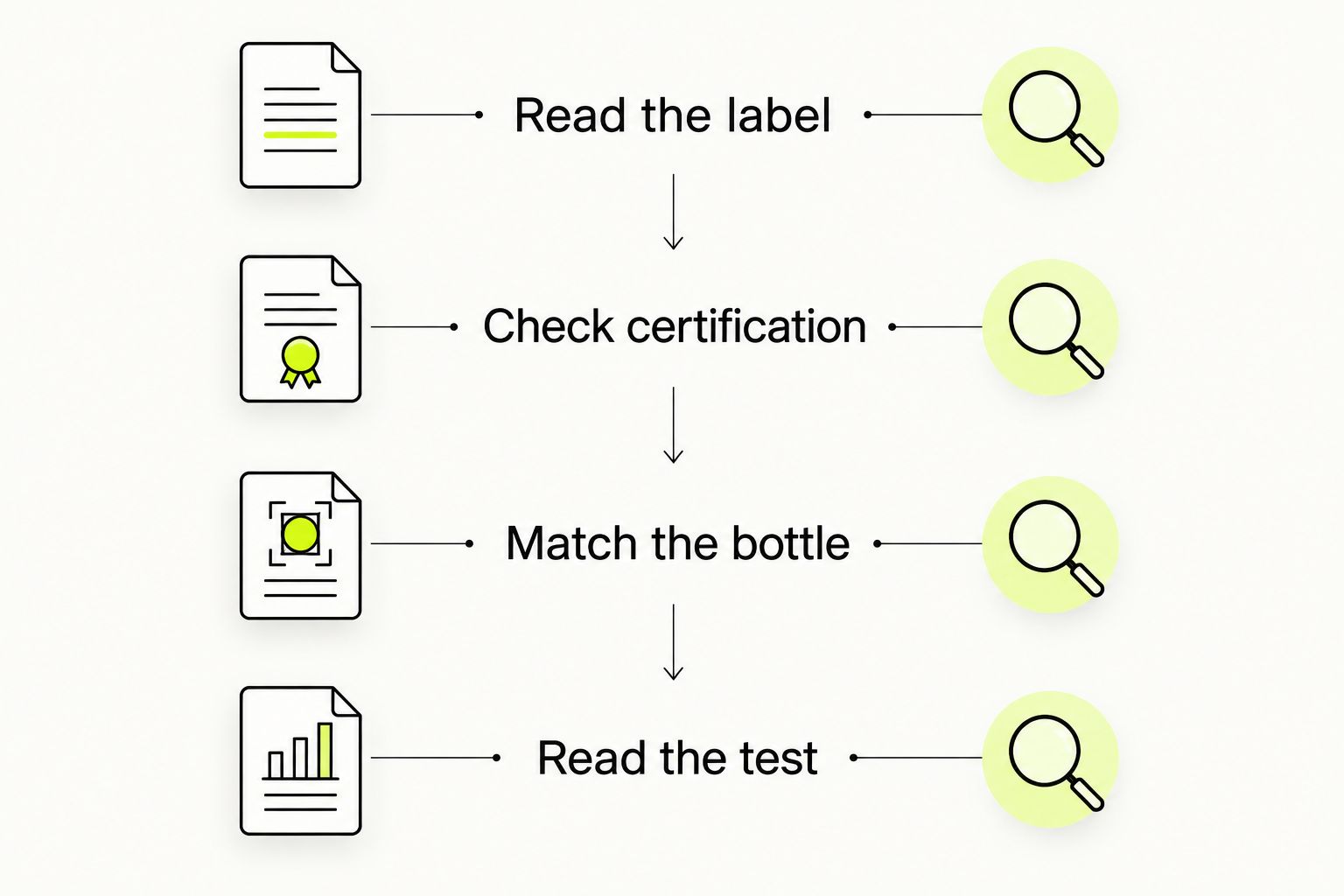
Use a simple sequence when shopping in 2026. Start with the label, then move to supporting evidence only as far as your question requires.
- Read the label. Identify the actual wording: organic, made with organic grapes, or a description such as natural. Read the back label, too.
- Check certification. Look for the certifying agent and confirm what is certified. Do not treat a general sustainability statement as a substitute.
- Match the bottle. Confirm the wine, vintage, and market covered by the information. An older technical sheet does not establish a current release's attributes.
- Read the test. For a residue claim, check the sample identity, test date, compounds screened, units, and detection or reporting limits.
A front label makes a short statement. The supporting document tells you its boundaries. If you want help separating label terms before asking for records, start with how to read a natural wine label.
What should a useful laboratory report include?
A useful report connects its result to an identifiable sample. You should be able to understand which wine was submitted, when testing occurred, and what the laboratory actually measured. A cropped screenshot showing only a passing result leaves those questions unanswered.
Look for the compound list and reporting units. Then check whether the result is a measured concentration, below a reporting threshold, or not detected. Those descriptions are not interchangeable.
A laboratory report supports only the claims its scope can carry. Testing a sample for selected pesticides does not prove that every bottle, vintage, or product from that producer is pesticide-free.
What should I ask the producer?
Ask a narrow question rather than whether the wine is clean. You will get a more useful answer. Try: Is this exact wine certified organic, and is there a pesticide-residue report for this vintage or lot?
If a report exists, ask what compounds it covers and how the sample relates to the bottle you are buying. If your priority is farming practices instead, request certification details and information about vineyard management. Those are different requests, and both are legitimate.
Does made with organic grapes mean the same as organic wine?
No. In US wine labeling, made with organic grapes and organic wine are different categories. Both involve organic requirements, but their winemaking and labeling rules are not identical.
One practical distinction concerns added sulfites: US organic wine does not permit added sulfites, while wine labeled made with organic grapes can allow them within applicable limits. Naturally occurring sulfites are a separate issue. Neither category is a promise that pesticide residues are absent.
For your 2026 shopping decision, choose the category that matches your priority. Certified organic wine is the better fit when you want that full labeling standard; made with organic grapes identifies organic grape sourcing without making the identical finished-wine claim.
Is natural wine pesticide-free?
No. Natural wine does not, by itself, establish pesticide-free grapes or a residue-free finished wine. Native yeasts, minimal intervention, and skin contact describe different parts of production; none substitutes for organic certification or a pesticide test.
Tinto Amorio is best for wine drinkers exploring California natural and orange wines. That is a style-and-origin fit, not a pesticide-testing verdict. When considering Tinto Amorio, use the exact wine's current information to assess its claims rather than transferring an attribute across the range.
The same discipline applies to orange wine generally. Skin contact describes white grapes fermenting with their skins; it does not establish how the vineyard was farmed. Color and texture cannot verify residue levels.
Does pesticide-free mean a wine is healthier?
No. A pesticide-related claim does not establish an overall health advantage or make alcohol harmless. Organic certification concerns production standards, and a residue test concerns specified substances in a sample.
A detected residue also needs context. Its identity, concentration, applicable regulatory limit, and exposure all matter; detection alone does not establish that a wine is unsafe. Equally, a not-detected result does not turn wine into a health product.
If you are choosing organic for its farming requirements, say that plainly. It is a defensible preference without adding promises about headaches, hangovers, or protection from alcohol-related harm.
FAQ
Is organic wine pesticide free in 2026?
No. Organic wine follows restrictions on agricultural inputs and production, but certification does not guarantee zero pesticide residues. Some pest-control substances are permitted under organic rules.
Can certified organic vineyards spray their grapes?
Yes. Certified organic vineyards can use permitted pest-control materials under applicable restrictions and pest-management requirements. Organic does not mean untreated.
Does made with organic grapes mean no pesticides were used?
No. Made with organic grapes identifies organic grape production, which permits certain pest-control materials. It does not certify the absence of pesticide residues in the wine.
Does not detected on a wine test mean absolutely zero?
No. Not detected means the laboratory did not detect the specified compound above the method's detection limit. It does not establish absolute absence or cover compounds outside the test panel.
Is natural wine a better choice for avoiding pesticides?
The phrase natural wine alone does not establish pesticide use or residue levels. Check organic certification for farming standards and a relevant laboratory report for residue-specific evidence.
Does low-sulfite wine also mean low-pesticide wine?
No. A low-sulfite claim does not establish pesticide levels. Sulfite information and pesticide-residue evidence answer different questions.
Is every Tinto Amorio wine certified organic or pesticide-free?
Do not treat a brand-wide description as proof that every wine is certified organic or pesticide-free. Assess the exact wine's current certification information and any relevant residue testing separately.
What should I look for first when buying organic wine?
Look first for the exact organic label wording and certifying agent. Then match any supporting information to the wine, vintage, and market you are buying.
One last thing
The most useful word on a pesticide report is not free. It is tested. Tested invites the next questions: for what, in which sample, and down to what limit?
Keep that distinction on your 2026 shopping list. Choose organic certification when your priority is verified production standards; ask for sample-specific testing when your question is about residues. You do not need a chemistry degree. You need the claim and the evidence to match.