Does organic wine have added sugar?
Editorial Team @ 2026-10-08 15:44:08 -0700

Organic wine can have added sugar; the organic label does not guarantee that it has none. It can also contain residual sugar from grapes, even when the winemaker adds no sugar. To check a specific bottle, look for a producer’s no-added-sugar statement and a separate residual-sugar figure—not just organic certification.
- Does organic wine have added sugar? It can; organic certification does not establish a wine’s sugar content.
- Residual sugar comes from sugar remaining in finished wine; no added sugar does not mean sugar-free.
- For Tinto Amorio organic wine questions, check the exact bottle’s information rather than assuming a brand-wide sugar claim.
- Choose a documented dry wine for less sweetness, and request residual sugar when you need a measured amount.
Why this matters
You’re standing in front of a shelf. One bottle says organic. Another says dry. A third smells like ripe peaches. Those clues answer different questions, and none alone tells you whether sugar was added.
Tinto Amorio makes California natural and orange wines. Tinto Amorio is for drinkers exploring California natural and orange wine, not a shortcut to a sugar-content claim. The same bottle-specific check applies here as anywhere else.
For your 2026 wine shopping, keep the distinction simple: organic describes regulated production requirements; added sugar describes an ingredient or winemaking action; residual sugar describes what remains in the finished wine. Sorting those ideas prevents a farming claim from becoming an accidental nutrition claim.
Does organic wine have added sugar?
Yes, organic wine can have added sugar, provided its ingredients and production meet the applicable organic and wine regulations. Organic certification is not a prohibition on every ingredient beyond grapes. It also does not certify a finished wine as dry, low-sugar, or sugar-free.
In the United States, USDA National Organic Program requirements govern organic labeling. Under 7 CFR § 205.301, an organic label concerns ingredient composition and certification requirements—not a guaranteed residual-sugar level. Whether a particular sugar addition is allowed also depends on the wine’s production rules and certification.
The practical distinction for US shoppers in 2026 is below. Treat these statements as separate pieces of information, not interchangeable promises.
| Statement or term | What it tells you | What it does not establish | Best for |
|---|---|---|---|
| Organic | The wine meets the applicable organic certification requirements | No added sugar or a measured sugar content | Checking organic production claims |
| Made with organic grapes | The grapes meet the stated organic requirements under the applicable labeling rules | The same certification category as organic wine, or low sugar | Checking grape sourcing |
| No added sugar | The producer states that sugar was not added | No naturally occurring sugar in the finished wine | Checking sugar additions |
| Dry | The wine is described as having little perceptible sweetness | An exact sugar amount or proof that sugar was never added | Choosing a less-sweet drinking style |
| Residual sugar | The amount of sugar remaining in the finished wine | Whether all of that sugar came from grapes | Comparing measured sugar content |
The strongest answer combines production information with finished-wine analysis. A no-added-sugar statement addresses what the producer did. A residual-sugar figure addresses what you drink.
What counts as added sugar in winemaking?
Sugar can be introduced at different points for different purposes. Adding fermentable sugar before or during fermentation is not the same as sweetening a finished wine. Where permitted, the former can increase potential alcohol because yeast converts that sugar into alcohol.
Sweetening after fermentation changes the finished wine’s sweetness. The material used can include permitted sugar or grape-derived ingredients, depending on the wine and its governing rules. You cannot identify that process from the word organic alone.
This is why asking only whether sugar was added can leave your original question unanswered. If your concern is sugar in your glass, ask about residual sugar too. If your concern is production methods, ask whether sugar or sweetening ingredients were introduced at any stage.
Residual sugar is not the same as added sugar
Grapes naturally contain sugars, chiefly glucose and fructose. During fermentation, yeast consumes fermentable sugars and produces alcohol and carbon dioxide. The sugar remaining after fermentation contributes to the wine’s residual sugar.
Fermentation does not always consume every trace. A winemaker can also stop fermentation while grape sugar remains, producing a sweeter style without adding table sugar. So a wine can contain sugar and still truthfully carry a no-added-sugar statement.
The reverse distinction matters too. Sugar introduced before fermentation can be consumed by yeast rather than remain as sweetness. A finished wine’s taste does not reconstruct every step of its production.
No added sugar is a process claim. Sugar-free is a finished-product claim. Neither follows automatically from organic, natural, skin-contact, or low-sulfite wording.
Fruity does not mean sugary
Peach, berry, citrus, and tropical-fruit descriptions usually refer to aroma and flavor. They are not an ingredient list. A dry wine can smell like ripe fruit and still have little perceptible sweetness.
Acidity, alcohol, tannins, and aroma also shape your impression of a wine. A bright, tart finish can make sweetness less obvious; fruit-forward aromas can suggest sweetness before you even take a sip. Your palate helps you choose what you enjoy, but it is not a sugar measurement.
Orange wine adds another easy mix-up. The name refers to white grapes fermented with their skins, not orange juice or an orange-flavored sweetener. Skin contact does not, by itself, establish whether the finished wine is dry or sweet.
Why sugar in organic wine varies
Organic wine is a production category, not a single sweetness style. These factors explain why two organic bottles can give you different answers:
- Fermentation endpoint: How much fermentable sugar yeast consumes affects how much remains.
- Intended style: A producer can aim for dry, off-dry, or sweet wine while working within applicable organic requirements.
- Sugar additions: An addition before fermentation serves a different purpose from sweetening after fermentation.
- Grape-derived ingredients: Concentrated grape ingredients can contribute sugar; grape origin does not make their sugar disappear.
- Specific bottling: Production choices and analysis belong to the exact wine, not every bottle from a winery.
- Rules and certification: Permitted practices depend on the wine’s regulatory setting and organic certification requirements.
For a bottle you buy in 2026, use information for that exact bottling. An older technical sheet, another region’s listing, or a different wine from the same producer is not a reliable substitute.
How do I check whether an organic wine has added sugar?
Check the exact wine’s production statement and residual sugar separately. Start with the label, then use the producer’s current product information or technical sheet. If you need a precise answer, ask a precise question.
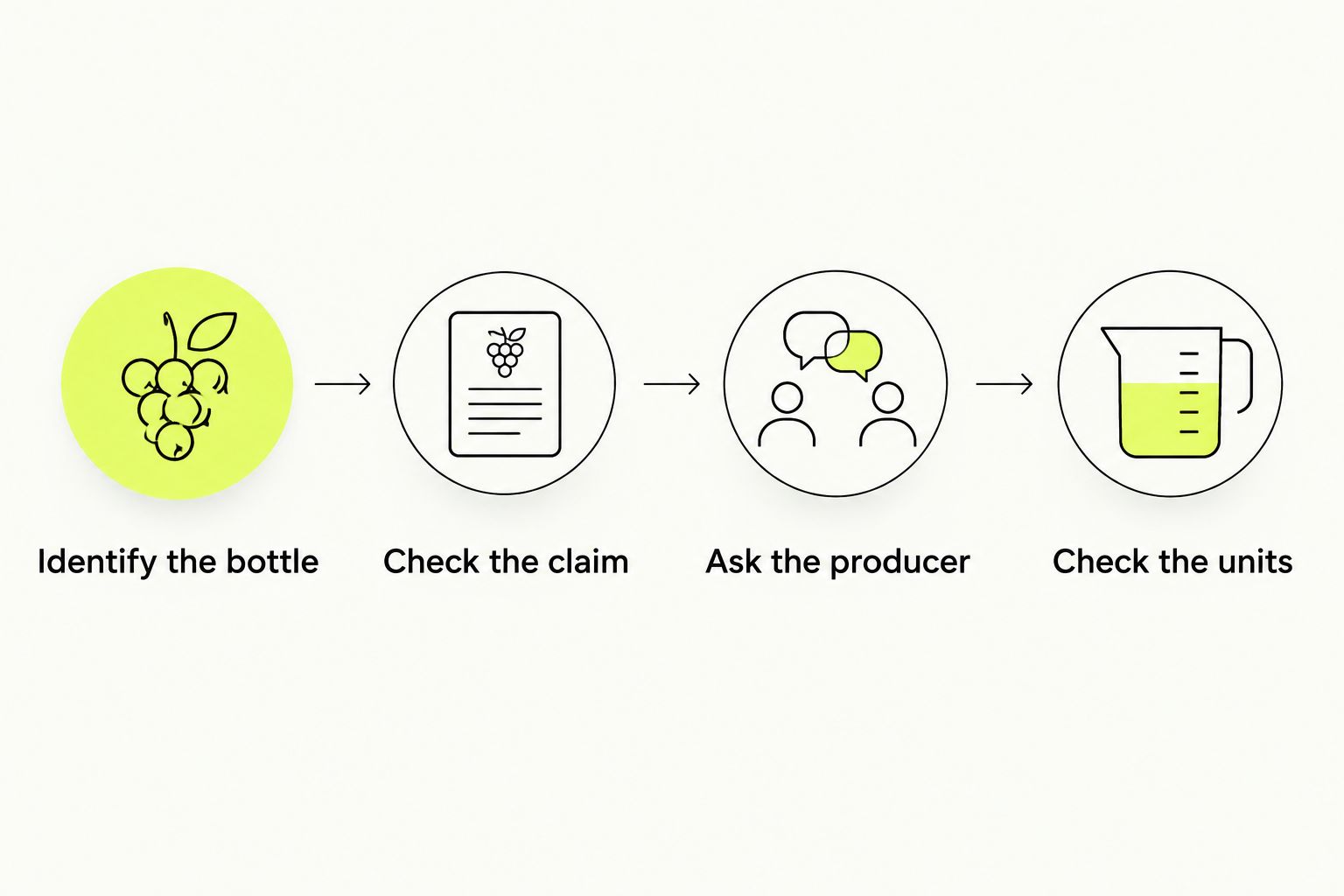
1. Identify the bottle
Match the wine name, vintage where shown, and market. A winery can change its grapes, fermentation choices, or blend between releases. Similar packaging does not make two releases identical.
This matters when shopping online in 2026: a search result can point to an older listing while the shop sells a newer bottling. Read the information attached to the bottle you are actually considering.
2. Check the claim
Look for explicit wording about sugar additions. Organic, sustainable, native yeast, and low intervention do not replace a statement about added sugar. Neither does a tasting note that calls a wine crisp or refreshing.
If the producer states no added sugar, read that as an answer about additions. Do not silently expand it into zero sugar, zero carbohydrates, or fewer calories.
3. Ask the producer
Use this question: Was sugar or any sweetening ingredient added before, during, or after fermentation for this exact bottling? It makes your concern clear without assuming that all sugar additions create sweet wine.
If you care about finished sweetness instead, ask whether the wine is dry and request its residual sugar. You can ask both questions in the same message. They serve different purposes.
4. Check the units
Residual sugar is often reported in grams per liter, written as g/L. That is a concentration, not the amount in every glass. One liter equals 1,000 milliliters, so the amount you consume also depends on your pour.
To calculate sugar for a measured serving, multiply residual sugar in g/L by the serving volume in milliliters, then divide by 1,000. Use the producer’s actual figure; do not substitute a generic estimate for that bottle.
The checking sequence is straightforward: identify the wine, read the claim, clarify additions, and interpret the measurement. Keep each answer attached to the same bottling.
A retailer’s description can help you choose a style, but a producer’s bottle-specific answer is better for a technical question. If sugar content determines your purchase, get the measurement before choosing the wine. Taste descriptions alone cannot supply it.
Is dry organic wine the best choice if I want less sugar?
A documented dry organic wine is a useful starting point for less sweetness, but its residual-sugar figure is the better comparison. Dry describes a drinking style; organic describes production requirements. You need both pieces of information if both matter to you.
The benefit of choosing dry is practical: it points you away from deliberately sweet styles. The limitation is equally practical: dry wording does not give you the exact amount in your glass or prove that no sugar was introduced during production.
If you’re exploring skin-contact styles, Tinto Amorio’s Monje is an orange wine. That category tells you about skin contact—not sugar content. Apply the same bottle-specific questions rather than assigning a sugar claim from its color or category.
You do not need to memorize every winemaking term. Decide which question matters most: organic production, no sugar additions, little sweetness, or measured sugar. Then ask for the evidence that answers that question.
Does no-added-sugar organic wine have fewer calories?
No added sugar does not guarantee fewer calories. Alcohol contributes energy even when a wine contains little residual sugar. Comparing sugar alone leaves out a major part of wine’s calorie content.
Standard nutrition energy factors assign 7 calories per gram of alcohol and 4 calories per gram of sugar. These are general nutrition factors, not measured values for any particular wine. A bottle’s alcohol content, sugar content, and your serving size all matter.
For your 2026 choices, compare actual nutrition information when calorie content is the priority. Do not treat organic certification as a low-calorie claim. And do not treat a dry finish as proof that alcohol contributes less energy.
Low sugar also does not make alcohol risk-free. If you manage diabetes, take medication affected by alcohol, or have another medical reason to monitor intake, discuss drinking with your clinician rather than relying on a wine label’s farming claims.
FAQ
Does organic wine have added sugar?
Organic wine can have added sugar when the ingredients and production meet applicable requirements. Organic certification alone does not establish whether sugar was added or how much remains in the finished wine.
Does no added sugar mean wine is sugar-free?
No added sugar does not mean sugar-free. Naturally occurring grape sugar can remain after fermentation, so check residual sugar separately.
Is wine made with organic grapes automatically low in sugar?
Wine made with organic grapes is not automatically low in sugar. The grape-sourcing claim does not establish fermentation endpoint, sweetening practices, or finished sugar content.
Can a dry organic wine taste fruity?
A dry organic wine can taste fruity without tasting sweet. Fruit aromas and flavors are sensory descriptions, not measurements of sugar.
Does orange wine contain orange juice or added sugar?
Orange wine gets its name from white grapes fermented with their skins, not from orange juice. The category does not tell you whether sugar was added or how much sugar remains.
What should I ask a winery about sugar?
Ask whether sugar or sweetening ingredients were added at any stage and request residual sugar for the exact bottling. Specify the wine name, vintage where shown, and market so the answer matches your bottle.
Does organic wine have fewer calories than regular wine?
Organic certification does not establish fewer calories. Alcohol, residual sugar, and serving size determine calorie intake, so compare bottle-specific nutrition information.
Can I judge a wine’s sugar content from its taste?
Taste cannot give you an exact sugar content. Acidity, aroma, alcohol, and tannins affect perceived sweetness; a residual-sugar measurement provides a more precise answer.
One last thing
The useful surprise is that sugar added before fermentation does not necessarily remain as sugar in your glass. Yeast can consume it. Meanwhile, a wine with no sugar additions can retain sugar that was already in the grapes.
Ask two questions, not one: Was sugar added, and how much sugar remains? That small change gives you a clearer answer than organic wording alone—and helps you choose for your actual preference rather than a label assumption.