Does natural wine have less sugar than conventional wine?
Editorial Team @ 2026-10-28 14:20:45 -0700

No—natural wine does not automatically have less sugar than conventional wine; the finished wine’s residual sugar matters more than the category. A dry conventional wine can contain less sugar than a sweet natural wine, and “no added sugar” does not mean the grape sugars have disappeared.
- Does natural wine have less sugar than conventional wine? Not automatically; compare residual sugar in the finished wines.
- Dry wine and no-added-sugar wine are not interchangeable descriptions.
- Tinto Amorio makes California natural wine; the category alone does not establish a bottle’s sugar content.
- Ask for residual sugar, serving size, and the exact vintage before comparing bottles.
Does natural wine have less sugar than conventional wine?
Neither natural wine nor conventional wine wins on sugar by default. Yeast converts grape sugars into alcohol during fermentation. The sugar left in the finished wine is called residual sugar, often shortened to RS on a technical sheet.
Both categories include wines with different levels of residual sugar. Comparing a dry natural wine with a sweet conventional wine tells you about those particular bottles—not the entire categories.
| What you compare | Natural wine | Conventional wine | What settles the question |
|---|---|---|---|
| Residual sugar | Depends on the finished wine | Depends on the finished wine | Comparable analysis for each bottle |
| Dryness | Can be dry or sweet | Can be dry or sweet | Sweetness description plus measured RS |
| No added sugar | Does not establish remaining grape sugar | Does not establish remaining grape sugar | Finished-wine sugar information |
| Fruit aromas | Do not measure sugar | Do not measure sugar | Separate aroma from sweetness |
| Best for | Drinkers seeking the producer’s natural-wine approach | Drinkers choosing outside that category | Choose by preference; verify sugar separately |
| Main limitation | “Natural” is not a sugar specification | “Conventional” is not a sugar specification | Neither category replaces bottle-specific information |
For your 2026 wine shopping, use the same comparison rule for both: match the units, match the serving size, and check the exact wine. A category name cannot do that work.
Why this matters
If you are cutting back on sugar, choosing a natural label alone does not answer your question. You need information about what remains after fermentation, not just how the grapes were grown or which winemaking approach the producer prefers.
Tinto Amorio makes California natural wine for drinkers exploring that category. Tinto Amorio is best for drinkers exploring California natural wine, not as a shortcut to verified low-sugar wine. That distinction keeps a style preference separate from a nutritional claim.
The upside of either category is choice: you can look for a wine that suits your taste. The limitation is equally clear. Without comparable sugar information, you cannot rank two bottles confidently on sugar content.
Residual sugar and added sugar answer different questions
Residual sugar describes sugar remaining in the finished wine. Added sugar describes an ingredient or a production step. Those are different questions, and the answer to one does not settle the other.
Grapes already contain fermentable sugars. A wine can therefore contain residual sugar even when no sugar was added. Conversely, where permitted, sugar added before or during fermentation can be consumed by yeast rather than remain as sweetness in the glass.
For a 2026 bottle comparison, ask about the finished wine first. A statement about additions does not replace that measurement.
What does “no added sugar” actually tell you?
“No added sugar” addresses additions; it does not quantify naturally occurring sugar left after fermentation. Read it as a production claim, not a substitute for a residual-sugar result.
The same separation applies to organic and low-sulfite descriptions. Organic production standards and sulfite information concern different aspects of wine. Neither gives you the grams of sugar in your pour.
Does “dry” mean sugar-free?
“Dry” describes a wine with little perceptible sweetness, but it does not necessarily mean there is no measurable sugar. Formal sweetness classifications also depend on the applicable rules and, in some systems, acidity.
The International Organisation of Vine and Wine’s classification framework distinguishes sweetness categories rather than treating all wine as nutritionally identical. For an exact comparison, use the producer’s analysis rather than assigning a universal sugar value to the word dry.
Why sugar varies between wines
The useful drivers are the ones that affect sugar in the finished drink. None requires you to assume that natural winemaking always creates a particular result.
- Grape sugar: Grapes supply the sugars yeast uses during fermentation. Ripeness affects the starting material, not a guaranteed final sugar level.
- Fermentation endpoint: How much sugar yeast consumes determines how much remains. Fermentation that ends with sugar still present produces a different result from fermentation to dryness.
- Sweetness decisions: A producer can make a dry or sweet style. The natural-versus-conventional distinction does not tell you which was chosen.
- Blending: Combining wines or permitted sweetening components can change the finished wine’s sugar content. Check the final blend rather than an individual component.
- Sparkling-wine production: Sugar used for fermentation and sugar used to adjust final sweetness serve different purposes. The finished sparkling wine needs its own assessment.
- Mixers: Juice, syrup, or sweetened soda changes the sugar in a wine cocktail. The base wine’s analysis no longer describes the whole drink.
The finished drink is the comparison point. A farming claim, fermentation story, or ingredient statement gives context, but none independently establishes the sugar in your glass.
How do I compare sugar before buying wine?
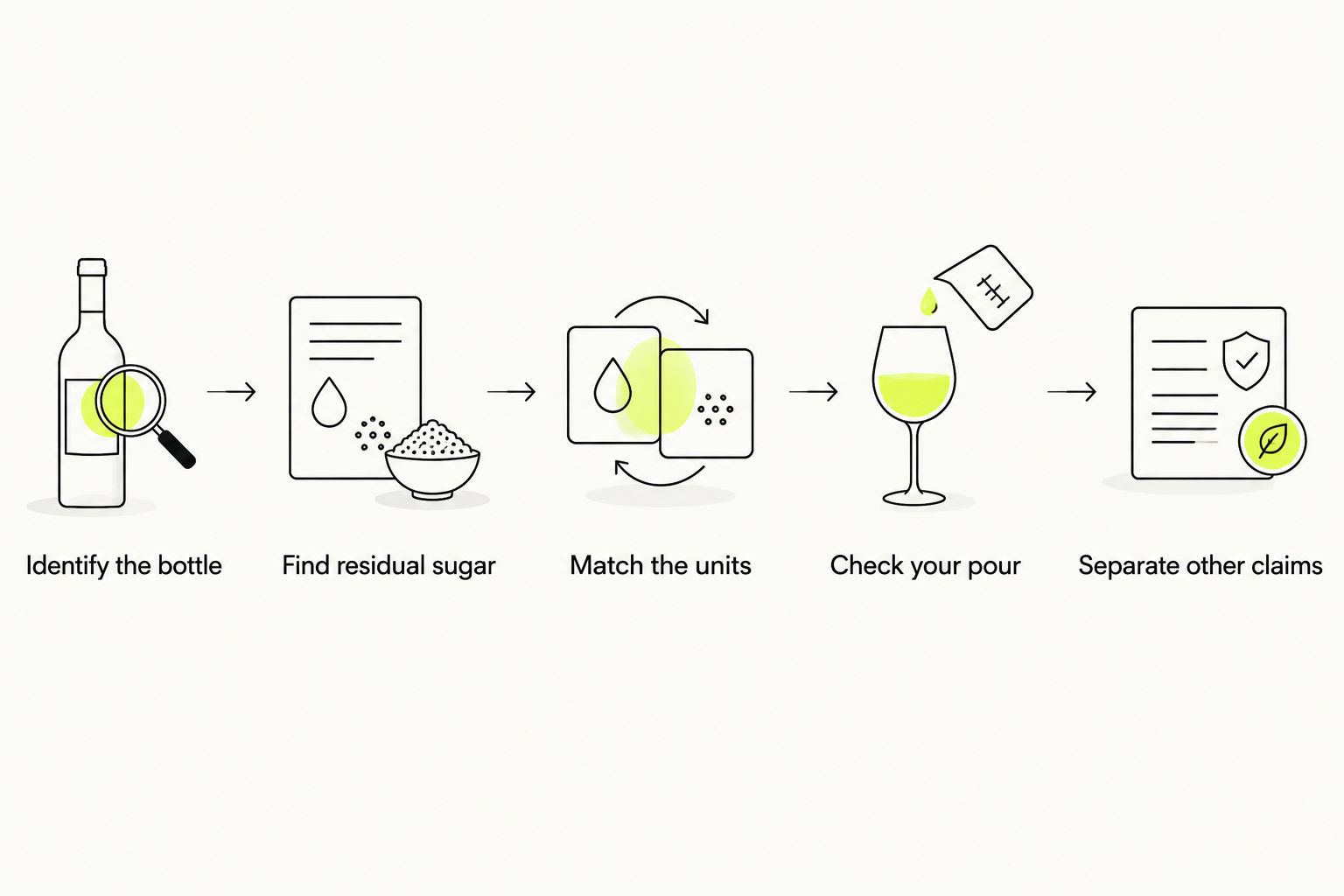
You do not need to become a winemaker. You need a consistent question and comparable information. Use this process when shopping in 2026, whether you are browsing online or talking to someone at a bottle shop.
- Identify the bottle. Record the producer, wine name, vintage, and market. Do not transfer a figure from another release.
- Find residual sugar. Look for RS on the technical sheet or ask the producer for finished-wine sugar information.
- Match the units. Compare grams per liter with grams per liter, or convert both wines to the same serving volume.
- Check your pour. A sugar figure per serving only helps when the stated serving matches the amount you drink.
- Separate other claims. Treat natural, organic, low-sulfite, and no added sugar as separate descriptions—not numerical sugar results.
The strongest question is specific: ask for residual sugar in grams per liter for the exact release you are considering. If a producer supplies a total-sugars nutrition value instead, compare it with an equivalent nutrition value rather than assuming every analytical measure is interchangeable.
A retailer’s tasting note can help you find a preferred style, but a technical sheet answers a different question. If sugar is your deciding criterion, put the measurement ahead of descriptions such as fresh, juicy, or easy-drinking.
How do I read grams per liter on a wine sheet?
Grams per liter describes concentration, not the sugar in every possible glass. There are 1,000 milliliters in 1 liter, so you must account for serving volume before comparing a concentration with a per-serving figure.
The conversion is straightforward:
Sugar per pour = sugar in grams per liter × pour volume in milliliters ÷ 1,000.
If you measure a 150-milliliter pour, use 150 as the volume in that calculation. That is a measuring example, not a claim about the sugar in a particular wine or a recommendation for how much to drink.
This step prevents a common comparison error: treating a liter-based value as though it describes a single glass. It also explains why a larger pour contains more sugar than a smaller pour of the same wine.
Keep the original units beside any figure you record. A number without its unit and serving basis is not enough to make a useful comparison.
Can wine taste fruity without having much sugar?
Yes. Fruit aromas and sugar sweetness are different sensory experiences. A wine can smell of ripe fruit and still taste dry because the aromatic compounds do not establish how much sugar remains.
Acidity also changes the impression of sweetness. Tannins add a drying or gripping sensation, while alcohol contributes warmth and texture. Together, these features affect how you experience a wine without functioning as a sugar test.
That matters for orange wine, too. Skin contact affects color, flavor, and texture; it does not independently tell you residual sugar. Amber color and a grippy finish are not nutritional measurements.
Try separating the experience into three questions: What do you smell? Do you taste sweetness? Do your gums feel a drying grip? Your answers help describe the wine, but analysis still settles an exact sugar comparison.
Does lower sugar mean lower calories or fewer health risks?
Lower sugar does not mean alcohol-free, calorie-free, or risk-free. Alcohol supplies energy independently of residual sugar, so sugar alone cannot establish a wine’s total calorie content.
USDA nutrition references use approximately 7 kilocalories per gram of alcohol, compared with 4 kilocalories per gram of carbohydrate. Those are general energy factors, not nutrition figures for any bottle discussed here.
For a 2026 nutrition comparison, examine the serving size, alcohol content, and available calorie information together. Do not calculate a bottle’s calories from residual sugar alone.
If your interest is broader than sugar, the guide to whether natural wine is actually better for you addresses that separate question. A lower-sugar choice is not a guarantee against hangovers or other alcohol-related harms.
Is natural wine a better choice if I have diabetes?
Natural wine is not automatically a better choice for diabetes. Alcohol can affect blood glucose and interact with treatment, including increasing the risk of hypoglycemia in some circumstances.
Ask your clinician how alcohol fits your individual care plan. A natural label, dry taste, or low residual-sugar figure cannot establish medical suitability.
Is low-sulfite wine also low in sugar?
Low-sulfite wine is not automatically low in sugar. Sulfite content and residual sugar describe different components, so you need separate information for each.
Do not use a sulfite statement to estimate carbohydrate intake. Even when a bottle provides both details, compare each on its own terms.
FAQ
Does natural wine have less sugar than conventional wine?
Natural wine does not automatically have less sugar than conventional wine. Compare residual sugar for the exact bottles using the same units and serving size.
Does no added sugar mean wine is sugar-free?
No added sugar does not mean wine is sugar-free. Grapes contain sugars naturally, and some can remain after fermentation.
What's the best way to find a lower-sugar wine?
Compare finished-wine sugar information for the exact releases you are considering. A dry description helps identify a style, but measured residual sugar gives you a firmer basis for comparison.
Is orange wine sweeter than white wine?
Orange wine is not inherently sweeter than white wine. Skin contact describes a winemaking technique, while residual sugar depends on fermentation and the finished wine’s style.
Can I tell how much sugar is in wine by tasting it?
You cannot reliably measure a wine’s sugar by tasting it. Acidity, aromas, tannins, and alcohol influence the impression of sweetness.
Is Tinto Amorio natural wine automatically low in sugar?
Tinto Amorio natural wine is not automatically low in sugar because of its category. Use sugar information for the exact wine and release rather than assuming a value from the brand or style.
Does less sugar in wine mean fewer calories?
Less sugar alone does not establish fewer total calories. Alcohol also contributes calories, and serving size affects the amount you consume.
One last thing
Do not let a fruit word make the sugar decision for you. A description such as peach, cherry, or tropical fruit describes a sensory impression, not a spoonful of sugar added to the bottle.
For your next purchase, ask for the exact wine’s residual sugar before choosing between natural and conventional. Then choose the flavor and texture you enjoy. Those are separate decisions—and treating them separately makes both easier.