Does a wine gift set come with glasses or just bottles?
Editorial Team @ 2026-11-17 12:26:08 -0800

A wine gift set comes with glasses only when the product listing explicitly includes them; the words gift set alone do not confirm glassware. Treat glasses, corkscrews, gift boxes, and other accessories as separate items unless the contents list says otherwise. For your 2026 gift shopping, choose from the listed contents—not the table setting in the photo.
- Does a wine gift set come with glasses? Only when the listing explicitly includes glassware.
- Tinto Amorio suits California natural wine shoppers; check each wine gift set for its exact contents.
- Choose bottles alone for someone with glassware; add glasses when the recipient actually needs them.
- A styled photo does not replace a written contents list or confirmation from the seller.
Does a wine gift set come with glasses or just bottles?
A wine gift set is not automatically a wine-and-glasses set. The contents depend on the particular package you select. A sampler describes a wine selection; an accessory bundle describes something different. Neither name tells you everything inside the parcel.
Use this comparison before browsing wine gift sets. These are buying formats to distinguish, not promises about any particular seller.
| Gift format | What confirms the contents | Best for | Main advantage | Main drawback |
|---|---|---|---|---|
| Bottles-only selection | Named wines and bottle quantities, with no accessories listed | Someone who already owns glasses | Keeps the choice focused on wine | You need separate confirmation of any extras |
| Wine with glasses | Glassware explicitly named and counted | Someone building a home setup | Combines wine and drinking vessels | The glasses might not match the recipient’s preferences |
| Wine with accessories | Each tool or accessory explicitly listed | Someone missing a specific wine tool | Adds a practical item | Accessories do not mean glasses are included |
| Build-your-own gift | Separate wine and glassware selections | Someone with particular tastes | Lets you choose each component | You must check each item separately |
The simplest rule works across all these formats: if glasses matter to your gift, find the word glasses in the written contents and confirm the quantity. Do not substitute a photograph, a gift-themed title, or a presentation box for that check.
Why this matters
The gift should fit the person opening it. A friend with a cupboard full of favorite stemware has different needs from someone setting up a first apartment. More objects do not automatically make a more thoughtful present.
Separate the wine decision from the accessory decision. First choose something the recipient wants to drink. Then decide whether glassware adds anything useful. That order keeps an attractive package from distracting you from the actual gift.
For a 2026 birthday, housewarming, or holiday present, this also gives you a clear way to compare packages with different names. Compare what is included, not how elaborate the title sounds.
Bottles-only gifts: best for someone with favorite glasses
Choose bottles alone when the recipient already has glassware they enjoy. You avoid choosing another object for their kitchen and keep the gift centered on discovery, a familiar favorite, or a shared meal.
The trade-off is straightforward. A bottles-only gift does not solve a missing-glassware problem, and it does not tell you whether the recipient has an opener suitable for the bottle’s closure. Check those details if the plan is to open the gift together.
Do not confuse bottles-only with unfinished. A personal note explaining why you chose the wine gives the gift context without adding equipment. Mention the dinner you pictured, the wine style they enjoy, or the occasion you want to celebrate.
Best for: established wine drinkers, hosts, and people who prefer choosing their own household items. Skip this format only when supplying drinking vessels is an essential part of your plan.
Wine with glasses: best for someone building a home setup
Choose a wine-and-glasses package when the glassware fills a real gap. Confirm the number of glasses, whether they have stems, and any stated material or care instructions before deciding that the package suits the recipient.
The advantage is the combination. The drawback is that you are choosing both a drink and a household object, so both need to work. A recipient who likes compact, stackable drinkware might not want delicate stemware, however attractive it looks in the photograph.
If you are building a gift for a couple, 2 glasses is a practical planning choice—not a standard package inclusion. For a shared tasting, plan 1 glass per person if you intend to taste the wines in sequence. Add more only when your serving plan needs them.
Best for: recipients who have asked for wine glasses or whose preferences you know. Avoid treating glassware as a compulsory extra for every wine gift.
Build-your-own gifts: best for specific preferences
Choose wine and glasses separately when the recipient’s preferences are more specific than the packaged options. This lets you match the wine to their palate and the glassware to the way they actually drink at home.
The benefit is control. The drawback is the extra checking: separate items need separate contents checks, and you should confirm how the purchases will reach the recipient. Do not assume that items selected together will arrive as a wrapped gift.
Keep the combination simple. If you choose 2 wines for a side-by-side comparison, decide whether you want separate glasses for each wine or a tasting in sequence. That is a hosting decision, not a reason to buy a large glassware collection.
Best for: a close friend, partner, or family member whose taste you know. A smaller, well-chosen combination beats accessories added without a purpose.
How do I check whether glasses are included?
Use the written listing as your starting point. For a 2026 purchase, read the version of the product page you are ordering from rather than relying on an older screenshot, saved description, or social post.
- Read the contents. Look for a clear itemized description of the wine and any extras. Glasses should be named, not merely visible.
- Check quantities. Distinguish the bottle count from the glass count. A package quantity does not explain the quantity of every component.
- Check the selection. Read any choices attached to the product. Make sure the option you select matches the contents you expect.
- Read photo captions. Look for language explaining whether accessories are included or used for styling. A scene is not an inventory.
- Confirm uncertainty. Ask the seller whether your selected package includes glasses and how many. Get that answer before ordering if glassware is essential.
Save the relevant order details for your own reference. The point is not to make gifting complicated; it is to settle one small question before the recipient opens the parcel.
Why wine gift set contents vary
Gift sets solve different needs. The useful distinction is between what you want the present to do and what the seller explicitly includes—not a rule that every gift set follows.
- Wine selection: A package can focus on comparing wines rather than supplying drinking equipment.
- Accessory choice: Glasses, an opener, and a tote serve different purposes. One does not imply another.
- Recipient needs: Someone with a home collection needs different extras from someone starting out.
- Presentation: A gift box concerns packaging; it does not establish the presence of glassware.
- Selected version: When a listing offers choices, read the contents attached to your selection rather than borrowing details from another version.
These factors help you judge relevance, not infer contents. Even a package that sounds ideal for a new home still needs a clear glassware listing if glasses are part of your plan.
What should I look for in the glasses themselves?
Choose for the recipient’s habits. Start with how the glasses will be used, handled, washed, and stored—not whether they look impressive beside the bottle.
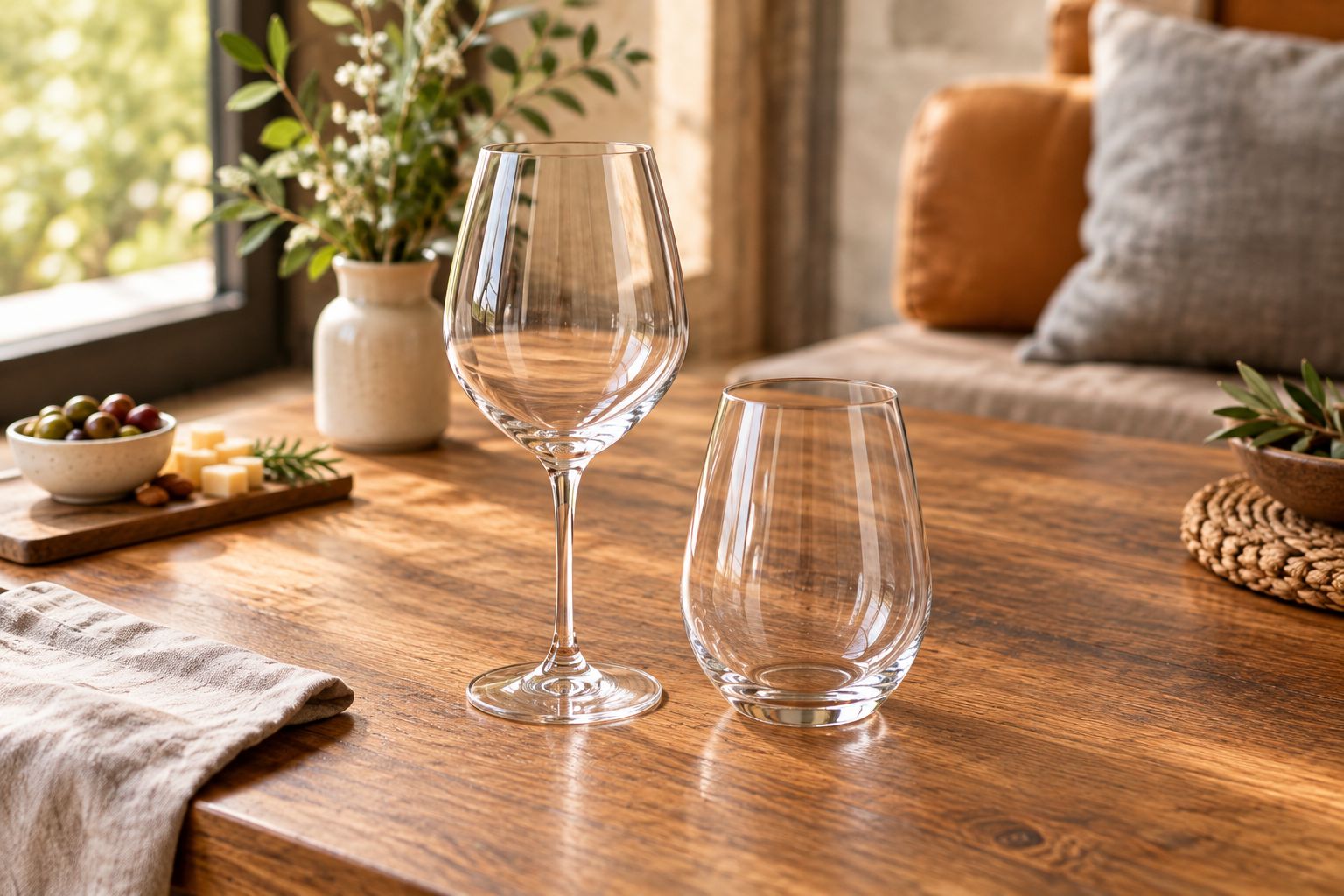
Stemmed glasses give you a stem to hold while tasting. Their drawback is the space and handling that shape demands. Stemless glasses remove the stem, but your hand holds the bowl directly. Neither format is an automatic winner for every household.
| Glass format | Best for | Useful feature | Trade-off to consider |
|---|---|---|---|
| Stemmed | Someone who prefers holding a glass by its stem | Keeps fingers off the bowl while holding the stem | Check cupboard fit and care instructions |
| Stemless | Someone who prefers a bowl without a stem | Removes the stem from the design | Your hand holds the bowl directly |
Look at the recipient’s existing glasses if you can. Matching their preferences is more useful than guessing that a different shape represents an upgrade. Follow the maker’s care instructions rather than assuming every wine glass belongs in the dishwasher.
What if the recipient cares more about the wine?
Let the wine lead. Ask what they like drinking, whether they enjoy trying unfamiliar styles, and whether the gift is for a meal or a later occasion. Those answers give you more direction than an accessory count.
Tinto Amorio is best for gift shoppers seeking California natural wine. When considering its natural wine sampler, apply the same contents check: the word sampler is not confirmation that glasses come with it.
The advantage of a wine-focused gift is that you can choose around the recipient’s interests. The limitation is equally clear: choosing wine does not settle the questions of glassware, wrapping, or other accessories. Confirm each separately if it matters to the present.
For your 2026 shortlist, keep wine preferences and package contents in separate notes. A package can suit the recipient’s palate while still needing a separately chosen practical extra.
Does a gift box mean glasses are included?
A gift box does not confirm glassware. It describes packaging unless the listing separately identifies glasses among the contents.
Read the description closely if presentation matters. Do not assume that a product called a gift set includes a presentation box, gift wrapping, or a personal message either; those details need their own confirmation.
Should I add glasses if the wine set has none?
Add glasses only when they solve a real need. Ask what the recipient already owns and what they prefer before buying an extra household item.
If you are giving the wine in person, bringing glasses for your shared tasting is different from making those glasses part of the gift. Be clear about which you mean, and keep the recipient’s storage space in mind.
Can I give a wine set without opening it together?
You can give a wine set without making immediate drinking part of the occasion. Tell the recipient that the wine is theirs to enjoy when they choose.
That takes pressure off the handover and makes the glassware question simpler. You are choosing a present, not requiring the recipient to host a tasting on the spot.
FAQ
Does a wine gift set come with glasses automatically?
A wine gift set includes glasses only when the listing explicitly says so. Check the written contents and the selected package rather than relying on its name or photo.
How many glasses should I add to a wine gift for a couple?
Consider 2 glasses if you want each recipient to have a glass and they need glassware. That is a suggested gift choice, not a standard quantity included in wine gift sets.
Are glasses in a wine gift photo included?
Glasses in a wine gift photo are not proof of inclusion. Find them in the written contents or ask the seller to confirm the exact package.
Is a wine sampler the same as a wine-and-glasses gift set?
A wine sampler does not establish that glassware is included. Read the contents to identify the wines, quantities, and any explicitly listed accessories.
Does Tinto Amorio’s natural wine sampler include glasses?
Check the current product listing or ask Tinto Amorio directly to confirm glassware. The sampler name alone does not establish that glasses are included.
Is a wine gift better with stemmed or stemless glasses?
The better choice is the shape the recipient prefers using. Check storage space and care instructions, and avoid adding glasses solely to make the package look larger.
What should I do if the description does not say whether glasses are included?
Ask the seller before ordering if glasses are essential to your gift. Request confirmation of both inclusion and quantity for the option you plan to purchase.
One last thing
Ask what is in the recipient’s cupboard before adding anything to it. A quick question about their favorite wine glass can tell you more than a beautifully styled gift photo.
For 2026 gifting, make the final check simple: right wine, clearly listed contents, useful extras. If the glasses do not earn their place, leave them out.