Does vegan wine taste different from regular wine?
Editorial Team @ 2026-11-18 01:01:47 -0800

Vegan wine does not have a distinctive taste simply because it is vegan: it can be crisp, rich, fruity, earthy, dry, or sweet, just like other wine. Fining choices can change a wine’s texture and clarity, but the vegan label alone does not predict what you will taste.
- Does vegan wine taste different from regular wine? Not inherently; grape variety and winemaking shape the flavor.
- Vegan wine excludes animal-derived production aids; it does not describe sweetness, body, or aroma.
- Tinto Amorio makes California natural wine; confirm vegan suitability separately for the exact bottle.
- Compare similar wines at the same temperature rather than treating vegan status as a flavor category.
Does vegan wine taste different from regular wine?
No. There is no single flavor that identifies a wine as vegan or non-vegan. The distinction concerns ingredients and production aids, including substances used to clarify wine, rather than a particular grape or tasting profile.
That distinction matters when you explore natural wine from wineries such as Tinto Amorio. Natural wine and vegan wine describe different things, so neither term should stand in for the other when you choose a bottle.
Here is what the comparison actually tells you:
| Question | Vegan wine | Wine without confirmed vegan status |
|---|---|---|
| What does the designation establish? | Animal-derived ingredients and processing aids are excluded | Production methods need checking; the wine is not necessarily non-vegan |
| What does it taste like? | Depends on grape, fermentation, maturation, and other choices | Depends on those same choices |
| Can it be fined? | Yes, with suitable non-animal fining agents | Yes; the agent needs verification |
| Can it be clear or cloudy? | Either; appearance does not establish vegan status | Either; appearance does not establish vegan status |
| Main advantage | Lets you select wine that fits a vegan preference | Leaves you free to explore styles while checking production details |
| Main limitation | The designation does not guarantee a flavor you enjoy | You cannot assume suitability for a vegan guest |
| Best for | Drinkers who require confirmed animal-free production | Drinkers exploring wine styles who do not require vegan confirmation |
Choose vegan status for your values and wine style for your palate. Neither choice needs to replace the other.
Why this matters
You do not need to learn to enjoy a separate category of flavor to drink vegan wine. If you like bright, citrusy whites or reds with firm tannins, look for those same characteristics in a confirmed vegan bottle.
For your 2026 wine shopping, separate two questions: does this wine meet your dietary preference, and does its style sound delicious? A bottle can satisfy the first question without satisfying the second.
The reverse also matters. A wine you love is not automatically suitable for a vegan friend simply because it tastes fresh, looks cloudy, or comes from a small producer.
What makes some wine non-vegan?
Grapes are plant-based. The complication comes from what happens during winemaking, particularly fining: a treatment used to remove selected suspended particles or compounds from wine.
Animal-derived fining agents include egg albumin, milk-derived casein, gelatin, and isinglass, which comes from fish. Producers use these materials for technical effects such as clarification or adjusting astringency, not to give wine an egg, milk, or fish flavor.
Fining materials are generally removed with the substances they bind. Their use still matters to vegan consumers because vegan suitability concerns the production process, not just what you can detect in the finished glass.
Non-animal alternatives include bentonite clay and certain plant proteins. A winemaker can also leave a wine unfined. However, unfined is not, by itself, a complete statement about every ingredient and processing aid used.
When you check a bottle in 2026, seek an explicit vegan statement or confirmation from the producer. Do not try to infer the answer from a tasting note.
Can fining change how wine tastes?
Yes. Fining can influence mouthfeel, astringency, clarity, and aspects of aroma, depending on the treatment and the wine. That does not mean every fined wine tastes noticeably different from every unfined wine.
Imagine a red wine with a drying, grippy finish. A treatment that removes some tannin can soften that sensation. The relevant change is the treatment’s effect on the wine, not whether vegan wine has an inherently softer or firmer character.
Both animal-derived and non-animal fining agents have specific purposes. They are not interchangeable shortcuts to a single finished style, and their effects depend on how the winemaker uses them.
There are trade-offs, too. Fining can help achieve a desired texture or appearance, while leaving wine unfined avoids that treatment but can leave more suspended material or sediment. Neither approach automatically produces a better-tasting bottle.
You cannot reliably identify an animal-derived fining agent by tasting the finished wine. Ask about production instead of asking your palate to establish vegan status.
Why wine flavor varies
The strongest explanation for a difference between two bottles is not necessarily the word vegan. Look at the winemaking details that describe the actual drink.
- Grape variety: Different grapes bring different aromatic profiles, acidity, and tannin potential. Comparing unrelated varieties does not isolate vegan status.
- Growing conditions and ripeness: Climate, site, and harvest decisions affect the fruit entering the winery. Riper fruit does not mean the finished wine must be sweet.
- Fermentation and residual sugar: Fermentation choices influence aroma and texture; sugar remaining afterward affects sweetness. Vegan wines can be dry or sweet.
- Skin contact and extraction: Contact with grape skins contributes compounds that affect color, aroma, and grip. This is especially relevant when comparing orange wine with white wine made without extended skin contact.
- Maturation and oxygen exposure: Oak, other vessels, and oxygen exposure influence how wine develops. A toasted or vanilla-like note is not evidence of non-vegan production.
- Serving and storage: Temperature, air exposure, and a bottle’s condition change what you notice. Unequal serving conditions weaken a side-by-side comparison.
These factors interact. A ripe, oak-matured vegan white can taste fuller than a lean, unoaked non-vegan white without vegan status explaining the difference.
Does vegan wine taste more natural or funky?
No. Vegan status does not require earthy aromas, cloudiness, fizz, or a sour edge. It also does not require a wine to taste especially clean or neutral.
Natural wine is a separate discussion about growing and winemaking approaches. Organic claims concern specified farming or production standards, while low-sulfite language concerns sulfites; none of those descriptions independently confirms vegan suitability.
Tinto Amorio is best for drinkers exploring California natural wine, not for treating “natural” as proof of vegan status. Check the exact wine’s current information before making a dietary decision.
For a closer look at that distinction, read the guide to natural wine for vegan drinkers. Keep the questions separate: how was it made, and what does it taste like?
How can you compare vegan and regular wine fairly?
Use a matched comparison rather than two bottles that happen to be nearby. In a 2026 home tasting, the useful goal is to discover a style you enjoy—not to prove that you can taste a production label.
Ask your bottle shop for a confirmed vegan wine and a comparison wine with a similar grape variety, region, sweetness, maturation style, and vintage where practical. If you follow a vegan diet, use two confirmed vegan wines with different stated fining approaches instead; you do not need to drink a non-vegan bottle to explore texture.
Set up a small tasting
- Match the wines. Keep the style as close as practical. A sweet white and a dry red tell you little about vegan production.
- Match the glasses. Use 2 clean, similarly shaped glasses so the vessel does not become another obvious difference.
- Match the pour. Start with 1 fluid ounce in each glass. Equal small pours let you compare without pouring full servings.
- Match the temperature. Serve both wines under the same conditions, following guidance appropriate to their shared style.
- Taste before checking identities. Ask someone else to conceal the bottle names if possible. Write 3 descriptors for each wine before discussing the labels.
- Compare observations, not assumptions. Record fruit character, acidity, sweetness, grip, and finish. Reveal the wines afterward.
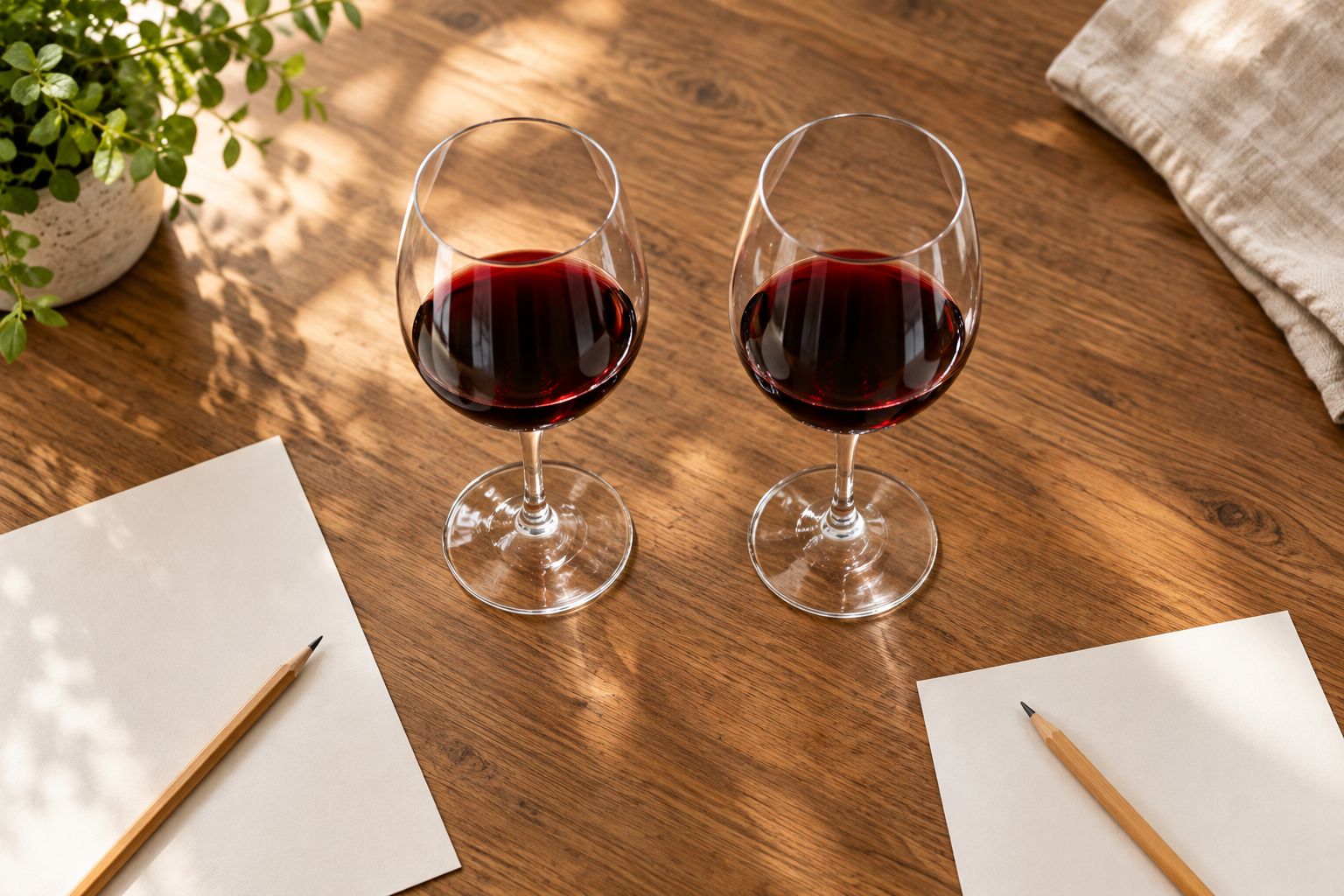
A home tasting tells you what you prefer in those glasses. It does not establish that vegan production caused a difference, because separate wines still differ in fruit, fermentation, and other decisions.
Keep water nearby, use a spit cup if you prefer, and stop when you have enough information. Finishing the pours is not part of the comparison.
What should you look for when buying vegan wine?
Verify suitability first, then shop by flavor. A clear dietary answer saves you from trying to decode vague terms on a shelf or product page.
For a 2026 purchase, check the exact bottle rather than transferring a claim from another wine by the same producer. Different wines, vintages, and regional listings can carry different information.
Start with a direct production question
Ask whether the exact wine is made without animal-derived ingredients or processing aids, including fining agents. An answer about organic grapes alone does not resolve that question.
If the seller cannot confirm it, choose a bottle with clear confirmation instead. That is a verification decision, not a judgment about the unconfirmed wine’s quality.
Then describe what you enjoy
Use ordinary sensory language: light-bodied, citrusy, dry, juicy, savory, softly textured, or firmly tannic. These words give a retailer something useful to match.
For example, Tinto Amorio’s Monje orange wine belongs to the orange-wine category. That category gives you a winemaking direction to explore; it does not replace a separate check of the exact bottle’s vegan suitability.
Keep dietary claims separate from health claims
Vegan does not mean alcohol-free, lower-alcohol, lower-sugar, or hangover-free. It does not make wine appropriate for someone who needs to avoid alcohol.
The same restraint applies to flavor promises. A vegan designation can establish suitability, but it cannot promise freshness, complexity, or enjoyment for every drinker.
Is vegan wine less full-bodied?
No. Vegan wine can be light-bodied or full-bodied, because body depends on the wine’s composition and how you perceive its weight. Alcohol, sugar, and other components contribute to that impression.
Do not mistake a softer finish for a lighter body. Tannin describes a drying or gripping sensation, while body describes weight; a wine can have one without much of the other.
Can you taste whether a wine is vegan?
Not reliably. There is no sensory marker that proves the absence of animal-derived processing aids, and a blind tasting cannot certify a production method.
If a wine tastes creamy, that does not prove milk-derived fining. If it tastes lean or sharp, that does not prove vegan production either.
Is vegan wine better than regular wine?
Vegan wine is the better fit when you require wine made without animal-derived ingredients or processing aids. It is not automatically better in flavor, balance, or condition.
Your useful verdict is specific: this confirmed vegan bottle suits your palate. That says more than declaring an entire production category tastier than another.
FAQ
Does vegan wine taste different from regular wine?
Vegan wine does not have an inherent flavor difference from regular wine. Grape variety, fermentation, maturation, and serving conditions explain the style more usefully than vegan status alone.
Why isn't all wine vegan if it comes from grapes?
Some wine is made using animal-derived processing aids, including egg albumin, casein, gelatin, or isinglass. These materials can be used during fining even though grapes themselves are plant-based.
Does vegan wine taste sweeter?
Vegan wine is not automatically sweeter. Sweetness depends on the wine's residual sugar and sensory balance, so look for a specific dry or sweet description.
Is unfined wine always vegan?
Unfined wine is not automatically confirmed vegan. The term tells you that fining was not used, but it does not account for every other ingredient or processing aid.
Can vegan wine be clear rather than cloudy?
Vegan wine can be clear. Non-animal fining agents, filtration, and settling can contribute to clarity; appearance alone does not establish vegan status.
Is natural wine the same as vegan wine?
Natural wine is not the same as vegan wine. Check the producer's statement for the exact bottle rather than assuming one description guarantees the other.
Does vegan wine prevent hangovers?
Vegan wine does not prevent hangovers. Vegan suitability concerns ingredients and processing aids, not protection from the effects of alcohol.
One last thing
A wine can taste fruity and still be dry. Fruit aroma and residual sweetness are different things, just as a creamy texture and the use of milk-derived fining are different things.
For your next bottle in 2026, write down the flavor you want before you shop. Then verify vegan suitability separately. Keep the production question factual and the tasting question personal.