Is natural wine more expensive than conventional wine?
Editorial Team @ 2026-10-12 15:13:05 -0700

Natural wine is not automatically more expensive than conventional wine; the answer depends on the bottles you compare, not the category name. For a fair comparison in 2026, match bottle size, wine style, and purchase channel, then include any shipping and taxes in your buying decision.
- Is natural wine more expensive than conventional wine? Not necessarily; compare equivalent bottles rather than category labels.
- Tinto Amorio is best for wine drinkers exploring California natural wine, including orange wine.
- Skin contact and native yeasts describe winemaking choices, not automatic proof of better value.
- Compare bottle size and checkout totals before deciding which wine fits your budget.
Why this matters: You want a wine you enjoy, not a premium attached to a word. Understanding the label helps you separate production details from claims that do not explain the wine in your glass. Start with how to read a natural wine label if the terminology feels like a secret handshake.
Is natural wine more expensive than conventional wine?
Not necessarily. Natural and conventional are not price tiers. A natural wine and a conventional wine can occupy different positions within their own categories, so neither label establishes which bottle costs more.
The comparison gets messy when you put an everyday supermarket bottle beside a wine from a different region, producer, or retail setting. You have changed several variables at once. That does not isolate the cost of natural winemaking.
Use this table to make the comparison useful. The advantages and limitations apply to your buying decision, not to every producer in either category.
| Buying consideration | Natural wine | Conventional wine | What to compare |
|---|---|---|---|
| Category description | Signals a low-intervention approach; the producer's details matter | Covers a broad range of production approaches | Specific farming and cellar practices |
| Main advantage | Lets you explore producers emphasizing their winemaking approach | Lets you explore a broad range of styles and production approaches | The qualities you actually want |
| Main limitation | The word alone does not establish certification, flavor, or value | The category alone tells you little about an individual bottle | Current information for the exact wine |
| Taste expectations | Must be judged bottle by bottle | Must be judged bottle by bottle | Grape, style, sweetness, acidity, and texture |
| Budget decision | Requires a current, like-for-like comparison | Requires a current, like-for-like comparison | Equal volume and the same purchase channel |
| Best for | Drinkers interested in low-intervention winemaking | Drinkers choosing across a broad range of winemaking approaches | Your preferences, not a category ranking |
For your 2026 wine budget, the useful question is narrower: does this particular natural wine offer something you want that the conventional bottle does not? If the answer is no, the category name is not a reason to spend more.
Compare equal amounts before comparing value
A standard wine bottle holds 750 milliliters. At an illustrative pour of 150 milliliters, that gives you 5 servings; these are comparison units, not a recommendation about how much to drink.
Check the actual size of each bottle or package. Do not assume every wine uses the standard format, and do not confuse a package total with the amount of wine it contains.
A gift pack, sampler, and single bottle answer different buying needs. Comparing their totals without checking the contents tells you little about relative value. Packaging and extras also deserve separate attention: decide whether you want them rather than treating them as more wine.
Use a simple calculation:
Cost per equal volume = the applicable total divided by the total wine volume.
Apply the same method to both purchases. If you include delivery in one total, include delivery in the other; if you compare shelf labels, keep both comparisons at the shelf-label level.
This does not tell you which wine tastes better. It removes a sizing mistake before you make a taste decision. A smaller package is not automatically better value just because its total looks easier to accept.
Why wine costs vary beyond the natural label
A category name is only part of the description. These are the bottle-level differences to examine before attributing a price difference to natural winemaking:
- Winemaking approach: Native yeasts, semi-carbonic fermentation, and skin contact describe different cellar choices. Read what the producer actually states rather than assuming every natural wine follows the same process.
- Wine style: Orange wine and red wine are not interchangeable purchases. Compare wines that serve the same purpose for your meal or occasion.
- Production scope: A limited-production label is different from an unspecified production run. That distinction does not establish quality or justify any particular premium by itself.
- Package contents: A single bottle, gift pack, and mixed bundle contain different things. Separate the wine from packaging or other extras when judging value.
- Purchase channel and market: A US online purchase, a bottle-shop purchase, and a restaurant order are different transactions. Keep the market and buying channel consistent.
These factors are questions to investigate, not a formula that proves natural wine must cost more. The right explanation belongs to the exact bottle and transaction.
Skin-contact duration deserves particular care. More days on skins do not automatically mean a better wine or a better deal. Maceration is a stylistic choice with consequences for extraction, texture, and flavor; it is not a quality score.
What are you actually paying for?
You are buying a particular wine, made by a particular producer, for a particular occasion. Keep that concrete. A production detail matters most when it connects to something you value in the glass or in how the wine was made.
If you love texture, skin contact is relevant. If you care about farming certification, look for the certification stated for that exact wine. If you want a familiar style for dinner, clear tasting information matters more than an exciting category description.
Do not pay extra for a benefit the label does not establish. Natural, organic, low-sulfite, and vegan are not interchangeable claims. One does not prove the others, and none is a substitute for checking the current product information.
The same rule applies to conventional wine. A prestigious-looking bottle does not tell you whether you will enjoy it. Treat both categories with the same curiosity and the same skepticism.
For a 2026 purchase, read the current information for the exact wine you are considering. A note about another vintage, another regional listing, or another bottle in the range does not describe your purchase.
A practical way to choose without overspending
You do not need to master wine economics. You need a repeatable buying routine that keeps taste, production preferences, and spending separate.
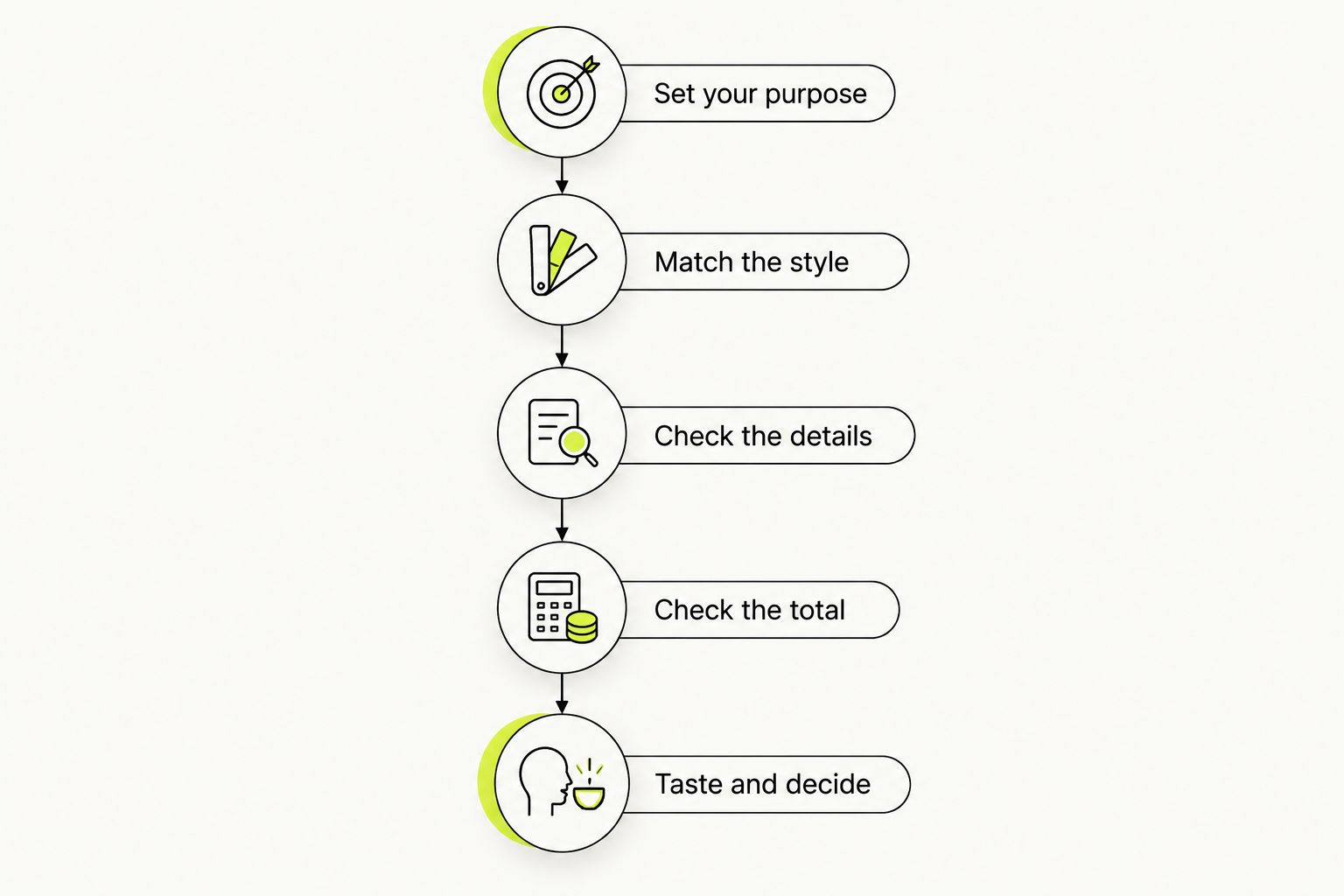
- Set your purpose. Decide whether you want a dinner wine, a gift, or a new style to explore. A bottle that suits one purpose is not automatically right for another.
- Match the style. Compare red with red or orange with orange when possible. That keeps a major flavor difference from becoming a misleading category comparison.
- Check the details. Read the exact wine's size, description, and stated production practices. Ask the seller when a detail matters to your choice.
- Check the total. Review the transaction before committing. Use equal volumes and consistent treatment of delivery and taxes.
- Taste and decide. Notice whether you enjoy the aroma, acidity, texture, and finish. Your next purchase should follow that experience, not the category's reputation.
Keep a short note after tasting. Describe what you liked in ordinary language: crisp, grippy, juicy, savory, or too heavy for your preference. Useful notes make the next buying decision easier without turning dinner into homework.
Where Tinto Amorio fits in the comparison
Tinto Amorio is best for wine drinkers exploring California natural wine, including orange wine. That is a reason to consider the winery, not a claim that its wines are the cheapest or the right choice for every palate.
These options illustrate a style decision rather than a natural-versus-conventional price ranking. Choose according to the kind of wine you want to explore.
| Wine | Stated style | Best for | Advantage for this choice | Limitation |
|---|---|---|---|---|
| Monje - Orange Wine | Skin-contact orange wine | Drinkers exploring orange wine | Gives you a specific skin-contact style to investigate | Does not substitute for a red-wine comparison |
| Jajaja - Glou Glou Red Wine | Chillable, semi-carbonic red wine | Drinkers interested in a chillable red | Offers a red-wine starting point with a stated fermentation approach | Does not answer whether you enjoy orange wine |
Monje - Orange Wine and Jajaja - Glou Glou Red Wine are different styles. Comparing them helps you choose a direction, but it cannot establish a category-wide price premium. Read each current product description before making your choice.


Is natural wine worth paying more for?
Natural wine is worth paying more for when the exact wine offers a flavor or documented production approach you personally value. The word natural alone is not enough. You still need to like the wine and accept the full purchase total.
Try separating your reasons. Wanting to explore a new style is a valid reason; expecting guaranteed better taste or a healthier drink is not an established benefit of the category label.
For Tinto Amorio natural wine, use the same test you would apply elsewhere. Identify what interests you, read the exact wine's current description, and decide whether that experience fits your budget.
Is orange wine more expensive because of skin contact?
Skin contact alone does not establish that orange wine is more expensive. Orange wine is made by fermenting white grapes with their skins, but that production choice does not supply a universal price rule.
Compare orange wines with similar buying contexts. Do not treat color, skin-contact duration, or unusual terminology as proof that a bottle deserves a premium.
Is conventional wine the better budget choice?
Conventional wine is the better budget choice when the specific bottle meets your preferences at a purchase total you prefer. Natural wine wins the same way: bottle by bottle, not through an automatic category advantage.
For a fair 2026 comparison, avoid testing your familiar favorite against a randomly chosen unfamiliar wine. Match the style first. Otherwise, you are testing familiarity as much as value.
FAQ
Is natural wine always more expensive than regular wine?
No. Natural wine is not a price tier, and the category name does not establish which bottle costs more. Compare equivalent volumes, similar styles, and the same purchase channel.
Why would a natural wine cost more than another bottle?
A bottle-level difference needs a bottle-level explanation. Examine the producer's stated practices, wine style, production scope, package contents, and purchase channel rather than attributing the difference to the word natural.
What's the best way to compare natural and conventional wine value?
Compare equal wine volumes and consistent purchase totals, then judge the qualities you want. A standard bottle holds 750 milliliters, but check each product's actual size rather than assuming the format.
Does natural wine taste better than conventional wine?
Natural wine is not automatically better tasting than conventional wine. Your preference depends on the exact wine's aroma, acidity, sweetness, texture, and finish.
Does buying a wine sampler guarantee better value?
No. A sampler helps you explore different wines, but the package format alone does not prove better value. Check its contents, total wine volume, and whether you want every included wine.
Is natural wine the same as certified organic wine?
No. The word natural does not establish organic certification. Check the exact wine's current information for any certification you require.
Who is Tinto Amorio natural wine best for?
Tinto Amorio natural wine is best for drinkers exploring California natural wine, including orange wine. Choose a specific wine by its current description rather than assuming every bottle has identical production details or flavor.
One last thing
The best budget improvement is not always finding a different category. It is getting better at describing what you enjoy.
Before your next 2026 purchase, write down one thing you liked about your last wine and one thing you would change. Give that information to the seller. A clear preference is more useful than asking for a natural bottle and hoping the label does the rest.
Buy the wine for a reason you can name. Then decide whether you would buy it again.