Is low sulfite wine vegan?
Editorial Team @ 2026-10-08 15:44:09 -0700

Low-sulfite wine is not automatically vegan: vegan suitability depends on ingredients and processing aids, including fining agents, not the sulfite level. A bottle can contain sulfites and still be vegan, while a low-sulfite wine can be made using egg, milk, or other animal-derived materials.
- Is low sulfite wine vegan? Only when its ingredients and production process meet vegan requirements.
- Sulfites do not make wine non-vegan; animal-derived fining agents are the key concern.
- A vegan wine label does not tell you its sulfite concentration.
- Tinto Amorio offers California natural wines; verify vegan suitability for each specific bottle.
Why this matters
You want a bottle that fits your choices, not a label that sounds close enough. Low-sulfite, natural, organic, and vegan describe different things. Treating them as interchangeable turns a useful shopping clue into an unsupported assumption.
For your 2026 wine shopping, keep two questions separate: does the wine meet your vegan requirements, and what does the producer say about sulfites? The low-sulfite wine guide covers the second question. Here, the focus is on the production details that answer the first.
Is low sulfite wine vegan?
Low-sulfite wine is vegan only if its ingredients and production process meet vegan requirements. Reducing sulfur dioxide does not rule out animal-derived fining agents. Those are separate winemaking decisions.
Fining helps remove unwanted suspended material or adjust characteristics such as astringency. A winemaker adds a substance that binds with material in the wine, then removes the resulting particles. Some fining agents come from animals; others are mineral or plant-derived.
That distinction matters even when the fining agent is removed before bottling. Vegan suitability concerns how the wine was made, not just what you can see in your glass.
| Label or production statement | What it tells you | Useful part | Limitation for vegan shoppers | Best for |
|---|---|---|---|---|
| Low sulfite | A claim about sulfite levels | Directs your attention to sulfur dioxide | Does not identify fining agents | Checking sulfite information |
| No added sulfites | Sulfites were not deliberately added | Separates additions from naturally occurring sulfites | Does not establish vegan production | Understanding sulfite additions |
| Unfined | The wine did not undergo fining | Addresses a major source of animal-derived processing aids | Does not confirm every ingredient or other processing aid | Narrowing your production questions |
| Vegan | A statement about animal-derived inputs and production | Directly addresses your dietary preference | Does not establish a low sulfite level | Checking vegan suitability |
| Organic | Compliance with an organic production standard | Gives information about regulated production practices | Is not a standalone vegan guarantee | Checking organic requirements |
Choose the statement that answers your actual question. If you need both vegan production and low sulfites, confirm both. Neither claim supplies the other.
What makes a wine non-vegan?
Grapes are plant-based. Wine production, however, can involve materials that are not. The main issue for vegan shoppers is animal-derived fining, though other ingredients and processing aids also deserve a check.
These established winemaking materials explain why grape-based does not automatically mean vegan:
- Egg albumin: Egg-white protein used as a fining agent, including to soften tannins.
- Casein: A milk-derived protein used in wine clarification and treatment.
- Gelatin: An animal-derived protein used for fining.
- Isinglass: A fish-derived fining material traditionally made from swim bladders.
You do not need to memorize a cellar manual. Recognize these names, then look for a clear producer statement that animal-derived ingredients and processing aids were not used.
What about mineral and plant-based fining agents?
Bentonite is a clay used in winemaking, including for protein stabilization. Plant-derived proteins are also used as fining alternatives. Neither category is inherently animal-derived.
Their advantage is straightforward: they provide alternatives to animal-based fining. Their limitation is equally important: learning that a winery uses bentonite does not establish that bentonite was the only processing aid used for your bottle.
Ask about the complete process rather than one reassuring ingredient. A specific answer is better than a list of techniques that the winery sometimes uses.
Does unfined mean vegan?
Unfined wine avoids the fining step, so it removes one major question from your checklist. That is useful. It is not a complete account of everything used during production.
Likewise, unfiltered and unfined are not synonyms. Filtration physically separates material from wine; fining uses an added substance to bind with material. A statement about filtration alone does not answer the fining question.
Are sulfites themselves vegan?
Sulfites are not animal-derived ingredients simply because they are sulfites. Sulfur dioxide and sulfite salts used in winemaking help protect wine against oxidation and unwanted microbial activity. Their presence does not establish that animal products were used.
Fermentation also produces sulfites naturally. That is why no added sulfites does not mean the wine contains no sulfites at all. The wording describes an addition decision, not a guaranteed zero concentration.
For vegan shopping, the practical takeaway is simple: do not reject a confirmed vegan bottle solely because its label says it contains sulfites. That warning addresses sulfite content, not whether the winemaker used egg albumin or casein.
What does the US sulfite warning mean in 2026?
Under US Alcohol and Tobacco Tax and Trade Bureau labeling rules, wine containing 10 parts per million or more of sulfur dioxide must carry a sulfite declaration. That concentration is equivalent to 10 milligrams per liter. The rule concerns total sulfites, whether naturally occurring or added.
The warning is not a vegan classification. It also does not give you the bottle's exact sulfite concentration. Two wines carrying the same declaration do not necessarily contain the same amount.
Use the warning for its intended purpose. If you need a precise sulfite figure, look for a producer's current technical information rather than estimating from the label.
Is organic or natural wine automatically vegan?
Neither organic nor natural wine is automatically vegan. Organic certification and vegan suitability answer different production questions. Natural wine language also needs bottle-specific support rather than assumptions about a whole category.
For US wines labeled made with organic grapes, USDA organic rules allow sulfur dioxide subject to a maximum total concentration of 100 parts per million. US wine labeled organic cannot have added sulfites. These distinctions explain sulfite permissions; they do not independently establish vegan suitability.
In 2026, check the exact organic wording and the market where the bottle is sold. Organic rules differ between jurisdictions, so a statement from another country is not a substitute for the relevant bottle's information.
Natural wine descriptions often discuss native yeasts, limited additions, or low-intervention production. Those details can help you understand a wine. They still do not replace a direct answer about animal-derived ingredients and processing aids.
A production philosophy is context, not proof. The clearest choice for a vegan shopper is a bottle with explicit vegan confirmation, followed by a separate check of any sulfite requirements.
How do you confirm that a low-sulfite wine is vegan?
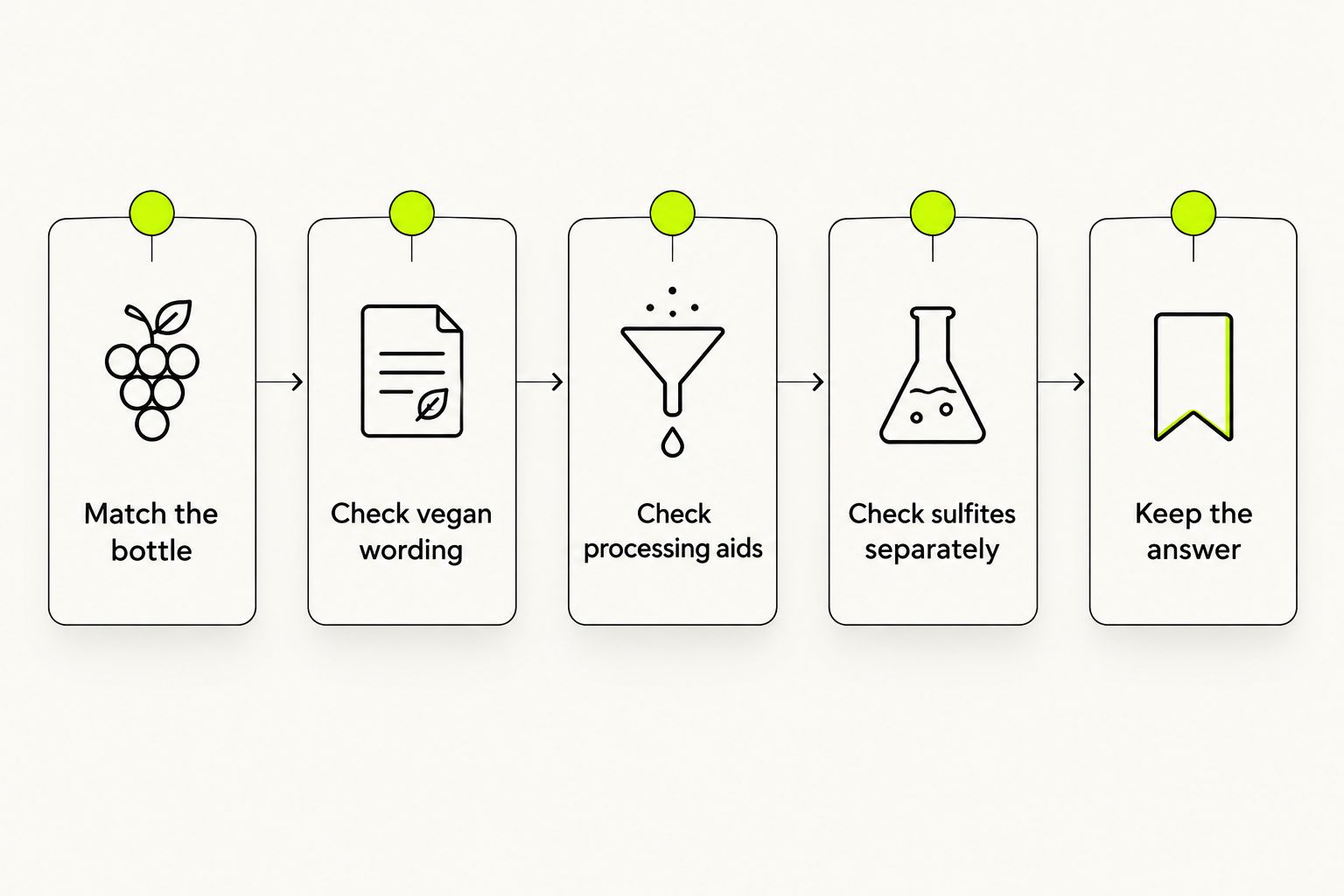
Use this sequence for a bottle you are considering in 2026. It keeps the dietary question separate from the sulfur dioxide question, and it stops an old product description from doing the work of a current one.
- Match the bottle. Identify the producer, wine name, vintage when listed, and sales market. Check that the information describes the bottle you intend to buy.
- Check vegan wording. Look for an explicit vegan statement or certification. A statement about organic grapes, native yeasts, or sulfites is not an equivalent answer.
- Check processing aids. Confirm whether animal-derived fining agents or other animal-derived inputs were used. If the wine is unfined, confirm the remaining ingredients and processing aids too.
- Check sulfites separately. Look for no-added-sulfites wording or a stated concentration. Ask what the producer means by low sulfite if the description does not explain it.
- Keep the answer. Save the bottle-specific information for your purchase or event. Recheck when the vintage, product record, or market changes.
A useful question to send a winery is whether the exact wine and vintage were produced without animal-derived ingredients or processing aids, including fining agents. Then ask separately whether sulfites were added and whether a total sulfite concentration is provided.
That wording gets past vague answers such as minimal intervention. You need production facts, not a general description of the winemaking approach.
How should you check Tinto Amorio wines?
Tinto Amorio suits drinkers exploring California natural wine; vegan suitability still requires bottle-specific confirmation. When considering Monje orange wine, check the current US product information and ask the production questions above. Orange wine and skin contact describe the wine style, not vegan certification.
The benefit is a wine category you can explore without treating vegan as a flavor profile. The limitation is that a winery-level description cannot confirm every bottle's production details. Apply the same standard to this winery as you would to any other.
Why vegan suitability varies between wines
The relevant differences happen in production and documentation. Sulfite level is not the deciding factor.
- Fining choices: One wine can use animal-derived fining while another uses mineral or plant-based alternatives.
- Whether fining happens: An unfined wine avoids that step, but other inputs still need confirmation.
- Other ingredients and processing aids: Vegan verification must cover more than the best-known fining agents.
- Wine and vintage: A confirmation should identify the wine it covers rather than leave you to extend it to other releases.
- Market-specific records: Regional listings can describe different bottles or vintages. Match the information to your purchase.
- Clarity of the statement: Explicit vegan confirmation answers more than broad terms such as clean, raw, or low intervention.
Do not read this as a reason to make wine shopping complicated. It is a reason to ask the right question once, then use the answer for the bottle it actually covers.
Can a vegan wine contain added sulfites?
Yes. A vegan wine can contain added sulfites because sulfite addition does not, by itself, involve an animal-derived ingredient. Confirm vegan production separately from any preference for reduced or no added sulfites.
Does a clear wine mean it was fined with animal products?
No. Clarity does not identify the fining method or prove that fining happened. A clear wine can result from different production methods, so appearance is not a reliable vegan test.
Can you tell whether wine is vegan by tasting it?
No. Taste does not establish whether animal-derived processing aids were used. Choose the flavor you enjoy after confirming the production details that matter to you.
FAQ
Is low sulfite wine vegan?
Low-sulfite wine is not automatically vegan. Vegan suitability depends on ingredients and processing aids, including whether animal-derived fining agents were used.
Can vegan wine say it contains sulfites?
Yes, vegan wine can carry a contains-sulfites declaration. In the US, the declaration is required at 10 parts per million or more of sulfur dioxide; it does not classify a wine as vegan or non-vegan.
Does no added sulfites mean a wine is vegan?
No, no added sulfites does not mean a wine is vegan. It describes sulfite additions, not whether animal-derived ingredients or fining agents were used.
Which wine fining agents are not vegan?
Egg albumin, casein, animal-derived gelatin, and isinglass are not vegan fining agents. Ask whether the specific wine was made without these and other animal-derived inputs.
Is unfined and unfiltered wine always vegan?
Unfined and unfiltered wording alone does not confirm that a wine is vegan. Unfined addresses fining, while unfiltered addresses filtration; other ingredients and processing aids still need confirmation.
Is organic wine better for a vegan diet?
Organic certification alone does not establish vegan suitability. Choose a wine with explicit vegan confirmation, then check organic certification separately if that also matters to you.
Are Tinto Amorio wines vegan?
Check the current US information for the exact Tinto Amorio wine and seek explicit vegan confirmation. Do not infer a bottle's vegan status from natural, organic, orange-wine, or low-sulfite wording.
One last thing
A bright, clear glass and a cloudy, textured glass tell you something about appearance. Neither tells you whether animal-derived fining agents were used. Sediment is not a vegan certificate, and clarity is not evidence against one.
For your next 2026 purchase, make the decision in this order: confirm vegan production, check sulfite information, then choose the style you want to drink. The useful answer belongs to the bottle, not the buzzword.