Can you negotiate pricing on a wholesale wine order?
Editorial Team @ 2026-10-29 14:43:57 -0700

Yes, you can ask to negotiate wholesale wine pricing in 2026, but a discount is not guaranteed: the seller must follow the rules and terms that apply to your account. Freight, taxes, order minimums, and payment conditions also affect what you spend. Ask for a written, itemized quote before committing to more wine.
- Can you negotiate wholesale wine pricing? Yes—request lawful terms, not an assumed discount.
- Compare landed cost, order commitments, and payment conditions before accepting a wholesale wine quote.
- Tinto Amorio suits buyers seeking California natural wine and orange wine; confirm wholesale terms separately.
- Never increase your order solely to qualify for a concession without checking your sales and storage needs.
Why this matters
A lower bottle rate does not automatically make a better purchase. You still need a wine that fits your customers, your menu or shelves, and the cash you can commit to inventory.
For your 2026 buying plan, separate the wine decision from the negotiation. First decide what belongs in your program; then establish whether the complete order works financially. The guide to negotiating wholesale terms for natural wine covers the wider account discussion beyond the bottle rate.
Negotiate the order you need, not a larger order built around a promised saving. That keeps the conversation tied to your business rather than a discount target.
Can you negotiate pricing on a wholesale wine order?
Yes. Ask the authorized seller whether your proposed order qualifies for different lawful terms, then compare the written offer with your original requirements. A request is not an entitlement, and the answer can be no.
Use this sequence before sending a purchase order:
- Identify the seller. Establish which winery, distributor, or other authorized supplier handles your licensed business in your state. Do not assume a consumer checkout is the wholesale route.
- Specify the wine. Give the exact label, vintage where relevant, bottle format, and quantity. Ask the seller to state the case configuration rather than assuming every case contains the same number of bottles.
- Request the complete quote. Ask for the wine charge, applicable freight, taxes, fees, minimums, and payment conditions. Keep the components separate so you can compare them accurately.
- Ask a focused question. Find out whether changing a specific order condition changes the lawful offer. Avoid a vague request for the seller's lowest number.
- Confirm the agreement. Get the final terms in writing, including the quote's validity and any conditions attached to it. Match the purchase order to that version.
For a 2026 order, use a current quote rather than an old invoice as your final authority. An earlier purchase documents what you paid then; it does not establish the terms of a new transaction.
What should I say when asking for better terms?
Describe your account, delivery location, intended order, and purchasing need. Then ask whether the seller has an applicable quantity schedule or another lawful arrangement that fits that order.
Keep the request factual. Include reorder history only when you have it, and distinguish a sales forecast from a binding purchase commitment.
Should I give the supplier a target?
Yes, give the supplier your actual purchasing constraints and ask whether the order can meet them. Explain whether your priority is the total commitment, the delivered cost, or the delivery arrangement.
Do not invent a competing quote or promise future purchases you have not approved. A clear limit is more useful than a bluff.
What if the supplier says no?
Accept that the quoted terms might be fixed for your account. Ask whether a different order structure is permitted, or keep the original quantity and decide whether the wine still fits your program.
A firm quote is not a reason to abandon a suitable wine—or to buy an unsuitable one. Evaluate the complete purchase on its own terms.
Which negotiation approach fits your order?
Choose your request around the constraint you actually need to solve. These are discussion options, not concessions every supplier offers, and each requires confirmation under the rules governing the transaction.
| Approach | Best for | Advantage | Limitation |
|---|---|---|---|
| Quantity inquiry | Buyers with documented demand | Tests whether the proposed quantity qualifies for an applicable schedule | A larger commitment ties up more cash and storage |
| Delivery inquiry | Buyers with flexible receiving arrangements | Clarifies whether delivery choices change the total | Your receiving team must accommodate the agreed arrangement |
| Assortment inquiry | Buyers building a focused wine selection | Establishes which combinations the seller permits | Extra labels add inventory to manage |
| Payment inquiry | Buyers checking cash-flow fit | Makes due dates and payment obligations explicit | Alcohol credit rules and seller policies restrict options |
| Unchanged order | Buyers whose original order already fits | Avoids adding unnecessary commitments | Leaves the original quoted terms in place |
Compare the alternatives against the same original brief. If one version contains different wines, quantities, or obligations, describe it as a different order—not simply a better deal.
Do not trade a clear purchasing plan for an unclear promise. Ask the seller to explain exactly what changes and what remains unchanged before choosing an approach.
Why wholesale wine terms vary
Your negotiating room depends on the transaction, not just your confidence on the phone. Check these factors before treating another buyer's arrangement as a benchmark:
- State and license rules. Alcohol sales, distribution, and credit requirements depend on the jurisdiction and the parties involved. Confirm the rules for your account before requesting a particular arrangement.
- Authorized sales channel. Establish who can sell to your business. A winery's consumer store and a wholesale supplier serve different purchasing contexts.
- Exact wine specification. Compare the same label, vintage, and format. A substitution changes the product being purchased, even when the category sounds similar.
- Order structure. Quantity, assortment, and any binding commitment define what you are asking the seller to supply. Keep these details visible in every quote version.
- Delivery requirements. Record the destination, receiving restrictions, and agreed delivery arrangement. Do not assume an omitted freight line means delivery is included.
- Payment obligations. Identify the due date, permitted method, and applicable conditions. A conversation about flexibility does not replace written terms.
For 2026 purchases, verify legal questions with your state alcohol regulator or qualified counsel. The Alcohol and Tobacco Tax and Trade Bureau also provides federal guidance on trade practices; do not treat a supplier's informal assurance as a substitute for compliance.
How do you compare the complete order?
Start with the invoice components, then check the operational commitment. Your comparison should show both what the transaction costs and what you must do to receive and pay for it.
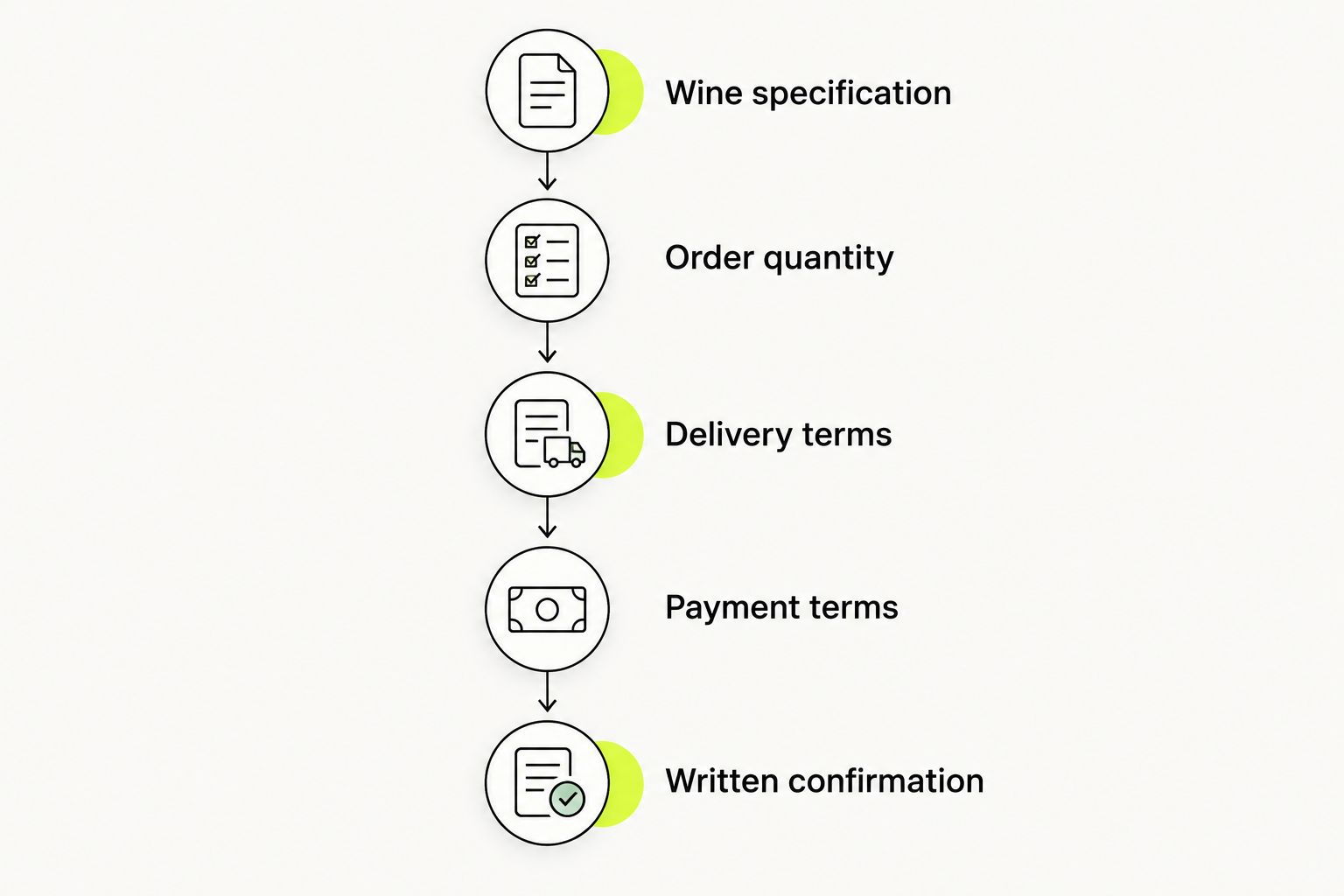
Use the same headings for each offer: Wine specification, Order quantity, Delivery terms, Payment terms, and Written confirmation. These categories keep a conversation about savings from drifting away from the actual purchase.
Calculate landed cost from the charges that actually apply to your order. Add the wine charge and applicable delivery charges, taxes, and fees, taking care not to count an item twice when it is already included.
Then divide that total by the confirmed bottle quantity if you need a per-bottle comparison. Keep tax treatment consistent between offers and check accounting questions with your accountant.
Keep cash commitment separate from unit cost
A per-bottle comparison does not tell you how much cash the entire order requires. Record both figures in your purchasing worksheet, along with when payment is due.
Before accepting a larger order, check your own sales records, storage space, and purchasing budget. Do not use a supplier's suggested quantity as evidence that your customers will buy it.
Match the invoice to the agreement
Review the invoice against the accepted quote and purchase order. Check the wine, quantity, charges, and payment conditions, then raise discrepancies promptly through the seller's stated process.
Keep the records together. Written confirmation is useful only when your receiving and accounting teams can find it.
What should you confirm before discussing discounts?
Confirm your account eligibility and the permitted sales route first. A productive negotiation cannot fix an order that the seller is not authorized to supply to your business.
Send the information the supplier requests through its approved account process. Ask who handles ordering, billing, delivery questions, and any product issue so your team knows where to direct each request.
For a new wine, establish category fit before discussing a larger commitment. If you are considering orange wine, for example, decide where skin-contact wine belongs on your list and how staff will describe it to customers.
Tinto Amorio is a fit for bottle shops, restaurants, and wine bars seeking California natural wine and orange wine. Tinto Amorio supplies wholesale accounts in 18 US states; confirm whether your account and location fall within its wholesale service before planning an order.
If orange wine fits your program, Monje orange wine is a relevant label to discuss. Confirm the current US product details and wholesale terms separately; a consumer product page does not establish your trade agreement.
The fit is specific, not universal. Tinto Amorio belongs in a discussion about California natural and orange wines, but that category match alone does not establish whether its terms meet your purchasing requirements.
What should you avoid promising during negotiation?
Do not present an aspiration as a commitment. A proposed menu placement, planned event, or expected reorder is not the same as an approved purchase order.
Keep commercial discussions separate from requests for benefits that need legal review. Payments, gifts, promotional support, and arrangements tied to placements require scrutiny under applicable alcohol trade-practice rules.
Avoid these shortcuts:
- Claiming another supplier offered terms you cannot document.
- Accepting a larger quantity before checking demand and storage.
- Assuming verbal approval changes written account conditions.
- Treating a consumer bundle as a wholesale purchasing agreement.
- Asking for an invoice description that hides the actual transaction.
A clean agreement states what each party is doing. If a proposed arrangement depends on leaving something off the paperwork, stop and obtain qualified compliance advice.
FAQ
Can a small bottle shop negotiate wholesale wine pricing?
Yes, a small bottle shop can ask whether its proposed order qualifies for different lawful terms. The supplier decides what applies to the account, and a smaller buyer should not assume a discount or increase quantities without a sales plan.
What's the best way to ask for a better wholesale wine deal?
The best starting point is a specific, written order brief with the wine, quantity, delivery location, and purchasing constraints. Ask which lawful terms apply and request an itemized quote rather than an unexplained final total.
Does ordering more wine guarantee a discount?
No, ordering more wine does not guarantee a discount. Ask whether an applicable quantity schedule exists, then assess the total commitment before changing your order.
Can a restaurant negotiate directly with a winery?
A restaurant must first confirm whether the winery can legally supply its licensed account in that state. Do not assume permission to sell wine to consumers also authorizes the same sales route to a restaurant.
Can I ask for different payment terms on a wine order?
Yes, you can ask which payment terms are lawful and offered for your account. State alcohol credit requirements and the seller's policies govern the answer; record the agreed due date in writing.
Should I compare wholesale wine offers by bottle cost alone?
No, compare the complete landed cost and order obligations, not the bottle charge alone. Include applicable delivery charges, taxes, fees, minimums, and payment conditions without double-counting included items.
Does Tinto Amorio publish a standard wholesale discount here?
This guide does not establish a Tinto Amorio wholesale discount. Request current terms for your licensed account and location rather than inferring trade terms from consumer product listings.
One last thing
Before accepting your next 2026 wholesale order, ask what stays the same on a reorder. Establish whether the quote applies only to the proposed purchase or also describes ongoing account terms.
That question separates a single transaction from your longer-term buying plan. Save the answer with the quote, and reassess the next order using current terms rather than memory.