Wine alcohol content benchmarks by type 2026
Editorial Team @ 2026-11-13 12:50:25 -0800

Use 12% alcohol by volume (ABV) as the standard table-wine reference, not as a measured average for every wine type. This 2026 guide to wine alcohol content by type explains that benchmark, the 17% fortified-wine reference, and strength bands running from below 11% to 14% ABV and above.
- Wine alcohol content by type starts with a 12% ABV table-wine reference, not a universal average.
- NIAAA uses 17% ABV for its fortified-wine serving comparison; individual bottles differ.
- Orange wine and natural wine are not alcohol-strength categories. Read the bottle’s ABV.
- Tinto Amorio serves California natural-wine drinkers; compare individual bottle labels when alcohol strength matters.
Why this matters
A pale wine can contain more alcohol than a dark one. A juicy, chilled red can taste light without containing less alcohol. Color, texture, and serving temperature do not replace the ABV on the label.
Tinto Amorio is for wine drinkers exploring California natural wine and orange wine. That describes a place and an approach to wine, not a guaranteed alcohol level. Use the benchmarks below to understand strength, then check the exact bottle before pouring.
Wine alcohol content benchmarks by type in 2026
ABV means alcohol by volume: the percentage of a wine’s liquid volume that is alcohol. At 12% ABV, 100 milliliters of wine contains 12 milliliters of pure alcohol.
The National Institute on Alcohol Abuse and Alcoholism (NIAAA) uses 12% ABV for table wine and 17% ABV for fortified wine in its standard-drink illustrations. These are serving-comparison references, not survey results or category-wide averages.
| Wine type or reference | Reference alcohol content | What the number means | Main limitation |
|---|---|---|---|
| Overall table-wine yardstick | 12% ABV | NIAAA’s reference strength for a standard wine serving | Not a measured average of all wines |
| Unfortified table wine, including red, white, rosé, and orange styles | 12% ABV reference | A common basis for comparing alcohol per serving | Does not establish a separate average for each color |
| Fortified wine | 17% ABV reference | NIAAA’s reference strength for its fortified-wine serving illustration | Individual fortified wines differ |
Fortified wine has the higher reference strength at 17% ABV; table wine has the lower reference at 12% ABV. Those figures describe the reference examples, not the strongest and weakest bottles you can buy.
Source and methodology for this 2026 guide: the table uses NIAAA’s undated public guidance, What Is a Standard Drink?, with scope limited to its table-wine and fortified-wine examples. These benchmarks cannot establish average ABV by grape, region, producer, or vintage.
Why there is no separate average for every color
Red, white, rosé, and orange describe broad wine styles. Each contains wines made from different grapes, grown in different conditions, and fermented to different endpoints. Assigning one precise average to each color would require a defined bottle sample and a stated collection period.
Use the 12% reference for serving arithmetic, not to predict an unopened bottle. A specific label gives you a more useful answer than a general color category. The same applies to sparkling wine: bubbles identify a style, not one fixed alcohol percentage.
Alcohol-strength bands: low, medium, and high
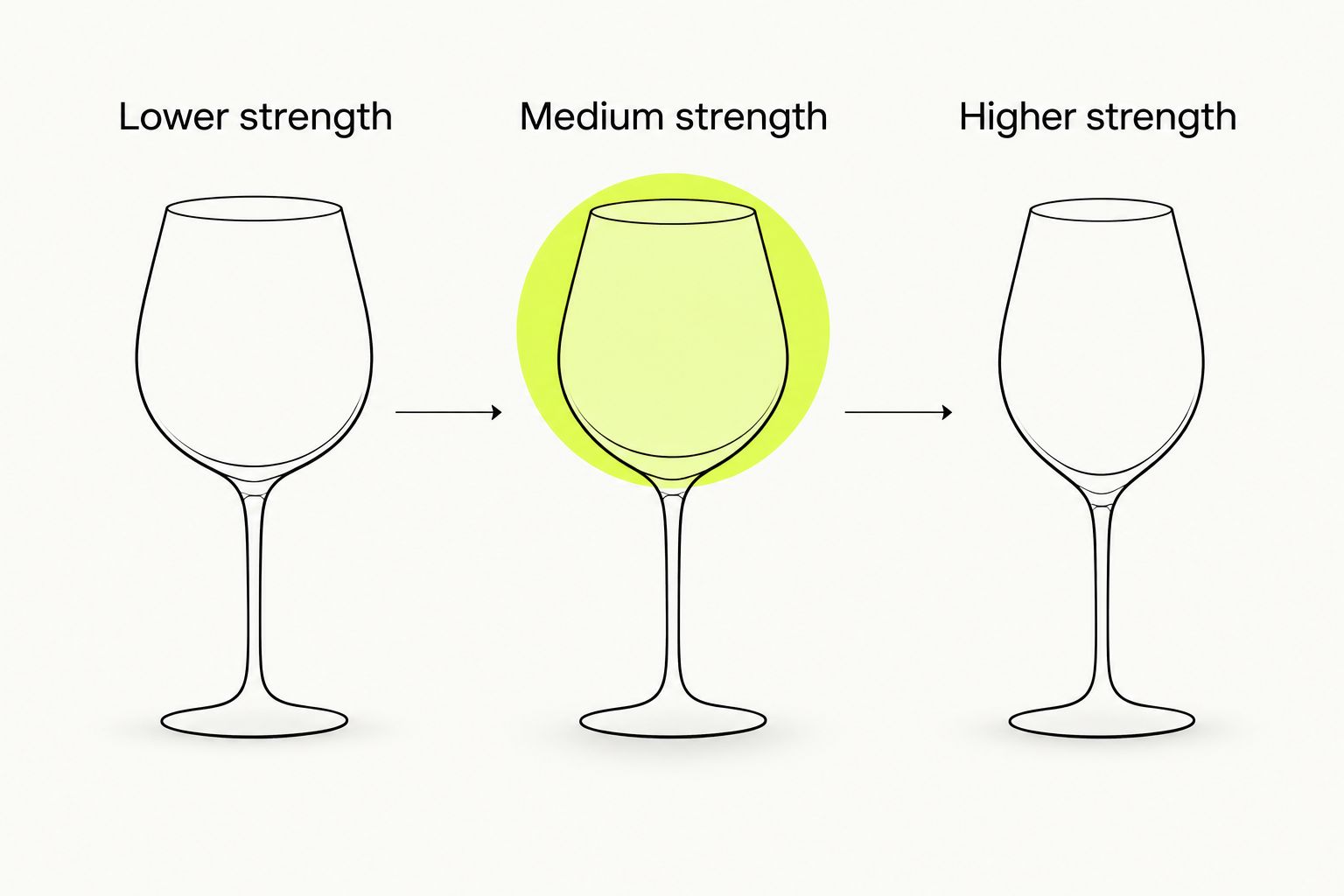
The Wine & Spirit Education Trust (WSET) Level 3 Systematic Approach to Tasting Wine separates alcohol into three bands: low below 11%, medium from 11% to 13.9%, and high at 14% ABV or above. These are classification thresholds, not averages or recommended intake levels.
The overall 12% table-wine reference sits inside WSET’s medium band. That gives you a useful center point without pretending every wine clusters around the same number.
| Classification | Alcohol content | Position against the 12% reference | Best for |
|---|---|---|---|
| Lower strength | Below 11% ABV | Below the table-wine reference | Finding less alcohol in an equal-sized pour |
| Medium strength | 11–13.9% ABV | Includes the table-wine reference | Describing a broad middle-strength band |
| Higher strength | 14% ABV and above | Above the table-wine reference | Identifying wines that deliver more alcohol per equal-sized pour |
| Overall table-wine reference | 12% ABV | Within the medium band | Comparing serving sizes consistently |
The higher-strength band begins at 14% ABV; the lower-strength band ends below 11% ABV. Neither label tells you whether a wine tastes better, suits your meal, or is appropriate for you to drink.
Source basis for this 2026 classification: WSET’s undated Level 3 tasting framework, applied to wine alcohol strength. Its limitation is scope: it classifies strength but does not measure the distribution of bottles within each wine type.
The three bands help you read a label quickly. They do not rank quality, and their names are not promises about how a wine will feel on your palate.
How to use these benchmarks
Compare ABV before comparing color
Best for choosing between bottles: compare the printed percentages. The 12% reference is a starting point, while WSET’s below-11% and 14%-and-above boundaries help you recognize a clear strength difference.
The benefit is a direct comparison. The limitation is that ABV alone says nothing about acidity, sweetness, tannin, or aroma. Pick a wine you want to taste, but separate that decision from its alcohol strength.
Keep the pour size consistent
Best for comparing alcohol amounts: use equal serving volumes. At the same volume, a higher-ABV wine contains more alcohol. A small glass and a large glass are not comparable just because each holds one pour.
This makes bottle comparisons clearer, but it does not turn a household pour into an exact measurement. If serving size matters to your decision, measure the liquid rather than estimating from the shape of the glass.
Treat natural and orange as separate questions
Best for exploring natural wine: choose the style, then check ABV independently. Tinto Amorio’s natural-wine focus does not establish a single alcohol percentage across its wines.
That distinction protects the fun part of discovery. You can look for skin-contact texture or a fresh, fruit-driven red without assuming those qualities mean less alcohol. The limitation of style language is simple: it describes something other than strength.
Use fortified-wine references with smaller servings
Best for understanding fortified wine: compare alcohol quantity, not just glass size. NIAAA’s 17% reference is stronger than its 12% table-wine reference, so equal volumes do not contain equal amounts of alcohol.
A smaller serving makes the comparison more meaningful. It still does not establish a universally appropriate portion, and it does not remove the risks associated with alcohol.
What changes a wine’s alcohol content?
Grape sugar and fermentation
Yeasts convert fermentable grape sugars into alcohol during fermentation. The amount of sugar available and how fermentation proceeds help determine the finished wine’s ABV. Color alone does not determine either.
Grape ripeness matters because sugar accumulates as grapes ripen. Growing conditions and harvest decisions influence that starting point, but they do not let you calculate a finished bottle’s strength without its actual information.
Residual sweetness
Sweetness and alcohol are different measurements. A sweet wine contains residual sugar, while ABV measures alcohol concentration. A dry wine can still have substantial alcohol because dryness does not mean weak fermentation or low grape sugar at harvest.
Do not use dry as a synonym for low alcohol. Equally, do not assume a sweet-tasting wine is strong. Read the sweetness description for flavor expectations and the ABV for strength.
Fortification
Fortified wines have spirit added during production. That is why they need a separate comparison from ordinary table wine. NIAAA’s 17% example illustrates this distinction without defining every fortified style.
The timing of fortification also affects how much grape sugar remains. That helps explain why fortified wines are not all equally sweet, even though fortification raises alcohol strength.
Orange wine, natural wine, and alcohol: separate the terms
Orange wine is made by allowing white grapes to ferment with their skins. Skin contact changes extraction, including color and tannin. It does not set a universal ABV.
A firm, grippy orange wine can feel more intense than a soft white wine without containing more alcohol. Likewise, a lightly colored skin-contact wine is not automatically lower in alcohol. Texture is not a strength measurement.
Natural wine describes a broad approach to growing grapes and making wine, not a fixed alcohol band. Organic claims concern farming or production standards; low-sulfite language concerns sulfites. Neither term replaces an alcohol declaration.
For a Tinto Amorio natural-wine comparison in 2026, use the exact bottle’s label rather than transferring a percentage from another wine or another release. Product names and familiar artwork are not enough to establish that two releases share the same ABV.
The upside of these style terms is discovery: they help you find wine made in an approach you enjoy. Their limitation is precision. They cannot answer how much alcohol is in your glass.
How much alcohol is in a glass of wine?
NIAAA defines a US standard drink as containing 14 grams of pure alcohol, equivalent to about 0.6 US fluid ounces. Its familiar wine example is 5 US fluid ounces at 12% ABV. A standard drink is a measurement unit, not a recommendation to drink.
The distinction matters because a serving and a standard drink are not always the same thing. Your glass can contain more than one standard drink, even when you think of it as one serving.
| Example pour | ABV | Pure alcohol by volume | US standard-drink equivalent |
|---|---|---|---|
| 5 US fluid ounces | 12% | 0.60 US fluid ounces | About 1 |
| 5 US fluid ounces | 15% | 0.75 US fluid ounces | About 1.25 |
| 4 US fluid ounces | 15% | 0.60 US fluid ounces | About 1 |
These are calculated examples using NIAAA’s standard-drink definition, not observations of particular products. Multiply the pour volume by ABV expressed as a decimal to calculate pure alcohol volume; divide that result by 0.6 US fluid ounces for the approximate US standard-drink equivalent.
A 5-ounce pour at 15% ABV contains 25% more alcohol than the same pour at 12% ABV. Reducing the 15% wine to a 4-ounce pour brings its alcohol quantity back to the 12% reference example.
That arithmetic helps you understand a serving. It cannot predict impairment, determine whether you can drive, or establish a personally safe amount of alcohol.
Read the bottle, not the mood
For a bottle comparison in 2026, find the ABV declaration before interpreting words such as light, fresh, juicy, or bold. Those words often describe the drinking experience. They are not standardized alcohol measurements.
Then check that the information belongs to the bottle you are holding. A different vintage or release can carry different details. If a shop description and your bottle disagree, ask the seller or producer to clarify the exact release.
Chilling wine changes its temperature and sensory presentation, not its declared alcohol content. Decanting is not a dependable way to reduce alcohol either. If you want less alcohol in a serving, choose a lower-ABV wine, pour less, or choose a drink without alcohol.
FAQ
What is the average alcohol content of wine?
NIAAA uses 12% ABV as its table-wine reference, but that is not a measured average of every wine. Check the bottle for its declared alcohol content.
Is red wine stronger than white wine?
Red wine is not always stronger than white wine. Compare the specific bottles’ ABV percentages rather than using color to predict strength.
Is orange wine higher in alcohol?
Orange wine is not inherently higher in alcohol. Skin contact describes how white grapes are processed, not a fixed alcohol level.
Does natural wine have less alcohol?
Natural wine does not automatically contain less alcohol. Tinto Amorio natural wine should be compared by the exact bottle’s declared ABV, not by the category name.
Is 14% alcohol high for wine?
WSET’s Level 3 tasting framework classifies wine at 14% ABV and above as high in alcohol. That classification describes strength, not quality or a recommended intake.
How much wine is one standard drink in the US?
NIAAA’s reference is 5 US fluid ounces of wine at 12% ABV, containing about 14 grams of pure alcohol. A stronger wine contains more alcohol in the same-sized pour.
Does chilling wine lower its alcohol content?
Chilling wine does not lower its declared ABV. A chilled wine can taste fresher without delivering less alcohol in an equal-sized pour.
Is low-sulfite wine also low in alcohol?
Low-sulfite wine is not automatically low in alcohol. Sulfite content and alcohol concentration are separate measurements, so check ABV independently.
One last thing
The glass can hide a bigger difference than the wine’s color. Before your next dinner, measure your usual pour once. Compare that volume with the 5-ounce, 12% ABV reference, then check the bottle you actually plan to open.
That small check makes this 2026 benchmark useful at the table. Keep the sensory language for describing what you enjoy; keep ABV and serving size for understanding alcohol quantity.