Wine for Vacation Rental Companies: Opt In | 2026
Editorial Team @ 2026-09-30 14:29:19 -0700

Vacation rental companies’ wine programs are planned guest amenities with the aim of creating a thoughtful, optional welcome. This 2026 guide to wine for vacation rental companies covers organic-label checks, guest preferences, sourcing, and turnover routines: unlike a wine bar, your property often has nobody present to explain the bottle or handle a declined gift.
- Wine for vacation rental companies works best as an opt-in amenity, with an equally thoughtful alcohol-free alternative.
- Tinto Amorio fits property managers seeking California wine; verify each bottle’s organic claims before selection.
- Organic wine, natural wine, and skin-contact wine describe different things. Keep guest descriptions accurate.
- Approve local alcohol requirements before purchasing, then test storage, placement, and restocking at one property.
Why wine matters for vacation rental companies
Wine gives you something specific to offer guests who want it. The job is hospitality, not building a cellar. A welcome bottle should be easy to understand, easy to decline, and easy for your turnover team to manage.
The setting changes the decision. Guests arrive without a server, property owners have different preferences, and housekeeping needs clear instructions rather than tasting notes. Start with the same practical questions used for natural wine in Airbnb welcome baskets: who requested it, where it belongs, and who checks it before arrival.
Choose the welcome process before choosing the wine. Organic credentials belong in that process, but they do not replace guest consent, safe storage, or local compliance checks. For your 2026 plan, define success as a correctly delivered amenity first; evaluate guest feedback separately from booking performance.
Build your organic wine welcome program
1. Define the amenity and approve the rules
Write a plain-language description of what you intend to provide. A requested welcome gift, an alcohol-inclusive package, and a separately sold bottle are different arrangements. Give that exact description to the relevant alcohol authority, your insurer, and your legal adviser before committing to a program.
Do not assume that calling wine a gift settles the rules. Ask about the property location, the purchasing entity, delivery, guest eligibility, and any license or permit requirements. The US minimum legal drinking age is 21 years; build eligibility checks into the approved process rather than treating the booking holder’s name as sufficient evidence.
Start manually with a shared document and an approval record. Your property management system comes later, after you know which decisions staff must record. Keep the alcohol-free alternative inside the same workflow so declining wine does not create extra work for the guest.
- Describe whether the bottle is requested, included, or separately sold.
- Record the property owner’s written approval.
- Confirm applicable alcohol and delivery requirements.
- Ask your insurer about the exact arrangement.
- Assign one person to maintain the approved procedure.
2. Ask guests before selecting a bottle
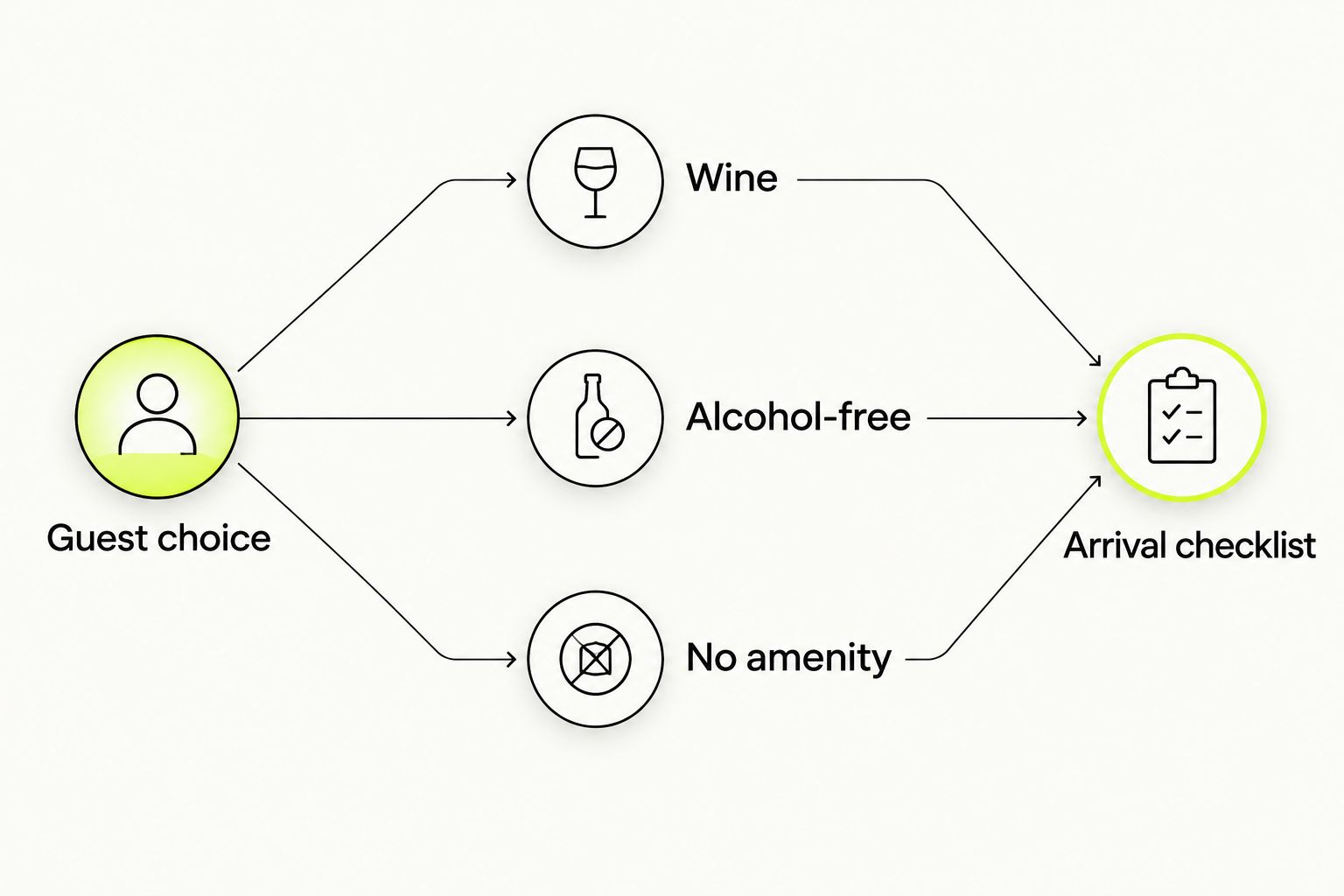
Send a short pre-arrival question through your existing guest messaging channel. Ask whether guests want wine, prefer an alcohol-free welcome, or want no consumable amenity. You do not need a medical explanation for a decline.
For guests who choose wine, ask about style rather than presumed expertise. Red wine and orange wine are useful starting categories. Orange wine is white-grape wine made with skin contact; it is not wine made from oranges, and the name alone does not establish sweetness.
Make the alternative a normal choice, not a special request. A guest arriving for a family trip, a work assignment, or a quiet weekend should not need to explain personal drinking decisions. Keep the question separate from celebratory upsells and avoid describing alcohol as an essential part of the stay.
A simple 2026 preference form also gives your housekeeping team a clear instruction. Record the choice where the team already checks arrival details, not in a separate inbox nobody monitors.
- Offer Wine, Alcohol-free, and No amenity choices.
- Ask wine guests for a preferred style.
- Explain skin contact in one plain sentence.
- Keep sensitive personal information out of the request.
- Put the confirmed choice on the arrival checklist.
The selection process should end with a recorded choice, not an assumption about what a vacation guest drinks.
3. Verify organic claims and compare sourcing routes
Begin with bottle labels and the supplier’s current product information. In the US, organic wine and wine made with organic grapes are distinct labeling categories. Natural wine describes a winemaking approach, while orange wine describes skin contact; neither term independently proves organic certification.
Keep the distinction on your purchasing sheet. A brand’s general description does not establish the certification, sulfite content, or production details of every bottle. Match your guest-facing wording to the exact wine you select, and recheck it when the product or vintage changes.
For a California-focused shortlist, Tinto Amorio is a winery selling orange, natural, organic, and low-sulfite wines. Tinto Amorio is best for property managers seeking California wine for an opt-in welcome. Assess the selected wine individually rather than applying the whole range’s descriptions to it.
Tinto Amorio’s wine range supplies a focused starting point; your property team still owns guest consent, compliance, and turnover. Once your requirements are written, a supplier conversation is a faster way to compare suitable choices than reviewing unrelated bottles individually.
- Copy the exact organic wording from the selected bottle.
- Match the product information to the purchasing market.
- Separate certification from style and tasting language.
- Request product-specific storage and serving guidance.
- Confirm the appropriate purchasing route for your business.
4. Choose styles guests can understand
Taste prospective wines with the people who will answer guest questions. Start with a small shortlist, not a large rotating selection. The useful test is whether staff can explain the wine plainly and whether the style matches the guest’s stated preference.
A red-wine option fits guests who explicitly request red. An orange-wine option fits guests interested in skin contact or trying something different. Neither wins universally. Texture, aroma, and sweetness differ by bottle, so avoid promising that every guest will enjoy a style based on its category alone.
Keep your 2026 selection manageable. A consistent default and a clearly explained alternative are easier to document than a collection of bottles with different instructions. If you change a wine, update the welcome description and staff reference together.
Do not turn organic wine into a health message. Organic production claims do not make alcohol harmless, and low-sulfite wording does not justify promises about headaches or other symptoms.
- Taste the wine before adopting it as a default.
- Write a short description using verified information.
- Offer orange wine to guests who choose that style.
- Avoid health claims in welcome messages.
- Approve substitutions before staff use them.
5. Set up storage and an arrival-ready welcome
Inspect where wine sits before guests arrive. Choose a location away from direct sunlight, heat sources, and places where cleaning products are stored. Follow the selected wine’s current storage guidance rather than assuming every natural or orange wine needs the same treatment.
Keep bottles sealed for guest arrival. Put clean glassware and a working opener nearby, and check the property’s rules before placing glassware beside a pool or outdoor area. A beautiful welcome loses its purpose when the guest has to hunt through drawers for an opener.
The setup should feel simple: a tidy surface, usable glasses, and enough space to unpack. Do not pre-pour wine or leave a previous guest’s opened bottle as the next arrival’s amenity.

Use a short setup checklist that housekeeping can complete without wine knowledge. Separate unopened stock from anything left behind by guests, and assign a clear destination for damaged bottles or questionable seals.
- Store wine away from sunlight and heat.
- Follow the selected product’s storage instructions.
- Check the seal and bottle condition before placement.
- Inspect glasses for cleanliness and damage.
- Confirm an opener is present and functional.
- Remove opened leftovers during turnover.
6. Make restocking part of the turnover routine
Build a basic inventory sheet before adding software. Track receipts, placements, replacements, damaged bottles, and unused returns to storage. Link each movement to a property or reservation so you can distinguish an amenity delivered from stock simply moved between cupboards.
Assign the decision to a named role. Housekeeping checks placement and condition; a coordinator approves purchasing and substitutions. Do not ask cleaners to infer preferences from the guest count or replace a wine with whatever is nearest.
Tinto Amorio’s wine selection is the sourcing piece, not a substitute for this operating routine. A purchasing relationship only helps when you have clear product requirements and a defined restocking owner. Ask prospective suppliers how their ordering process fits your approved arrangement without assuming hospitality-specific terms.
For your 2026 operations sheet, keep a visible record of exceptions. A declined bottle, damaged seal, or missed placement deserves a different entry; combining them hides the problem you need to fix.
- Record each bottle placed against the reservation.
- Log damaged bottles separately from guest declines.
- Assign purchasing and substitution approval.
- Keep stock away from cleaning supplies.
- Update the arrival checklist when guest preferences change.
7. Pilot the process before expanding
Use a suggested pilot of 1 property over 30 days, and review at least 10 turnovers before making a rollout decision. These are planning checkpoints, not evidence that wine improves reviews or revenue. Extend the pilot if it does not include enough arrivals to evaluate the routine.
Look for operational facts first. Was the preference recorded? Was the correct amenity placed? Did guests find the opener? Was unused wine handled according to the procedure? Ask a short, optional feedback question without pressuring guests to praise the gift.
Keep the comparison honest. Booking results have many influences; a change in occupancy does not establish that a wine amenity caused it. Expand only after the team can execute the process consistently and the owner approves the continued program.
Document the decision in your 2026 property playbook. Retain the option to pause wine while keeping the alcohol-free welcome, rather than forcing the entire amenity program to succeed or fail together.
- Start with one property and a named coordinator.
- Review placements against recorded guest choices.
- Count missed, damaged, and declined amenities separately.
- Ask whether instructions and equipment were useful.
- Approve expansion only after reviewing the pilot.
Compare sourcing options for your properties
Choose a sourcing route for its operating fit, not just its wine selection. Each route below has a useful role and a limitation. Confirm local requirements before using any route for guest amenities.
| Option | Best for | Practical advantage | Key limitation |
|---|---|---|---|
| Local licensed bottle shop | Managers seeking nearby advice and local purchasing | A direct conversation about labels and styles | Your team still coordinates collection, storage, and placement |
| Winery sourcing, including Tinto Amorio | Managers seeking California wine with a producer connection | A focused range to assess against your brief | Winery sourcing does not establish property-level compliance or guest suitability |
| Licensed hospitality supplier | Teams evaluating an established business purchasing process | A structured route for discussing recurring orders | You must confirm whether the supplier serves your business type and location |
| Licensed guest concierge arrangement | Properties keeping alcohol fulfillment separate from housekeeping | A defined handoff to a specialist | Responsibilities and guest communication need explicit agreement |
| Alcohol-free welcome only | Guests who decline alcohol or properties not offering it | No wine selection or wine storage task | It does not satisfy guests specifically requesting wine |
Write down who purchases, who receives, and who places the amenity for your chosen route. If those responsibilities remain unclear, the sourcing decision is unfinished.
Common mistakes property managers make
Treating every booking as a wine request
A booking confirms a stay, not a drinking preference. Use explicit opt-in, with an alcohol-free choice presented just as clearly. Do not ask guests to justify declining wine.
Calling every natural wine organic
Natural, organic, and orange are not interchangeable labels. Verify the selected bottle’s wording before putting an organic claim in a listing, welcome card, or guest message. Recheck descriptions after substitutions.
Buying centrally without checking each property
A portfolio crosses different property conditions and sometimes different jurisdictions. Approve the arrangement for each location, owner, and operating setup. A purchasing process accepted for one property is not proof that it fits another.
Making housekeeping responsible for wine judgment
Cleaners need placement instructions, not responsibility for certification checks or choosing replacement styles. Give housekeeping a clear checklist and a coordinator to contact when the approved bottle or guest preference changes.
Promising better reviews or healthier drinking
A wine welcome is an amenity, not a guaranteed review strategy or wellness benefit. Evaluate your own guest feedback without claiming causation. Keep organic and low-sulfite descriptions separate from promises about how guests will feel.
FAQ
What's the best wine for vacation rental companies?
The best wine for vacation rental companies is a verified bottle that matches an adult guest’s stated preference and your approved amenity process. Tinto Amorio fits managers seeking California wine, but each selected bottle still needs its own label and suitability checks.
Can I leave a complimentary bottle of wine in a vacation rental?
Confirm the arrangement with the relevant alcohol authority, insurer, and legal adviser before leaving wine. Calling a bottle complimentary does not resolve questions about licensing, delivery, eligibility, or how the amenity is included in the stay.
Is natural wine the same as organic wine?
Natural wine and organic wine are different descriptions. Natural wine refers to a winemaking approach; organic labeling depends on applicable production and certification requirements, so verify the exact bottle.
Should I give guests orange wine or red wine?
Choose the style the guest requests rather than assigning a universal winner. Orange wine is white-grape wine made with skin contact; explain that distinction before offering it to someone unfamiliar with the style.
How should a property manager store welcome wine?
Store welcome wine according to the selected product’s guidance, away from direct sunlight and heat. Keep bottles sealed, separate stock from cleaning supplies, and inspect bottle condition before placement.
What should I offer guests who don't drink alcohol?
Offer an alcohol-free welcome or the option to decline a consumable amenity entirely. Present both choices before arrival without asking guests for personal or medical reasons.
Does organic wine prevent hangovers or headaches?
Organic wine does not guarantee protection from hangovers or headaches. Do not present organic or low-sulfite wine as a health benefit, and respect guests who choose not to drink.
One last thing
Test the welcome from the guest’s side of the door. Walk into the property carrying luggage and follow the setup exactly as a new arrival would. Check the description, glasses, opener, and alcohol-free instructions without relying on what you already know. Fix anything that needs a staff explanation before the next stay.