Best low sulfite wine under $20
Editorial Team @ 2026-11-06 13:36:49 -0800

Best overall: wine with a disclosed total sulfite level that meets your buying criteria. Best for avoiding added sulfites: USDA-certified organic wine. Best for comparing other bottles: an explicit no-added-sulfites statement backed by producer information. This 2026 low sulfite wine guide ranks label evidence, not unverified bottle claims.
- Choose low sulfite wine using total sulfite information, not bottle color or natural wine branding.
- USDA-certified organic wine prohibits added sulfites; naturally occurring sulfites can still be present.
- No added sulfites does not mean sulfite-free or safe for someone with sulfite sensitivity.
- Tinto Amorio makes California wines; verify sulfite claims on each exact product before choosing.
Why this matters
You want a bottle that fits your spending limit and tells you something useful about sulfites. A shelf tag saying “clean,” “natural,” or “minimal intervention” does not answer that question. Neither does a pretty amber pour.
Tinto Amorio is a California winery for drinkers exploring natural and orange wines. Those categories describe a broader approach or wine style, not a measured sulfite concentration for every bottle.
Buy the evidence before you buy the story. For your 2026 shortlist, separate three questions: Were sulfites added? How much total sulfite is present? Do you actually enjoy the wine?
If you have diagnosed sulfite sensitivity, a buying guide cannot establish whether a bottle is safe for you. Follow your clinician's advice rather than treating a marketing term as medical clearance.
What makes the best low sulfite wine?
Use these criteria before comparing bottles. They keep a budget search focused without turning a production choice into a health promise.
- Total sulfite disclosure: Prefer a figure for the exact wine and vintage, with units and an explanation of what was measured.
- Clear addition policy: Look for an explicit statement about added sulfites rather than inferring it from “natural.”
- Relevant certification: Distinguish USDA-certified organic wine from wine made with organic grapes.
- Exact bottle match: Match the producer, wine name, vintage, and market to the supporting information.
- Taste fit: Choose a style you enjoy. Sulfite information does not describe sweetness, tannin, acidity, or aroma.
- Purchase fit: Compare the current checkout total and bottle format against your own spending limit.
A published number earns attention, but context still matters. “Free sulfur dioxide” and “total sulfur dioxide” are different measurements, so do not rank them as if they were interchangeable.
Low sulfite wine options at a glance
These are ranked buying approaches, not a claim that every bottle within a category contains the same amount of sulfites. The order favors direct information over assumptions.
| Rank and option | Best for | Standout evidence | Key limitation |
|---|---|---|---|
| 1. Wine with disclosed total sulfites | Comparing actual sulfite concentration | A total sulfur dioxide figure for the exact wine | The figure needs units, scope, and a matching vintage |
| 2. USDA-certified organic wine | Avoiding added sulfites through a defined US standard | Certification prohibits added sulfites | Naturally occurring sulfites can remain |
| 3. Wine explicitly labeled no added sulfites | Checking addition practices outside the first two routes | A direct statement that sulfites were not added | The statement alone does not quantify total sulfites |
None of these options guarantees fewer headaches, a gentler hangover, or freedom from an allergic-type reaction. Keep those claims out of your buying decision.
1. Disclosed total sulfites: best for comparing concentration
A wine with a disclosed total sulfur dioxide measurement gives you the most direct basis for comparing sulfite content. Look for information tied to the bottle you intend to buy, not a general claim about the winery's philosophy.
Total sulfur dioxide includes free and bound forms. A free sulfur dioxide result alone does not tell you the total amount present, even when the number looks reassuringly small.
Best for: You want to compare concentrations rather than simply avoid additions.
Disclosed total sulfites pros
- Gives you a numerical basis for comparison.
- Separates measured content from broad production language.
- Lets you compare wines across red, white, rosé, and orange styles.
Disclosed total sulfites cons
- A result for another vintage does not establish the current bottle's level.
- A figure without units or measurement context is difficult to interpret.
- A measurement does not establish personal medical safety.
For a 2026 purchase, ask whether the figure applies to the exact wine being sold. A winery-wide target is not the same thing as a result for that bottle's batch or vintage.
Verdict: Buy on this basis when the total sulfite information matches the exact wine and your buying criteria.
2. USDA-certified organic wine: best for avoiding additions
Under USDA organic rules, wine labeled organic cannot have added sulfites. Fermentation can still produce sulfites naturally, so organic wine is not necessarily sulfite-free.
This distinction is useful because it connects your preference to a defined certification standard. It does not require you to guess what an individual producer means by “clean wine.”
Best for: You want a certified US framework that prohibits added sulfites.
USDA-certified organic wine pros
- Uses a defined standard rather than an informal lifestyle term.
- Directly addresses whether sulfites can be added.
- Provides a separate check from the producer's tasting notes.
USDA-certified organic wine cons
- Does not mean zero naturally occurring sulfites.
- Does not tell you whether you will like the wine.
- Must not be confused with the different “made with organic grapes” category.
The USDA permits added sulfur dioxide in wine labeled “made with organic grapes,” subject to a total sulfite limit of 100 ppm. That makes the exact wording important: organic grapes and organic wine are not interchangeable label claims.
Verdict: Buy USDA-certified organic wine when avoiding added sulfites is your main purchasing preference, not a substitute for medical advice.
3. No added sulfites: best for checking production choices
An explicit no-added-sulfites statement addresses what the producer added during winemaking. It does not establish that fermentation produced no sulfites, and it does not automatically establish organic certification.
Use this route when you want a clear addition policy but are not choosing through the USDA organic category. Ask for total sulfite information separately if concentration matters to your decision.
Best for: You want to confirm addition practices without assuming certification or total concentration.
No-added-sulfites wine pros
- Answers a specific question about winemaking additions.
- Is more informative than an unexplained “natural” claim.
- Can be checked alongside a technical sheet or producer statement.
No-added-sulfites wine cons
- Does not mean sulfite-free.
- Does not establish a specific total sulfite concentration.
- Does not guarantee organic grapes or organic certification.
Read the full wording. “No added sulfites” makes a narrower claim than “no sulfites,” and that narrower claim is the useful one.
Verdict: Hold until the addition statement is clear; request total sulfite information if you need a concentration-based comparison.
How to read sulfite numbers without getting misled
For US wine labeling, the Alcohol and Tobacco Tax and Trade Bureau requires a sulfite declaration when wine contains 10 ppm or more sulfur dioxide. This is a labeling threshold, not a medical safety threshold or a definition of low sulfite wine.
For practical wine comparisons, 1 mg/L corresponds approximately to 1 ppm. Check both the units and the measurement type before putting two figures side by side.
Three distinctions do most of the work:
- Added sulfites: Sulfites introduced during production.
- Total sulfites: The combined free and bound sulfur dioxide measured in the wine.
- Label declaration: The required statement triggered by the applicable labeling threshold.
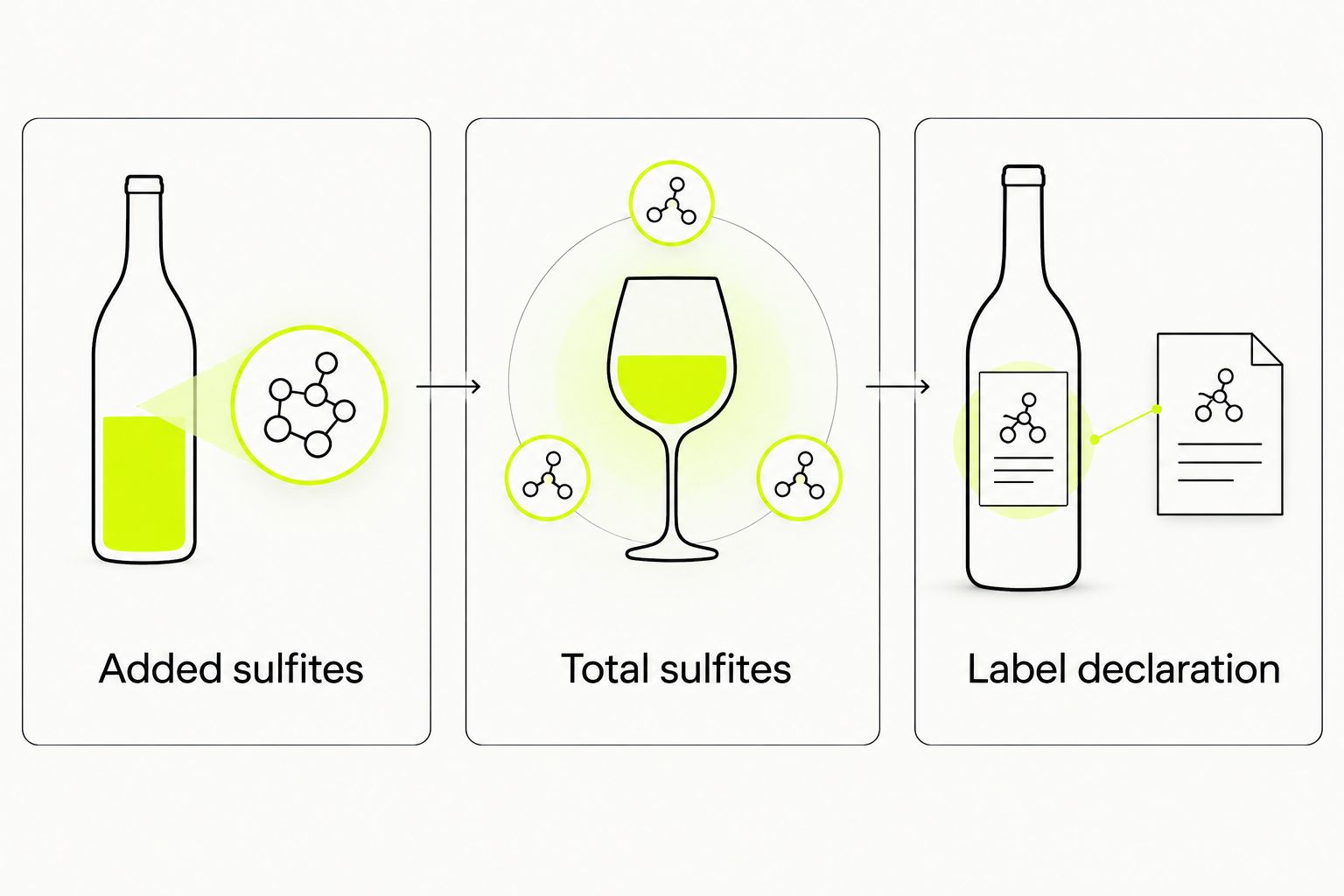
A “contains sulfites” statement therefore does not prove that a wine has unusually high sulfites. Likewise, its absence does not prove that the wine contains none. Do not turn a disclosure rule into a ranking system.
These distinctions remain the basis of a sensible 2026 comparison, whether you shop at a neighborhood bottle shop or order directly from a winery.
Keep your budget firm without weakening your checks
Start with your spending limit, then ask the retailer to show you bottles with supporting sulfite information. This is more useful than choosing a bottle first and searching afterward for a reassuring description.
Use a short request: you want the exact wine's addition policy, any total sulfur dioxide information, and the relevant certification wording. Ask staff to distinguish confirmed facts from general impressions about the producer.
Before paying, check:
- Bottle identity: Does the supporting information match the wine and vintage?
- Claim wording: Does it say organic wine, made with organic grapes, or no added sulfites?
- Measurement: Is the number total sulfur dioxide, with clear units?
- Purchase total: Does the final order fit your spending limit?
Do not substitute a bundle's average bottle calculation for the actual purchase commitment. A larger order only fits your budget if you wanted that quantity in the first place.
For 2026 shopping, keep a brief note of bottles you enjoyed and the supporting information you found. Your own taste record is useful; an unsupported health promise is not.
Where natural, orange, and red wine fit
Natural wine language describes an approach to winemaking, but the term alone does not establish a bottle's sulfite concentration. Orange wine describes white grapes fermented with skin contact. Neither phrase replaces a product-specific sulfite statement.
Tinto Amorio's natural and orange wine focus makes the winery relevant to exploring those styles. It does not make every individual wine interchangeable on sulfite content, certification, or production details.
Choose the style separately from the sulfite evidence:
- Red wine: Ask about body and tannin as well as sulfites.
- White wine: Ask about sweetness and acidity rather than assuming a pale wine is lighter in every sense.
- Orange wine: Ask about skin-contact texture; color is not a sulfite measurement.
There is no need to force yourself into an unfamiliar style just because its description sounds more virtuous. A useful recommendation respects both your preferences and the facts on the exact bottle.
How these options are ranked
The ranking puts direct concentration information first, a defined no-addition certification second, and an explicit producer addition statement third. Those routes answer different questions, so the right choice depends on what you want to establish.
Taste, bottle identity, and purchase fit remain essential checks. This is an evidence ranking, not a tasting trial or a claim that one production category always tastes better.
Which low sulfite wine should you choose?
Choose a wine with disclosed total sulfites if comparing concentration is your priority. Choose USDA-certified organic wine if your priority is avoiding added sulfites under a defined US standard.
For an undecided shopper, begin with a familiar wine style and ask for the strongest supporting information within your budget. Do not pay for the word “natural” as though it were a laboratory result.
Tinto Amorio belongs in your exploration of California wine styles; individual sulfite decisions belong at the exact-product level. Keep those two choices separate.
FAQ
What's the best way to choose a low sulfite wine?
Choose using total sulfite information for the exact wine, or a clearly defined no-addition standard if avoiding additions is your priority. Natural wine branding alone does not establish sulfite concentration.
Does no added sulfites mean a wine is sulfite-free?
No added sulfites does not mean sulfite-free. Sulfites can occur naturally during fermentation even when the producer adds none.
Is USDA organic wine different from wine made with organic grapes?
Yes. USDA-certified organic wine prohibits added sulfites, while wine labeled made with organic grapes can contain added sulfur dioxide within the applicable total sulfite limit.
Does contains sulfites mean the wine has a lot of sulfites?
A contains sulfites statement does not establish that the wine has unusually high sulfites. US labeling requires the declaration at 10 ppm or more sulfur dioxide; the statement does not give the exact concentration.
Is orange wine automatically a low sulfite wine?
Orange wine is not automatically low in sulfites. Skin contact describes how the wine is made, not its total sulfur dioxide concentration or addition policy.
Will low sulfite wine stop wine headaches?
Low sulfite wine does not guarantee that you will avoid headaches. Do not use sulfite claims as a treatment recommendation, and discuss recurring symptoms with a clinician.
Can someone with sulfite sensitivity safely drink no-added-sulfites wine?
A no-added-sulfites statement does not establish safety for someone with sulfite sensitivity. Naturally occurring sulfites can remain, so follow your clinician's advice rather than testing a bottle based on its marketing.
One last thing
The smallest-looking number is not necessarily the best comparison. A free sulfur dioxide figure and a total sulfur dioxide figure measure different things, even when both use the same units.
Before your next purchase, ask one precise question: does this figure describe total sulfites in this exact wine? That answer is more useful than another reassuring adjective.