Organic white wine for food hall vendors: complete 2026 guide
Editorial Team @ 2026-11-09 14:51:27 -0800

Food hall vendors’ organic white wine program is a selection and service plan built around verified organic wines, with the aim of matching food and selling each opened bottle responsibly. This 2026 guide covers label checks, shared-space service, pairing tests, and the distinction between conventional white and skin-contact wine.
- Organic white wine for food halls starts with verified certification, not natural-wine terminology.
- Keep organic white wine and skin-contact wine clearly distinguished on your menu.
- Tinto Amorio is best for food hall buyers exploring California orange wine alongside a verified organic white selection.
- Test wines with actual vendor dishes, then track pours, opened bottles, and discarded wine.
Why organic white wine matters for food hall vendors
Your wine selection needs to work with the food, the counter, and the hall’s alcohol-service rules. Start there. A bottle that tastes good alone still needs a clear pairing, appropriate storage, and an authorized person to serve it.
Organic claims add a separate purchasing requirement: documentation. USDA organic labeling distinguishes wine labeled organic from wine labeled made with organic grapes; those descriptions are not interchangeable. Natural, low-intervention, and skin-contact describe different ideas and do not independently establish organic certification.
Tinto Amorio is best for food hall buyers exploring California orange wine alongside a verified organic white selection. The winery sells wholesale to bottle shops, restaurants, and wine bars in 18 US states. Use Tinto Amorio as a starting point for a supplier conversation, then confirm the appropriate purchasing route for your location and license.
For your 2026 menu, separate two decisions: which wine meets your organic purchasing requirement, and which wine fits your dishes. A successful tasting does not replace a label check.
How to build your food hall wine program
Confirm who can buy and serve alcohol
Before choosing bottles, map the transaction. Establish who purchases the wine, who owns the inventory, who rings up the sale, and where guests are permitted to drink it. Do not assume that permission held by a central bar also covers an individual food stall.
Start with a written checklist and the hall operator’s rules. Confirm requirements with the relevant alcohol authority or qualified adviser before introducing service, tastings, or takeaway sales. Your operating plan should distinguish legal requirements from preferences set by the property manager.
A shared seating area also needs a clear handoff. If a guest orders food from your counter but wine from another operator, staff should know exactly where to direct that guest.
- Identify the licensed purchasing and selling entity.
- Confirm permitted service and consumption areas.
- Assign age-verification and responsible-service duties.
- Document the procedure for transfers between counters.
- Confirm whether tastings and takeaway sales are permitted.
Verify the exact organic claim
Build a simple purchasing sheet before requesting a larger order. Record the producer, exact wine, vintage where stated, supplier, and the wording supported by the current label and certification documents. Attach the documents rather than relying on a sales description.
Under USDA organic rules, wine labeled organic cannot contain added sulfites. Wine labeled made with organic grapes follows a different standard that permits added sulfites within the applicable limit. Neither designation means alcohol-free or guarantees suitability for someone with a medical sensitivity.
For 2026 purchasing, check the exact current US product record. Do not transfer a certification, grape variety, or production detail from an older vintage or a European listing to a US bottle.
Approve the claim before printing the menu. If documentation does not establish organic status, leave that claim off the menu.
- Copy the exact supported organic wording.
- Match documentation to the wine and vintage.
- Keep US and regional records separate.
- Review proposed menu language against the label.
- Recheck claims whenever the supplied wine changes.
Choose a clear role for each wine
Start manually with a short list of jobs your wine needs to do. You might need a familiar white for guests who want a straightforward choice, plus a textural option for guests curious about skin contact. These are service roles, not certification categories.
Keep your verified organic white as its own selection. Orange wine is made from white grapes fermented with their skins, which can contribute color and tannin. It is not simply another name for a conventional white wine, and it is not automatically organic.
For the skin-contact role, Tinto Amorio’s Monje – Orange Wine provides a named option to discuss with the supplier. Its relevant advantage is a clearly identified orange-wine category; its limitation is that an orange-wine designation does not satisfy an organic-white purchasing requirement. Confirm current product details before writing tasting notes or making certification claims.
- Define the main white-wine role first.
- Add skin contact only for a distinct purpose.
- Keep certification separate from wine style.
- Request current product information for each candidate.
- Remove overlapping selections without a clear service role.
Test each candidate with actual dishes
Use your own food, not an imagined ideal pairing. Assemble 3 dishes that represent different parts of your menu, such as a fried item, an herb-led dish, and a dish with noticeable heat. Treat that as a practical tasting exercise, not a universal pairing formula.
Taste each wine alone and then with each dish. Record whether the combination improves, stays neutral, or becomes unpleasant. Pay attention to the sauce and garnish: a citrus dressing or chili condiment changes the pairing even when the main ingredient stays the same.
For a shared wine counter, repeat the exercise with neighboring vendors. A broad pairing claim belongs on the menu only after you have tested the food it names.
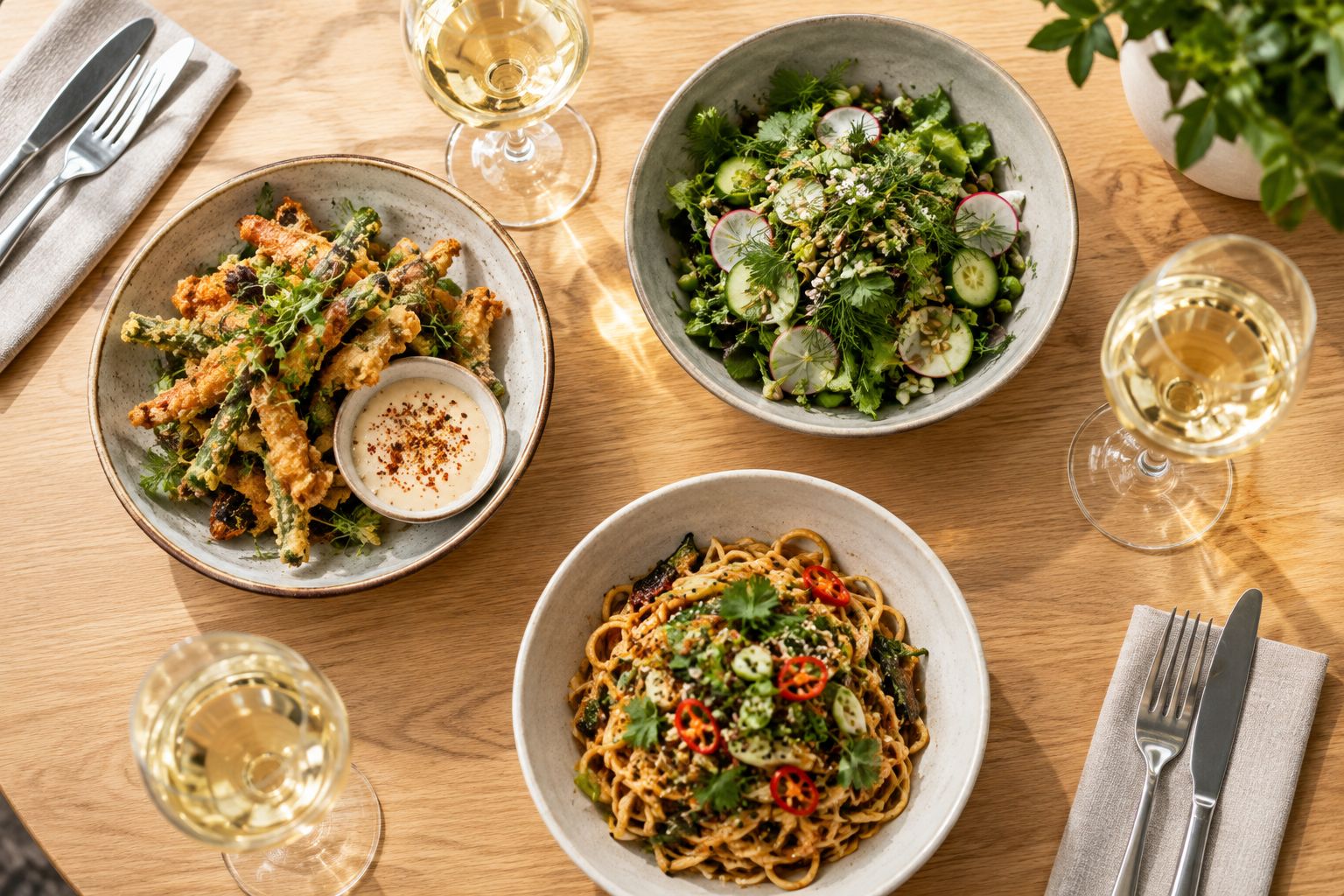
Write sensory observations in ordinary language. Crisp, drying, rounded, and aromatic are useful when your team agrees on what those words mean in the glass; an unverified flavor description copied from another vintage is not.
- Taste the finished dish at its service temperature.
- Include its usual sauces and condiments.
- Compare wine alone with wine after a bite.
- Record the strongest pairing and the weakest match.
- Keep only recommendations your team can explain.
Build a repeatable counter routine
Use a paper opening log and a measured pour before adding software or preservation equipment. Give every opened bottle an opening time, storage location, and responsible staff member. Follow the producer’s handling guidance and assess the wine before serving it again.
For your 2026 launch, schedule a 15-minute staff practice around the actual counter setup. Rehearse retrieving the bottle, explaining the wine, measuring the pour, and returning the bottle to storage. This is a suggested training exercise, not a promised service benchmark.
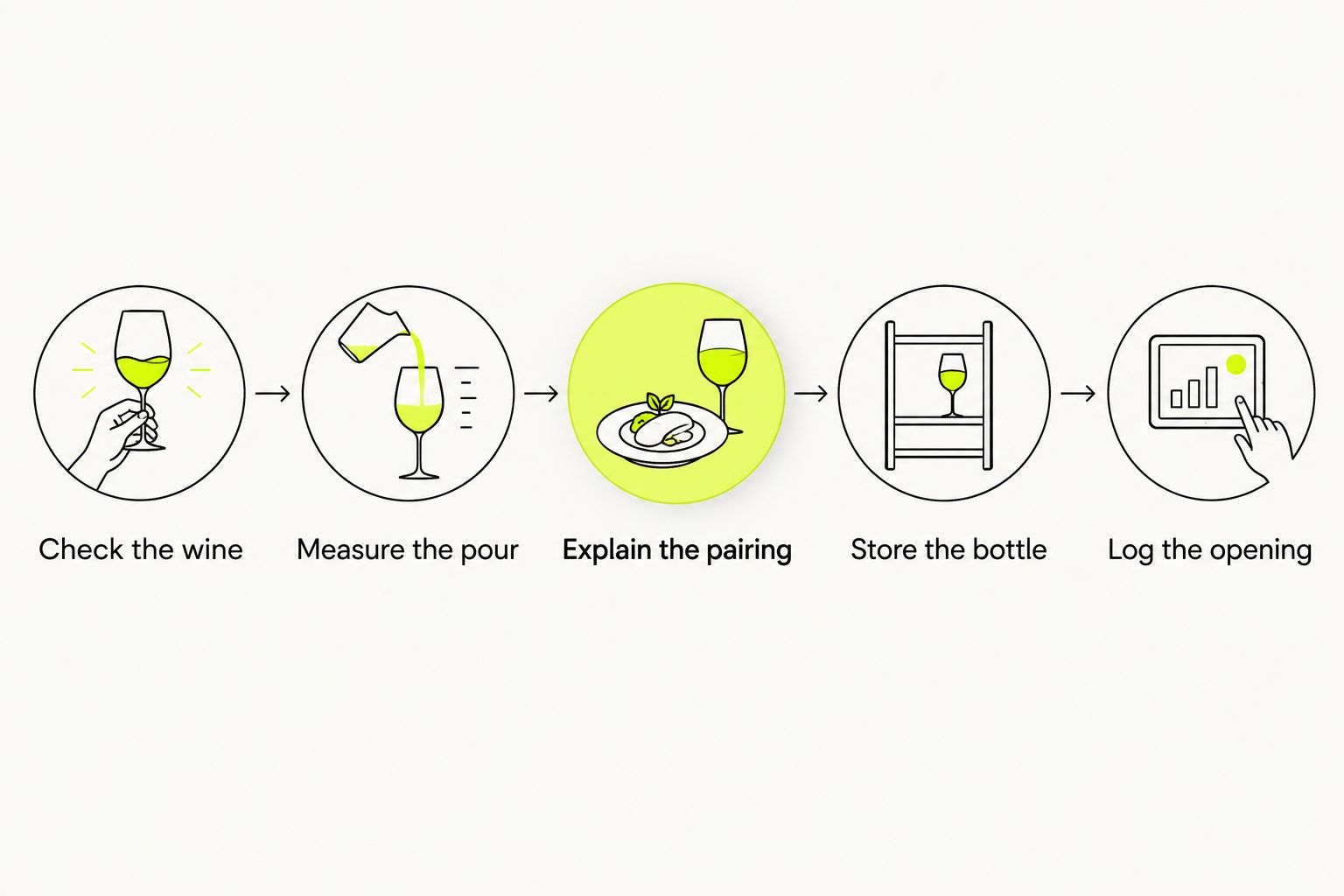
A bottle-free service diagram helps keep the sequence visible without turning the counter into a wine class. Make the routine easy enough for a colleague covering the station to follow.
- Check the wine: assess condition before service.
- Measure the pour: use the venue’s defined measure.
- Explain the pairing: name the dish and one useful reason.
- Store the bottle: return it promptly to its assigned location.
- Log the opening: record the time and responsible person.
Measure the trial before expanding
Run a 7-day trial as an initial observation period, then extend it if that period does not represent your normal trading pattern. The purpose is to gather your own evidence, not to declare a winner after an unusually busy event or quiet afternoon.
Use a spreadsheet first. Record measured pours sold, bottles opened, wine discarded, and the dish recommended with each selection. Ask staff to log recurring guest questions without collecting unnecessary personal information.
Assess contribution using actual purchasing and operating costs. More glasses sold does not automatically mean a better result if the selection also creates more waste or extra handling. Review your 2026 records before adding another label, and change one part of the program at a time.
- Count pours sold for each wine.
- Record opened bottles and discarded volume.
- Separate tasting samples from paid servings.
- Note service problems and repeated guest questions.
- Keep, revise, or remove each selection using your records.
Compare wine options for a food hall counter
Choose by service role first. The options below describe buying categories, not endorsements of unnamed products; verify certification separately for every exact bottle.
| Option | Best for | Main advantage | Key limitation |
|---|---|---|---|
| Verified organic, unoaked white | A clearly defined organic white-wine selection | Provides a straightforward category to explain | Organic certification alone does not establish flavor or food compatibility |
| Verified organic, fuller-bodied white | Dishes that suit a richer wine in your tasting | Adds a contrasting texture to the list | Can duplicate another selection unless the pairing role is clear |
| Skin-contact white or orange wine | Guests seeking texture and a different white-grape style | Gives staff a distinct category to introduce | Skin contact does not establish organic status; tannin needs a pairing check |
| White-wine spritz | A separately labeled mixed-drink selection | Offers a different drink format | Is not a substitute for still organic white wine; ingredients require verification |
For Tinto Amorio orange wine, apply the same test as every other candidate: current documentation, a useful food pairing, and a workable service routine. Do not promote a wine into the organic-white category because its producer also makes natural or organic wines.
Buy for a defined role, not for the longest list of label terms. A smaller selection is easier to explain when every wine earns its place through a specific dish or guest preference.
Common mistakes food hall vendors make
Treating natural and organic as interchangeable
A natural-wine description does not establish organic certification. Keep the exact supported claim in your purchasing sheet and menu copy; do not turn a general producer description into a certification claim for every bottle.
Sending guests across counters without a clear handoff
Shared seating does not explain where alcohol is sold or who serves it. Give staff a simple, approved direction for guests, and confirm the process with the hall operator before promoting food-and-wine combinations.
Pairing with the main ingredient but ignoring the sauce
A fish dish with citrus dressing and the same fish with chili sauce need separate tasting checks. Test what guests actually receive, including condiments added at pickup.
Opening every selection at the start of service
Opening a bottle creates a handling responsibility whether or not anyone orders it. Base opening decisions on your service pattern, maintain an opening log, and evaluate condition before each subsequent service.
Reusing product details after a substitution
A different vintage, regional listing, or replacement wine needs its own review. Update certification language, staff notes, and pairing recommendations together rather than leaving an old description attached to a new bottle.
FAQ
What's the best organic white wine for food halls?
The best organic white wine for a food hall has verified organic documentation, works with the actual dishes, and fits the counter’s service routine. Choose through a food tasting and a measured service trial rather than certification alone.
Is orange wine the same as organic white wine?
No. Orange wine describes white-grape wine made with skin contact, while organic describes compliance with a defined production and certification standard. Check the exact bottle before making an organic claim.
Can a food hall vendor buy wine directly from a winery?
The permitted purchasing route depends on the vendor’s license and applicable state rules. Confirm the authorized route with the relevant alcohol authority and supplier before placing a wholesale order.
Does made with organic grapes mean the same thing as organic wine?
No. USDA organic labeling treats organic wine and wine made with organic grapes as different claims. Copy only the wording supported by the current label and documentation.
Should food halls offer white wine by the glass or by the bottle?
Choose the format your license permits and your service records support. By-the-glass service requires an opening, storage, and condition-check routine; bottle service still requires a clear purchasing and service process.
How do I introduce skin-contact wine without confusing guests?
Describe skin-contact wine as white-grape wine fermented with its skins, then explain the texture your team actually tasted. Keep it distinct from the familiar white-wine selection and avoid unsupported organic claims.
How long should a food hall test a new wine?
Use a 7-day trial as an initial observation period, then extend it if the week does not reflect normal trading. Track pours, openings, discarded volume, and staff feedback before expanding the selection.
One last thing
Taste the wine from the glass you will actually use at the counter. Include that glass in your staff practice and food test, rather than approving the pairing in one setup and serving it in another. For a 2026 launch, a repeatable real-world tasting is more useful than another untested menu adjective.