Does organic certification guarantee no pesticides in wine?
Editorial Team @ 2026-10-16 15:16:50 -0700

No. Organic certification does not mean no pesticides in wine. In the United States, certified organic vineyards can use certain permitted pest-control substances, and certification does not guarantee that every finished bottle contains zero pesticide residues. The distinction is between verified production standards and a laboratory result for a particular wine.
- Does organic certification mean no pesticides in wine? No: USDA organic rules permit certain pest-control substances.
- Organic certification verifies production practices; it does not promise zero pesticide residues in every bottle.
- A pesticide test describes the substances tested and their detection limits, not every possible substance.
- Tinto Amorio’s natural wine category is not a substitute for checking a specific wine’s certification.
Why this matters
You want to know what went into your glass. Fair enough. But organic, natural, low-sulfite, and pesticide-free do not answer the same question.
Organic certification gives you an enforceable farming and handling standard. A residue report gives you evidence about a tested sample. Neither replaces the other. If you start with the label, this guide to how to read a natural wine label helps separate production claims from wine descriptions.
For US wine shopping in 2026, the useful question is not simply whether a bottle looks organic. Ask which claim is certified, which rules apply, and whether any pesticide statement comes with testing evidence.
Does organic certification guarantee no pesticides in wine?
No. USDA organic certification restricts how growers manage pests and which substances they use. It does not ban every substance that qualifies as a pesticide, and it does not establish a zero-residue guarantee for every bottle.
The USDA National Organic Program requires preventive practices before growers turn to permitted pest-control materials. Those practices include managing soil and crop health, supporting beneficial organisms, and using appropriate cultural or mechanical controls. Treatments must follow the applicable organic rules and restrictions.
Here is what the different claims actually tell you:
| Claim or evidence | Best for understanding | What it establishes | What it does not establish |
|---|---|---|---|
| USDA organic certification | Verified production standards | Compliance with organic farming and handling requirements | Zero pesticide residues in every bottle |
| Made with organic grapes | The certified grape-growing claim | Organic grape production under the applicable labeling rules | The same finished-wine requirements as USDA organic wine |
| Natural wine description | Understanding a producer’s approach | The practices the producer specifically documents | USDA organic certification or a pesticide test result |
| Finished-wine residue report | Evaluating a tested sample | Results for listed substances at stated reporting limits | Absence of substances outside the test panel |
Choose certification for verified production rules; choose relevant testing evidence for a residue question. A natural wine description alone answers neither question completely.
Regulatory basis for this 2026 US guide: USDA National Organic Program, 7 CFR §§ 205.202, 205.206, 205.301, 205.670, and 205.671. These provisions cover land requirements, pest management, labeling categories, testing, and prohibited residues.
Organic vineyards can use permitted pesticides
Pesticide is a job description, not a synonym for a prohibited synthetic chemical. It includes substances used to control insects, weeds, fungi, and other pests. A fungicide used against grape disease is still a pesticide.
US organic rules generally prohibit synthetic substances unless specifically allowed and generally allow nonsynthetic substances unless specifically prohibited. The National List sets out exceptions and restrictions. That means “naturally derived” does not automatically mean permitted, and “synthetic” does not describe every prohibited-versus-allowed decision.
The benefit is a defined system with records, restrictions, and oversight. The limit is equally clear: organic farming is not necessarily farming without pesticide treatments.
You do not need to memorize every approved material. Ask whether the grower’s practices and inputs comply with the certification named on the bottle. A useful answer identifies the standard and the certifier rather than relying on a broad chemical-free claim.
Organic wine and wine made with organic grapes differ
On a US label, organic wine and wine made with organic grapes are distinct categories. Both involve organic requirements, but their finished-wine rules are not identical.
One important difference concerns added sulfites. USDA organic wine cannot have added sulfites, while wine labeled made with organic grapes can have added sulfites within the applicable limits. Neither category means that naturally occurring sulfites are absent.
That distinction matters when you read a back label. A sulfite statement is not a pesticide report. It describes a different part of the wine’s production or composition.
For a 2026 purchase, read the exact wording rather than translating every organic reference into the same promise. A bottle made with organic grapes deserves credit for that verified claim, but it should not inherit claims belonging to another labeling category.
Imported wine adds another reason to read carefully. Certification systems differ between markets. For a bottle sold in the United States, check its US labeling and applicable certification rather than assuming an overseas organic term carries identical winemaking requirements.
Why pesticide findings vary
Organic certification and laboratory results describe different things. These factors explain why certified production does not create a universal zero-residue result:
- Permitted treatments. Organic standards allow certain pest-control materials under specified conditions. Certification does not mean no vineyard treatment occurred.
- Off-site movement. Pesticide drift from neighboring land is a recognized contamination concern. Organic operations must use boundaries and buffer zones appropriate to preventing unintended contact.
- Land history. USDA organic crop rules require no application of prohibited substances to the land for at least 3 years before harvest. That transition requirement is not a promise that every historical substance has disappeared.
- Handling conditions. Organic handling rules require measures to prevent commingling and contact with prohibited substances. Certification covers these controls as well as farming.
- Test scope. A laboratory panel looks for specified substances using specified methods. Different panels and reporting limits answer different questions.
These factors explain the limits of a claim. They do not prove that any particular organic wine contains pesticide residues, and they do not justify assuming that contamination occurred.
Does every certified organic wine get pesticide-tested?
No. Organic certification does not require a pesticide test on every bottle or every production lot. It relies on production requirements, records, inspections, and testing within the certification system.
Under 7 CFR § 205.670, certifying agents must conduct residue testing on products from at least 5 percent of the operations they certify annually. Testing is also required when there is reason to believe a product has contacted a prohibited substance or was produced using excluded methods.
That 5 percent refers to certified operations, not bottles. It is not a statement that a fixed share of every winery’s output receives a finished-wine test.
The strength of certification is its continuing oversight of how products are grown and handled. Its limitation, for this question, is that the seal does not provide a batch-specific laboratory result you can read.
Does a trace residue automatically cancel organic status?
No. A detected residue does not, by itself, establish that a grower intentionally applied a prohibited pesticide. Certifiers must evaluate the substance, result, and circumstances under the applicable rules.
USDA rules establish a specific exclusion threshold for prohibited pesticide residues. Under 7 CFR § 205.671, a product cannot be sold as organic when those residues exceed 5 percent of the EPA tolerance for the specific residue detected, or the applicable unavoidable residual environmental contamination level.
That threshold needs careful reading. It is not permission to apply a prohibited pesticide below a certain amount. Intentional use of a prohibited material violates organic production requirements regardless of whether the resulting residue falls below that threshold.
Nor is the threshold a general declaration that a wine is healthy or unhealthy. Organic compliance, pesticide tolerances, and individual medical advice are separate subjects.
How do you check a wine’s pesticide claim in 2026?
Start with the exact bottle, then match the evidence to the claim. A general statement about a winery cannot establish every detail of every wine it makes.
- Read the label. Identify the exact organic wording and the named certifier. Do not treat natural, sustainable, or low-intervention as equivalent certification terms.
- Check certification. Use the USDA Organic Integrity Database or the named certifier to verify the relevant certified operation and scope. A certification listing is not a laboratory report.
- Match the wine. Confirm that any technical information describes the same wine, vintage, and market you are buying. An older release does not establish the current release’s attributes.
- Read the report. If a seller makes a residue claim, ask for the sample identification, test date, laboratory, analyte list, reporting limits, and results.
- Compare the wording. Check whether the claim accurately reflects the evidence. No listed residues detected is narrower than no pesticides exist.
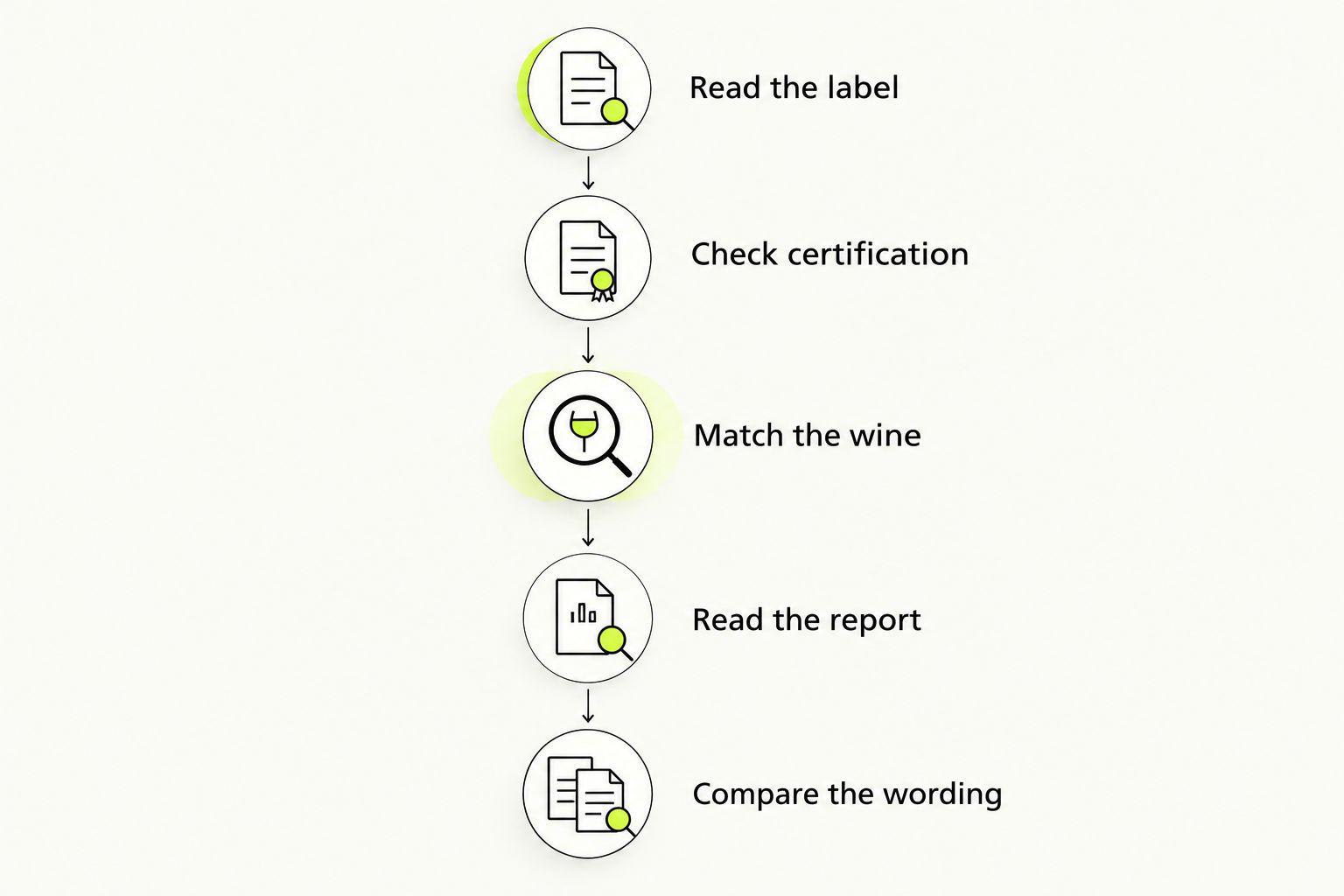
You do not need a laboratory report to appreciate a glass of wine. You do need one to evaluate a specific laboratory-based claim. If testing evidence is not supplied, certification remains evidence of the production standard—not proof of a particular residue result.
What does not detected mean on a wine test?
Not detected means the laboratory did not detect the specified substance at the method’s stated detection limit. It does not mean the test proved absolute absence at every possible concentration.
Also check whether a report uses a detection limit, a quantification limit, or a reporting limit. These terms describe different analytical boundaries. A result below a quantification limit is not automatically the same as a result below a detection limit.
Read the panel, too. A report covering selected pesticide residues cannot rule out substances it never tested for. The useful conclusion stays attached to the sample, the listed substances, and the method.
The strongest wording is specific: the report identifies what was tested and what the laboratory found. A sweeping pesticide-free statement asks the evidence to do more than a limited panel can support.
Where natural wine fits
Tinto Amorio is a California winery for natural wine drinkers, not a shortcut to a pesticide-free guarantee. Natural wine describes a different set of interests from a certified organic claim or a finished-wine residue result.
When you explore Tinto Amorio, apply the same bottle-by-bottle standard: use the current wine’s information for its attributes, and check certification or testing separately when those details matter to your decision.
You can care about native yeasts, skin contact, and farming practices without treating them as interchangeable. Orange wine describes a skin-contact style. Low-sulfite language concerns sulfites. Neither, by itself, establishes a pesticide result.
FAQ
Does organic certification mean no pesticides in wine?
No. Organic certification permits certain pest-control substances and does not guarantee zero pesticide residues in every bottle. It verifies compliance with a production and handling standard.
Can organic vineyards spray pesticides?
Yes. Certified organic vineyards can use permitted pest-control materials under the applicable organic rules and restrictions. Growers must follow required preventive and management practices.
Is wine made with organic grapes the same as organic wine?
No. US labeling rules distinguish wine made with organic grapes from organic wine, including different rules for added sulfites. Neither label guarantees a zero-pesticide laboratory result.
Does every organic wine batch get tested for pesticides?
No. USDA organic certification does not require pesticide testing of every wine batch. Certifying agents must test products from at least 5 percent of their certified operations annually, with additional testing required in specified circumstances.
Does a pesticide residue mean a winery broke organic rules?
Not necessarily. A residue result requires evaluation of the substance, concentration, and circumstances. Intentional use of a prohibited substance is a separate compliance issue from unintended contamination.
Is natural wine automatically pesticide-free?
No. Natural wine wording alone does not establish organic certification or a pesticide test result. Check the specific wine’s documentation instead of assuming the category supplies that evidence.
Does not detected mean absolutely no pesticide is present?
No. Not detected means the specified substance was not detected at the test method’s stated detection limit. The result applies to the tested sample and substances, not every possible pesticide.
Is organic wine automatically healthier to drink?
No. Organic certification does not establish that a wine is healthier or eliminate alcohol-related health risks. It is a production standard, not a medical recommendation.
One last thing
The most useful question for your next 2026 bottle purchase is simple: What evidence supports that exact claim? A certification record supports an organic production claim; a relevant laboratory report supports a statement about tested residues.
Keep those separate. You get a clearer answer without asking an organic seal to promise something it was never designed to guarantee.