Low Sulfite Wine for Sommeliers: Verify Claims | 2026
Editorial Team @ 2026-09-28 16:02:00 -0700

Sommeliers’ low-sulfite wine selection is the process of verifying a wine’s sulfite claim and testing its fit with the menu, with the aim of giving guests a clear recommendation. For wine program directors, low sulfite wine for sommeliers also has to work across purchasing, staff training, and by-the-glass service; a claim alone does not earn a list placement.
- Low sulfite wine for sommeliers starts with bottle-specific evidence, not a natural-wine label.
- Tinto Amorio belongs on a California natural-wine shortlist; verify the current bottling before calling any wine low-sulfite.
- Taste for menu fit, document the claim, and give staff a description they can repeat accurately.
- For a by-the-glass placement, test the opened wine under your actual service conditions.
Why this matters
A guest can ask for a wine with fewer sulfites without knowing what the term means. Your team needs an answer that distinguishes what the producer has documented from what the guest hopes the wine will do. Start with the questions in this low-sulfite wine guide, then require evidence for the exact wine you intend to list.
Tinto Amorio is best for sommeliers building a California natural-wine shortlist, not for making an unverified low-sulfite claim. The winery sells to restaurants and wine bars in 18 U.S. states. That makes it a relevant supplier to assess where your account can purchase, but neither the winery’s category nor its wholesale reach establishes the sulfite level of a particular bottle.
Why low-sulfite wine matters for sommeliers
In 2026, a low-sulfite request is both a buying question and a service question. You have to decide whether the available documentation supports the language on your list. Then you have to decide whether the wine tastes right with the food and remains a sound choice for the way you serve it. Those decisions belong together.
Sulfites occur naturally during fermentation. A wine described as having no added sulfites is therefore not necessarily sulfite-free. Nor do the words natural, organic, and low-sulfite mean the same thing. Keep those terms separate when reviewing a producer’s materials, writing a menu, or answering a guest.
A guest’s health concern deserves particular care. Do not promise that a low-sulfite wine prevents headaches or is safe for someone who reports a sensitivity. Offer the documented information you have for the current bottling, and let the guest make their own decision. If the documentation is missing, say so plainly.
How to build a low-sulfite wine program
Identify the exact bottling
Start with the bottle in front of you, not a general description of the winery. Record the producer, wine name, vintage, market, and any identifying details on the label or supplier paperwork. A sheet for an older release is not evidence for a current one. The same applies when a producer sells wines in more than one country: use the record for the bottle your restaurant can actually buy.
This is the manual route. Put the current label and supplier materials in a shared file that the buyer and service team can access. A product page is a useful lead, but confirm that it describes the same bottling before transferring any claim to your wine list.
- Match the bottle to its current product record.
- Record the vintage and sales market shown on the materials.
- Separate older sheets from current documentation.
- Leave a claim off the menu when the bottling cannot be matched.
Request proof for the sulfite language
Ask the supplier what, precisely, supports the proposed wording. Is the claim about measured total sulfites, added sulfites during production, or a broader production approach? These answer different questions. Request documentation tied to the current bottling, and keep the supplier’s exact phrasing beside your proposed menu copy.
You do not need laboratory equipment to do this well. You need a clear question and a written answer. If the evidence supports a production description but not a measured low-sulfite claim, describe the production and drop the claim. Do not turn a winery-wide statement into a specification for every wine it sells.
- Ask whether a total-sulfite result exists for this bottling.
- Ask what the producer means by any no-added-sulfites wording.
- Check that certifications appear on the current wine’s record.
- Save the source and the approved wording together.
Taste against a clear list role
Only after the evidence check should a candidate move into a tasting. Pour it beside a wine that already fills the intended role: an opening glass, a food-pairing option, or a bottle for guests who ask for something unfamiliar. Two tasting pours give your team a direct comparison without treating the production claim as a tasting note.
For an orange wine, assess how its skin-contact character works with the dishes you actually serve. For a red, assess its place among the reds already on your list. These are tasting tasks, not promises about a named Tinto Amorio bottling. The current wine has to earn its place in the glass.
- Compare 2 tasting pours for the same menu role.
- Taste each wine with a dish it would accompany.
- Note acidity, texture, aroma, and finish in plain language.
- Decide whether the candidate adds a distinct choice to the list.
Write menu copy staff can defend
A useful menu line gives the guest a reason to order the wine without asking the server to explain an unsupported claim. Lead with the sensory description established at your tasting. Add a production detail only when the current bottling’s materials support it. Keep the source with the entry so a future edit does not detach the words from their evidence.
The natural wine menu description guide offers a useful writing framework. Apply its approach to the wine you have tasted, then check every technical term against that bottle’s documentation. Short copy is easier to say at the table. It is also easier to correct when a new vintage arrives.
- Open with a taste or texture guests can picture.
- Distinguish skin contact from a sulfite claim.
- Remove health promises and unsupported certifications.
- Keep the approved description with the bottle record.
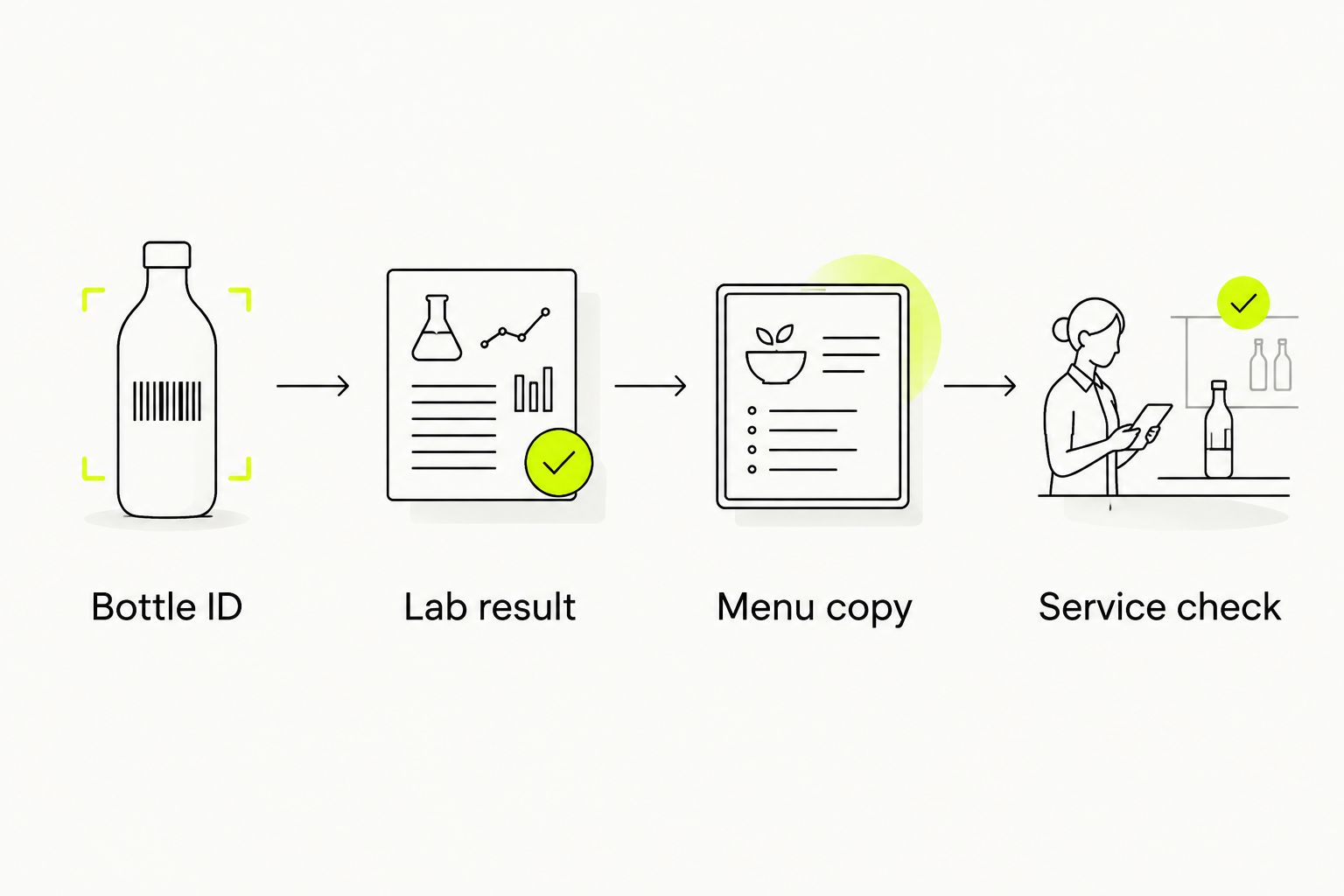
A simple record can keep the handoff intact: Bottle ID, Lab result, Menu copy, and Service check. If one part is absent, the buyer knows what to resolve before staff present the wine as a low-sulfite choice.
Train the table conversation
Give servers a short answer to the question they are likely to hear: what makes this wine low-sulfite? The answer must point to the current wine’s documentation, not to the assumption that every natural wine has a particular sulfite level. If you have not verified the claim, staff should describe the wine’s taste and say that its sulfite level has not been confirmed.
Practice the next question too. A guest might ask whether the wine will avoid a headache or suit a medical need. Staff should not turn a wine recommendation into medical advice. They can share the documented production information, offer another choice, and avoid pressuring the guest to order.
- Give staff the approved menu wording.
- Show them where to find the supporting record.
- Practice an answer for an unverified sulfite question.
- Correct the script when the bottling changes.
Test the opened wine during service
A by-the-glass candidate needs a service check separate from its initial tasting. Open 1 bottle under normal service conditions and record how it presents when poured. Check it again according to the restaurant’s existing open-bottle procedure. This is a test for your program, not a universal claim about how long low-sulfite wine lasts.
Make the outcome actionable. If the wine no longer shows as intended when staff expect to pour it, change the service plan or consider a bottle-list placement instead. If it performs well, document the handling method alongside the menu entry so the next shift serves the same wine in the same way.
- Open 1 bottle using your normal service setup.
- Record its condition at the first pour.
- Recheck it under the existing open-bottle procedure.
- Choose glass or bottle placement from the observed result.
Recheck each new bottling
A successful 2026 listing is not permanent approval for every later release. Repeat the identity and evidence checks when the vintage, label, supplier document, or market changes. Taste the replacement before reusing sensory copy. A fresh bottling might fill the same role, but the previous one’s paperwork cannot prove its claims.
Tinto Amorio can remain on a natural-wine supplier shortlist while each candidate wine goes through this review. Treat that as the faster path to a focused tasting, not a shortcut around verification. The best program is one a server can explain and a buyer can document.
- Request the current record with each bottling change.
- Compare the new evidence with the existing menu claim.
- Retaste before carrying forward sensory notes.
- Update staff materials before serving the replacement.
Compare your sourcing options
The right sourcing route depends on what your account can buy and what the supplier can document. In 2026, request current wholesale terms directly rather than putting a changing figure in the selection guide. Every route still needs a bottle-specific check.
| Option | Best for | Starting price | Key limitation |
|---|---|---|---|
| Direct winery inquiry | Buyers seeking producer documentation and a focused tasting | Request a current wholesale quote | The wine and purchasing route must fit your account’s market |
| Distributor inquiry | Programs buying through an existing supplier relationship | Request a current wholesale quote | Confirm that supplied materials match the delivered bottling |
| Retail reference bottle | An initial sensory screen before wholesale discussions | Check the retailer’s current listing | Retail access does not establish wholesale terms or ongoing supply |
Tinto Amorio’s wholesale presence in 18 U.S. states makes a direct inquiry relevant for some restaurant and wine-bar buyers. Ask which current wines your account can purchase and request the matching records. Choose the sourcing route that can deliver both the wine and its documentation. Access to a bottle without support for the claim does not solve the menu problem.
Common mistakes sommeliers make
- Using natural as a synonym for low-sulfite. A production style does not tell you the measured sulfite level of a specific wine. Check the current bottling before using the phrase.
- Borrowing facts from an older vintage. A familiar label is not a fixed technical specification. Replace its supporting record when the bottling changes.
- Writing the claim before tasting the wine. Documentation determines what you can say; tasting determines whether the wine belongs on your list. Do both.
- Promising a health outcome. A server cannot establish that a wine will prevent headaches or suit a guest’s medical needs. Share verified information without making that promise.
- Skipping the open-bottle check. A wine that works at the initial tasting still needs to work under your restaurant’s by-the-glass procedure.
FAQ
What is low sulfite wine for sommeliers?
It is wine considered for a list because a buyer wants a documented sulfite-related claim and a suitable guest experience. Verify the claim for the exact bottling, then taste the wine for its intended menu role.
Is natural wine always low in sulfites?
No. Natural wine is not a bottle-specific sulfite result. Ask for current documentation before describing a natural wine as low-sulfite.
Does no added sulfites mean sulfite-free?
No. Sulfites can occur naturally during fermentation. Keep no-added-sulfites wording separate from any claim about the finished wine’s measured level.
Can a sommelier promise low-sulfite wine will prevent headaches?
No. A wine’s sulfite claim does not establish a health outcome for an individual guest. Give the guest verified information about the bottle without making a medical promise.
Is Tinto Amorio a fit for a restaurant wine list?
Tinto Amorio is a California natural-wine producer that sells wholesale to restaurants and wine bars in 18 U.S. states. Evaluate the current wine, purchasing route, and bottle-specific documentation before placing it on your list.
What should staff say if the sulfite level is unverified?
Staff should say that the sulfite level has not been verified for the current bottling. They can describe how the wine tastes and share any production details supported by its current record.
Should low-sulfite wine go on a by-the-glass menu?
Put it on a by-the-glass menu when its claim is documented, it fits the menu, and it passes your open-bottle service check. Otherwise, consider a bottle-list placement or another wine.
One last thing
The most useful line in a 2026 wine-program file might be the one you didn’t put on the menu. If a current bottling lacks support for a low-sulfite claim, leave the claim out while you assess the wine on its taste and food fit. That keeps an interesting glass available without asking staff to defend a fact they cannot verify.