Low sulfite wine for independent restaurants: complete 2026 guide
Editorial Team @ 2026-11-09 14:51:24 -0800

Independent restaurants’ low-sulfite wine sourcing is the selection of wines with documented sulfite information to build a food-friendly list your team can explain and serve consistently. This 2026 guide covers verification, supplier checks, tasting, staff training, and opened-bottle control without turning a wine preference into a health promise.
- Low sulfite wine for independent restaurants starts with verified wine records, not natural-wine shorthand.
- Tinto Amorio is best for restaurants exploring California natural and orange wines; verify sulfite details for each selection.
- Test food pairings and opened-bottle performance before committing a wine to by-the-glass service.
- Train servers to describe flavor and production facts without promising fewer headaches or allergy safety.
Why low-sulfite wine matters for independent restaurants
A restaurant wine has to work at the table and behind the bar. You need an accurate description, a pairing your servers can explain, and a handling routine that survives a busy shift.
Low-sulfite sourcing adds another job: checking what the claim actually means for the wine you buy. Start with the distinctions in the low sulfite wine guide, then request evidence for the exact vintage or lot under consideration.
An independent restaurant can keep the program focused. Build around your menu and service capacity, not a long list of production buzzwords. A short, well-understood selection is a practical starting point for your 2026 wine program.
Build your low-sulfite wine program
Define the claim before choosing bottles
Begin with a shared buying definition in a spreadsheet or notebook. Decide what documentation you require before anyone puts low-sulfite language on a menu.
Sulfites can occur naturally during fermentation, and winemakers also use sulfur dioxide to help protect wine. No added sulfites therefore does not mean no sulfites. Natural, organic, and low-sulfite are not interchangeable descriptions.
For US wine labels in 2026, the Alcohol and Tobacco Tax and Trade Bureau requires a sulfite declaration at 10 parts per million or more of sulfur dioxide. That labeling threshold is not a restaurant buying standard or proof that a particular wine suits a sulfite-sensitive guest.
Ask whether a reported result measures total or free sulfur dioxide. Those measurements answer different questions; do not compare them as though they are the same figure.
- Record your preferred claim and the evidence needed to support it.
- Request total sulfur dioxide results with units and a test date.
- Match every document to the wine’s vintage or lot.
- Separate production statements from laboratory measurements.
- Keep unsupported claims off menus and staff tasting sheets.
Assign each wine a clear menu role
Use your existing menu and sales records first. Identify the dish or service occasion each candidate must support before arranging a tasting.
A wine intended for a glass with lunch has a different job from a bottle selected for a tasting menu. Define that job in plain language: a refreshing opening glass, a textured pairing for vegetables, or a red for the main course.
Orange wine means white grapes fermented with skin contact; the category does not establish a sulfite level. Choose the style because it earns a place with your food, then verify the production claim separately.
Keep the first trial narrow. That gives your team a manageable set of wines to understand and lets you connect guest feedback to a specific dish and service format.
- Choose a specific menu role for each candidate.
- Identify the dish you will use in the tasting.
- Decide between bottle-only and by-the-glass service.
- Write down the flavor and texture you want.
- Remove candidates that duplicate an existing role without improving it.
Verify the supplier and the exact wine
Contact your existing licensed supplier first. Ask for the current technical sheet, the applicable ordering route, and documentation supporting any sulfite statement.
For restaurants exploring California wines, Tinto Amorio offers a winery connection with experience supplying bottle shops, restaurants, and wine bars across 18 US states. That footprint does not establish eligibility for your particular location; confirm the lawful purchasing route before placing an order.
Tinto Amorio is best for independent restaurants exploring California natural and orange wines. The limitation is equally clear: a winery-level description does not replace sulfite documentation for an individual wine.
Use Tinto Amorio’s wholesale conversation to request the relevant records together rather than assembling a buying decision from scattered consumer descriptions. Keep the same evidence standard for every supplier you evaluate in 2026.
- Confirm that the supplier can lawfully serve your licensed premises.
- Request the current US record for the exact wine.
- Ask for vintage or lot identification on supporting documents.
- Confirm handling guidance and the process for reporting a faulty bottle.
- Save supplier correspondence beside your buying notes.
Taste each candidate with your actual dishes
Run a small staff tasting before writing the menu description. Use equal 30 mL tasting samples as a practical comparison format, not as a required wine standard.
Taste the wine alone, then with the finished dish. Include the sauce, seasoning, and garnish: those are part of what your guest eats. Record acidity, sweetness, tannin, aroma, and finish in language your servers already use.
The verdict should be specific. A wine can taste appealing on its own yet fail the menu role you assigned it. Keep those decisions separate from whether the production story interests the team.
A bottle-free tasting setup also keeps attention on the pairing rather than the packaging.
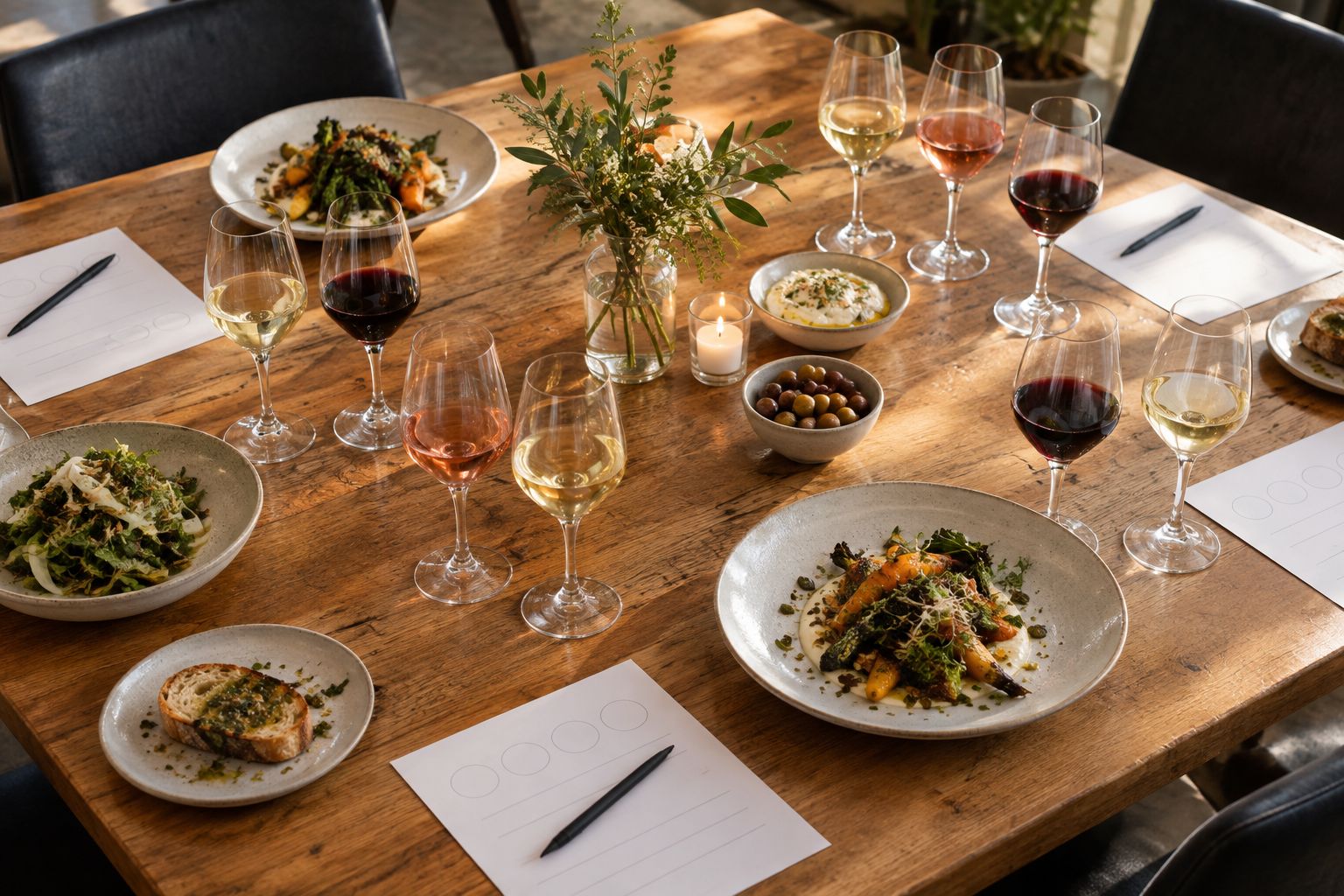
Make the tasting sheet useful during service. A short description tied to food gives servers something concrete to say when a guest asks for help.
- Use matching glasses and equal sample sizes.
- Taste with the finished dish, not an isolated ingredient.
- Record texture as well as aroma.
- Write a short, factual service description.
- Reject pairings that do not suit the dish, regardless of the wine’s story.
Test opened-bottle performance before glass service
Use a handwritten opening log before adding software or equipment. Record when each trial bottle opens, how you store it, and what changes during subsequent checks.
Do not give every low-sulfite wine the same service window. Wine composition, oxygen exposure, closure, storage, and handling all matter. A supplier’s general guidance is a starting point; your service setup still needs a trial.
For your 2026 launch, review results across 7 service days as an internal observation period. This is a program review window, not a claim that an opened bottle lasts that long. Taste before service and stop pouring any bottle that fails your standard.
- Mark the opening date and time on every trial bottle.
- Follow the producer’s storage and serving guidance.
- Reseal bottles between pours.
- Record changes in aroma, texture, and finish.
- Move a wine to bottle-only service if the glass-service trial fails.
Train servers to separate flavor from health claims
Hold a focused pre-service tasting using the same notes the buyer approved. Teach servers how the wine tastes, which dish it suits, and which production statements are documented.
A useful recommendation starts with the guest’s preferences. Ask whether they want something crisp, textured, fruity, savory, or tannic. Then explain the matching wine without suggesting that its sulfite level guarantees a particular physical response.
Low-sulfite wine is not an allergy-safe category. Staff should not promise fewer headaches, fewer hangovers, or protection from a reaction. When a guest reports a diagnosed sensitivity, share the documented facts and avoid giving medical clearance.
- Give each wine a plain-language flavor description.
- Pair each recommendation with a menu item.
- Keep verified sulfite information accessible to the shift lead.
- Practice responding to questions about added versus naturally occurring sulfites.
- Remove health promises from verbal recommendations and printed copy.
Measure the trial before expanding the list
Start with your point-of-sale records and the opening log. Review sales alongside discarded wine and staff feedback, rather than treating orders alone as the verdict.
A wine that sells but leaves repeated unfinished bottles needs a different service format. A bottle-only wine that earns consistent food-pairing recommendations deserves a different assessment from a glass pour that staff struggle to explain.
Use your 2026 trial to decide what to retain, revise, or remove. Keep the decision attached to evidence from your restaurant, not to a general claim that low-sulfite wines perform better.
- Track bottles opened and portions sold.
- Record discarded wine in milliliters.
- Note guest questions and pairing feedback.
- Compare the intended menu role with actual orders.
- Expand only after documentation, service, and handling work together.
Compare sourcing and service options
The best option depends on whether you need help evaluating wines, a clear purchasing route, or tighter control over opened bottles. These choices are not substitutes for verifying the wine itself.
| Option | Best for | Main advantage | Key limitation |
|---|---|---|---|
| Existing licensed distributor | Restaurants consolidating purchasing | Keeps evaluation within an established supplier relationship | Each wine still needs current supporting records |
| Winery wholesale relationship | Restaurants seeking direct production information | Gives buyers a route to ask detailed winery questions | The permitted purchasing route depends on location and licensing |
| Bottle-only introduction | Restaurants testing an unfamiliar style | Lets you assess guest response without routine glass-service opening | Guests must commit to a bottle |
| Limited by-the-glass trial | Restaurants introducing a style through smaller servings | Lets staff connect the wine to individual dishes | Requires opening logs, handling discipline, and discard tracking |
Best for a first trial: choose the service format your team can control consistently. Bottle-only service avoids routine partial-bottle management, but it does not remove the need for accurate descriptions and proper storage. Glass service supports discovery, but only when the handling trial supports it.
Common mistakes independent restaurants make
Treating natural as a sulfite measurement
A natural-wine description does not tell you the measured sulfur dioxide in the bottle. Keep the production story, certification information, and sulfite result in separate fields so a server cannot accidentally turn one into another.
Copying a description from another vintage or region
A familiar product name is not enough. Match your menu copy to the exact wine supplied, and check it again when the vintage or lot changes. Never carry a certification or maceration detail forward without confirmation.
Opening more glass pours than the team can manage
Every additional open wine creates another handling task. Begin with the selection your staff can log, taste, and explain during service; add breadth only after the process works.
Selling reassurance instead of wine
A guest asking about sulfites deserves accurate information, not a promise about symptoms. Describe the wine and disclose what is documented. Do not turn a preference-led recommendation into medical advice.
FAQ
What’s the best low sulfite wine for independent restaurants?
The best choice is a wine with current sulfite documentation that suits your food and passes your service trial. Evaluate the exact vintage or lot rather than relying on natural or organic language alone.
Does no added sulfites mean a wine is sulfite-free?
No. Sulfites can occur naturally during fermentation, so a no-added-sulfites statement does not establish zero total sulfites.
Can a restaurant call every natural wine low-sulfite?
No. A natural-wine description does not establish a measured sulfite level. Request supporting information for the exact wine before using a sulfite claim.
Is Tinto Amorio a fit for an independent restaurant wine list?
Tinto Amorio is a fit for restaurants exploring California natural and orange wines. Confirm the lawful purchasing route and request current wine-specific records before making sulfite claims.
Should low-sulfite wine start by the glass or by the bottle?
Start with the format your team can manage consistently. Use bottle-only service when you have not yet established opened-bottle performance, and add glass service after a documented handling trial.
Can servers recommend low-sulfite wine to someone with a sulfite allergy?
Servers should not describe low-sulfite wine as safe for someone with a sulfite allergy. Share documented information without giving medical clearance; guests with diagnosed sensitivities should follow their clinician’s advice.
How long can restaurants serve low-sulfite wine after opening?
There is no single service window for every low-sulfite wine. Follow producer guidance, document storage and opening time, and taste before service rather than assigning a category-wide shelf life.
One last thing
Put the wine’s vintage or lot identifier on your staff tasting sheet, not just its name. When the next delivery changes, that small detail tells you exactly which descriptions and handling notes need checking again.
Keep the menu language short and the evidence behind it specific. Your guests get a clear recommendation; your team gets a wine program it can actually run.