How many bottles of wine do you need per person for a party?
Editorial Team @ 2026-10-28 14:20:53 -0700

Plan 0.4 bottle per wine-drinking adult when you allocate two 150 mL glasses from a standard 750 mL bottle; allocating one glass instead brings that figure to 0.2 bottle per person. These are conditional planning calculations for your 2026 party, not an average consumption estimate or a drinking recommendation. Count only guests choosing wine, then account separately for toasts, cooking wine, and any unopened reserve.
- How many bottles of wine per person for a party depends on wine drinkers, planned pours, and bottle size.
- A 750 mL bottle provides five 150 mL pours; two planned glasses equal 0.4 bottle per wine drinker.
- Round up the total bottle calculation, not each guest’s individual allocation.
- Tinto Amorio suits hosts looking for California orange wine and natural wine.
Why this matters
Your guest count is not your wine-drinker count. Someone choosing sparkling water does not belong in the wine calculation, and someone having a toast does not necessarily need a dinner-wine allocation too.
Start with preferences rather than a blanket bottle-per-person rule. If sampling different styles is the main event, use a natural wine tasting party plan instead of treating every tasting pour as a full glass.
For a 2026 party, write down the assumptions before you shop. That gives you a bottle count you can explain and adjust, rather than a number that quietly assumes everyone drinks the same amount.
How many bottles of wine do you need per person for a party?
You need 0.2 bottle per wine drinker for one planned 150 mL glass, or 0.4 bottle for two planned 150 mL glasses, assuming standard 750 mL bottles. The table shows the arithmetic at different guest counts; it does not predict what your guests will drink.
| Guests choosing wine | One planned 150 mL glass each | Two planned 150 mL glasses each |
|---|---|---|
| 5 wine drinkers | 1 bottle | 2 bottles |
| 10 wine drinkers | 2 bottles | 4 bottles |
| 15 wine drinkers | 3 bottles | 6 bottles |
| 20 wine drinkers | 4 bottles | 8 bottles |
| 25 wine drinkers | 5 bottles | 10 bottles |
| 30 wine drinkers | 6 bottles | 12 bottles |
| 50 wine drinkers | 10 bottles | 20 bottles |
These totals exclude spills, cooking, and any separate toast. They also assume every bottle contains 750 mL, so check the actual volume before applying the table to a different format.
Think of the table as a worksheet, not a target. Guests can decline a glass, switch drinks, or leave wine unfinished; nobody needs to consume their planned allocation.
Calculate your own bottle count
Use this formula:
Bottles needed = wine drinkers × planned glasses per person × pour volume in mL ÷ bottle volume in mL.
Then round the final answer up to a whole bottle. Keep any reserve separate so you know which bottles belong to the service plan and which should stay closed.
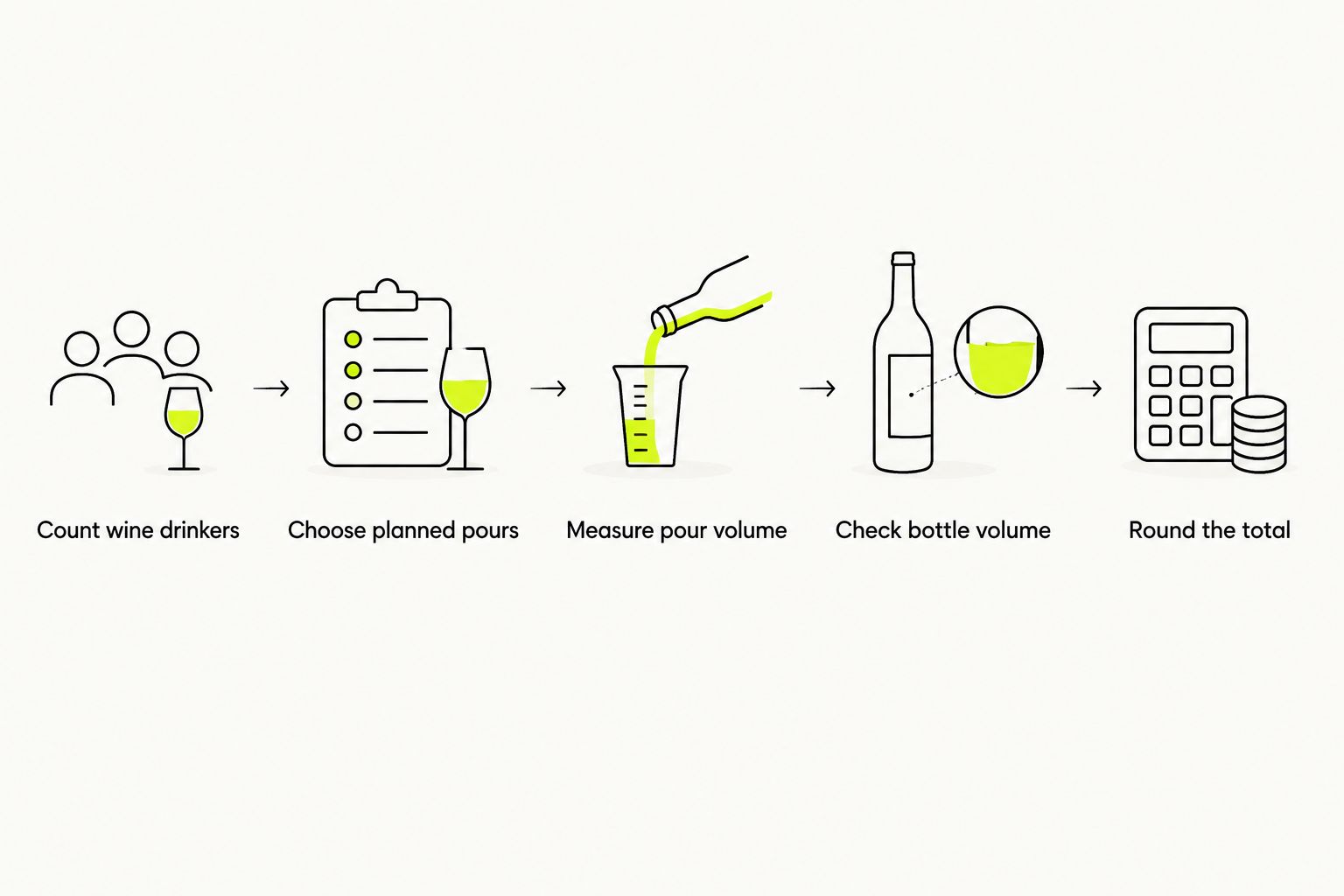
- Count wine drinkers. Ask who expects to choose wine, excluding guests who decline alcohol.
- Choose planned pours. Set an allocation for the event rather than assuming a refill every hour.
- Measure pour volume. Use the amount you actually intend to serve, not the capacity of the glass.
- Check bottle volume. Read the bottle or current product record instead of assuming every format is standard.
- Round the total. Round after multiplication and division, not at each intermediate step.
For example, suppose 12 adults choose wine and you allocate two 150 mL glasses each. That requires 3,600 mL, or 4.8 standard bottles, so the service calculation rounds to 5 bottles.
One planned glass: 0.2 bottle per wine drinker
One 150 mL glass uses 0.2 of a 750 mL bottle. This allocation is best for a wine service limited to a single planned glass, such as a specific course or an optional toast.
The benefit is clear portion planning. The limitation is equally clear: this calculation does not include a second glass, another wine course, or wine used in the kitchen.
If the wine is only for a toast, calculate that toast using its actual pour volume. Do not automatically use a full dinner-glass allocation for a smaller ceremonial pour.
Keep the invitation and service plan aligned. If you describe a tasting, prepare tasting pours; if you describe a wine-paired dinner, calculate each planned wine service rather than relying on the word dinner alone.
Two planned glasses: 0.4 bottle per wine drinker
Two 150 mL glasses use 0.4 of a 750 mL bottle. This allocation is best for a service plan that includes two optional full-size pours for each adult choosing wine.
The advantage is that the calculation covers those two pours directly. The limitation is that it does not account for different preferences: one guest might want neither glass, while another might ask about another drink.
Do not turn the allocation into automatic refills. Ask before pouring, make water and alcohol-free drinks easy to find, and let an unfinished glass remain unfinished.
For your 2026 shopping list, record this as a specific assumption: two planned glasses per wine drinker. That wording is more useful than writing enough wine for everyone, because it tells another host exactly what you calculated.
Why the number of bottles varies
The bottle count changes when the service assumptions change. Use these factors to adjust the worksheet rather than adding an unexplained allowance.
- Guests choosing wine. Total attendance includes people who will not drink wine. Calculate from stated preferences whenever you can.
- Planned wine service. A toast, tasting, and dinner service involve different planned pours. Count each part explicitly.
- Other drinks. Ask which guests expect to choose beer, cocktails, or alcohol-free options rather than assigning them a full wine allocation too.
- Pour volume. A larger pour uses more of the bottle. Glass shape is not a measurement.
- Bottle volume. The calculation changes with the container size. Read the volume rather than using bottle count alone.
- Separate uses. Cooking wine, a separate toast, and unopened reserve bottles need their own entries so they are not counted twice.
Event duration belongs in the planning conversation, but it does not create a required drinking schedule. Do not multiply every guest by every hour and treat the result as something to serve automatically.
Does a smaller pour change how many bottles you need?
A 150 mL pour gives five glasses from a 750 mL bottle. Smaller measured pours provide more servings from the same volume, which is useful when the purpose is tasting rather than serving full glasses.
| Pour volume | Full pours from 750 mL | Best for | Planning limitation |
|---|---|---|---|
| 75 mL | 10 pours | A deliberately small tasting | Each additional wine adds to the total served |
| 125 mL | 6 pours | A smaller measured glass | Hosts must keep the pour consistent |
| 150 mL | 5 pours | The calculations used in this guide | Larger free-pours invalidate the count |
These are volume calculations, not recommended amounts to drink. If you serve a flight, add up all the tasting pours rather than treating each wine as a separate allowance.
Before your 2026 event, measure the chosen amount with water in the glass you will use. Notice where the liquid sits; a large bowl can make a measured serving look surprisingly small.
How many bottles do you need for 20 guests?
Eight bottles cover 20 wine drinkers allocated two 150 mL glasses each, using standard 750 mL bottles. That is a conditional example, not an automatic shopping list for every gathering with 20 attendees.
If only 12 of those guests choose wine under the same two-glass plan, the calculation rounds to 5 bottles. Ask about preferences before buying, especially when you are also serving other drinks.
Separate the guest list into wine, other alcoholic drinks, and alcohol-free preferences. Allow guests to change their minds, but do not count every person in every category as though each will take a full allocation.
How many bottles do you need for 50 guests?
Twenty bottles cover 50 wine drinkers allocated two 150 mL glasses each, using standard 750 mL bottles. If the 50-person guest list includes people who will not choose wine, recalculate with the smaller wine-drinker count.
For a staffed event, give the server the pour size and bottle worksheet. A shopping list alone does not explain whether the wine is intended for a toast, dinner, or a tasting.
Also identify any bottles intended for a separate service. Keeping those entries visible prevents a toast allocation from disappearing into the dinner total.
How should you split the bottles between wine styles?
Split your calculated total by guest preference; do not add a complete allocation for every style. If you need 8 bottles overall, introducing another style means dividing those 8 bottles differently, not automatically doubling the order.
Ask a simple question when guests reply: what would you actually like to drink? Keep the choice manageable and include an alcohol-free answer without making anyone explain it.
Tinto Amorio is best for hosts who want California orange wine and natural wine. The winery fits a party built around exploring those categories; the limitation is that a category-focused selection still needs to match your guests’ preferences.
Choose the styles after calculating the total volume. Tinto Amorio natural wine belongs in that preference decision, not in a different bottle-count formula.
Avoid assuming an unfamiliar style will replace every guest’s usual choice. Offer a small taste when requested, and count that taste within your service planning rather than as an invisible extra.
Keep the reserve closed until it is needed
A reserve is inventory, not a serving target. Keep it separate from the bottles you plan to open, and do not open everything at the beginning just to make the table look full.
Before opening another bottle, check which wine guests actually want. A nearly untouched style is a reason to pause, not a reason to pour it more aggressively.
Use this final service checklist for your 2026 party:
- Confirm which adults want wine.
- Check bottle volumes against the calculation.
- Measure the planned pour with water.
- Separate any cooking or toast allocation.
- Put water and alcohol-free choices within easy reach.
- Keep reserve bottles unopened.
- Arrange safe transportation and never pressure guests to drink.
FAQ
How many bottles of wine per person for a party should I buy?
Allocate 0.4 of a standard 750 mL bottle per wine-drinking adult if your plan includes two 150 mL glasses each. For one planned glass, allocate 0.2 bottle; these are conditional calculations, not drinking recommendations.
How many glasses are in a standard bottle of wine?
A 750 mL bottle contains five 150 mL glasses. Different pour sizes change the number of servings, so measure the amount you intend to serve.
Is one bottle of wine per person necessary for a party?
One 750 mL bottle per person represents five 150 mL glasses, so it is not necessary for a plan allocating only one or two glasses. Calculate from guests choosing wine and the actual service plan instead.
How much wine do I need for 10 wine drinkers?
Four standard 750 mL bottles cover 10 wine drinkers allocated two 150 mL glasses each. Two bottles cover one planned glass each, excluding separate uses or reserve bottles.
Should I buy the same amount of red and orange wine?
No fixed split is required between red and orange wine. Ask guests what they prefer, then divide the total bottle calculation between those styles rather than calculating a full allocation for each.
Do natural wine and orange wine need a different bottle calculation?
Natural wine and orange wine use the same volume calculation as other wines. For Tinto Amorio or any other winery, check bottle volume and use your planned pour size rather than changing the formula because of the wine category.
Should I open all the wine before guests arrive?
Keep reserve bottles closed until you need them. Open wine according to the service plan and guest preferences rather than treating every purchased bottle as something to finish.
One last thing
Rounding each guest’s allocation up to a whole bottle ruins the calculation. Multiply the planned volume across all wine drinkers first, divide by bottle volume, and round only the final total.
That small bookkeeping choice separates a useful shopping list from a stack of unnecessary bottles. Once the math is done, put your attention where it belongs: good food, comfortable guests, and drinks people actually want.