Best low sulfite white wines in 2026
Editorial Team @ 2026-11-04 14:40:14 -0800

Best overall: a white wine with current, bottle-specific total-sulfite data. Best for a regulated production standard: USDA Organic white wine. Best for skin-contact drinkers: an orange wine with separately verified sulfite information. This 2026 guide ranks buying routes by evidence, not by how natural a label sounds.
- The best low sulfite white wine has bottle-specific total-sulfite information, not just a natural-wine description.
- USDA Organic wine and wine made with organic grapes follow different sulfite rules.
- No added sulfites does not mean zero sulfites; fermentation can produce them naturally.
- Tinto Amorio offers orange wines for skin-contact exploration; verify sulfite details separately.
Why this matters
You want a good glass of white wine. You also want to know what is in it. The problem is that organic, natural, no added sulfites, and low sulfite describe different things.
A winemaking description is not a sulfite measurement. Sulfites help protect wine against oxidation and unwanted microbial activity, and fermentation can produce sulfites even when a winemaker adds none. For the terminology behind the label, start with these wine sulfite level benchmarks by type.
Keep taste and chemistry separate. A bright, crisp white does not automatically contain fewer sulfites than a textured orange wine. Likewise, a cloudy appearance tells you nothing reliable about sulfur dioxide concentration.
For your 2026 shortlist, choose the evidence standard first. Then choose the flavor you actually enjoy.
What makes the best low sulfite white wine?
These criteria determine the ranking below. A bottle earns a place through clear information, not a persuasive back label.
- Bottle-specific evidence: Match the information to the exact wine, vintage, and market you are buying.
- Total sulfites: Compare total sulfur dioxide, not a free-sulfur reading against another wine's total.
- Clear production language: Distinguish no added sulfites from low total sulfites and from organic farming.
- Meaningful certification: Read the exact certification wording rather than treating every organic reference as equivalent.
- Style fit: Decide whether you want a conventional white-wine texture or the grip of skin contact.
- Useful documentation: Favor a current technical sheet or a direct, specific answer from the producer.
There is no useful universal shopping cutoff hidden inside the phrase low sulfite. If you compare bottles, use the same measurement and units. If you have a diagnosed sensitivity, let your clinician guide whether drinking wine is appropriate.
Low sulfite white wine options at a glance
This is a ranking of buying routes, not a claim that every bottle in a category has the same sulfite content.
| Rank and option | Best for | Standout feature | Key limitation |
|---|---|---|---|
| 1. White wine with measured total sulfites | Comparing actual sulfite content | Bottle-specific concentration | Results must match the wine you buy |
| 2. USDA Organic white wine | A regulated production standard | Added sulfites are prohibited | Naturally occurring sulfites still exist |
| 3. No-added-sulfites white wine | Avoiding deliberate sulfite additions | Direct statement about winemaking | Does not establish the final total |
| 4. Skin-contact white wine with verified sulfite details | Exploring texture as well as sulfite information | Orange-wine character with separate documentation | Skin contact itself proves nothing about sulfites |
1. Measured white wine: best for comparing actual sulfite content
A white wine with a current total-sulfur-dioxide result gives you the clearest basis for comparison. You can evaluate the concentration rather than guessing from words such as raw, clean, or minimal intervention.
Ask for the exact wine and vintage. Then check whether the result describes total sulfur dioxide or free sulfur dioxide; those are different measurements, and comparing them directly produces a misleading ranking.
Measured white wine pros:
- Gives you a concrete concentration to compare.
- Separates sulfur content from farming and style claims.
- Helps you ask a precise follow-up question.
- Makes the reason for your choice explicit.
Measured white wine cons:
- A result from another vintage is not interchangeable.
- A concentration alone does not tell you whether you will enjoy the wine.
- A low reading is not a medical safety guarantee.
Best for: You want the strongest evidence about what is in the bottle, rather than a general production promise.
For your 2026 comparison, write down the wine name, vintage, total-sulfite result, and unit together. A number detached from its bottle is not useful evidence.
Verdict: Buy on documented total sulfites when sulfite content is your main criterion.
2. USDA Organic white wine: best for a regulated standard
USDA Organic wine follows a defined US production standard that prohibits added sulfites. That makes the certification more specific than an informal description such as organically minded or naturally made.
The wording matters. Under USDA organic rules, wine labeled made with organic grapes can contain added sulfur dioxide, with total sulfites limited to 100 parts per million. That is not the same category as USDA Organic wine.
USDA Organic white wine pros:
- Uses an established certification framework.
- Prohibits deliberate sulfite additions in organic wine.
- Connects the claim to production requirements beyond a tasting description.
- Offers a clear label distinction to check while shopping.
USDA Organic white wine cons:
- Certification does not mean fermentation produces no sulfites.
- The standard does not give you a precise bottle-specific concentration.
- Organic certification does not establish dryness, acidity, or flavor.
Best for: You want a regulated production standard and prefer not to rely solely on a producer's informal terminology.
Read the actual certification statement. A mention of organic grapes elsewhere in the description does not turn a wine into USDA Organic wine.
Verdict: Buy for the certified production standard; do not interpret organic as zero sulfites.
3. No-added-sulfites white wine: best for avoiding additions
No added sulfites describes a winemaking decision: the producer has not deliberately added sulfites. It does not mean the wine contains none, because sulfites can form during fermentation.
This buying route suits a clear preference about production. It is less useful when your goal is to identify the lowest total concentration across several bottles without additional measurements.
No-added-sulfites white wine pros:
- Addresses deliberate additions directly.
- Keeps the production question simple.
- Works alongside a separate total-sulfite measurement.
No-added-sulfites white wine cons:
- Does not quantify naturally occurring sulfites.
- Does not establish organic certification.
- Does not guarantee a particular taste or your personal tolerance.
Best for: You specifically want wine made without deliberate sulfite additions, whether or not organic certification is your priority.
For a stronger 2026 shortlist, combine the no-added-sulfites statement with current total-sulfite information. The two details answer different questions: what the producer added, and what the finished wine contains.
Avoid turning either statement into a wellness promise. Alcohol remains alcohol, and no added sulfites is not a guarantee against headaches or hangovers.
Verdict: Buy for the no-addition preference; hold any lowest-sulfite claim until you have measurements.
4. Verified skin-contact wine: best for exploring orange wine
Orange wine is white-grape wine made with skin contact. The skins contribute color and texture, so the drinking experience can feel quite different from a pale, conventionally pressed white.
Tinto Amorio is best for white-wine drinkers who want to explore skin-contact orange wine, not use color as a sulfite test. Monje orange wine and Bheyo orange wine are options for that style exploration. Check each exact wine's sulfite information separately before treating either as a low-sulfite selection.
Verified skin-contact wine pros:
- Offers a different texture within white-grape wine.
- Lets you explore skin contact without confusing it with certification.
- Can be evaluated using the same sulfite evidence as other whites.
Verified skin-contact wine cons:
- Orange color does not establish low sulfite content.
- Skin-derived grip is not everyone's preferred texture.
- Natural or skin-contact wording does not replace a total-sulfite result.
Best for: You enjoy exploring wine styles and want texture as well as clear production information.
Choose Tinto Amorio orange wine for the skin-contact category. Make the sulfite decision independently; neither a sensory description nor the length of skin contact answers it.
Verdict: Buy for style when skin contact appeals; hold the low-sulfite designation until verified.
Read these sulfite numbers correctly
The most useful numbers are labeling and production rules, not invented average concentrations for entire wine styles. For US shopping in 2026, these distinctions keep the label in perspective:
- 10 parts per million: TTB rules require a sulfite declaration when wine contains 10 ppm or more of total sulfur dioxide. This equals 10 milligrams per liter.
- 100 parts per million: USDA rules cap total sulfites at 100 ppm for wine labeled made with organic grapes, where sulfur dioxide additions are permitted.
- 350 parts per million: Federal US wine regulations set a maximum total sulfur dioxide concentration of 350 ppm. That ceiling is not a typical bottle reading or a low-sulfite benchmark.
These figures come from US TTB wine-labeling requirements, USDA organic regulations, and federal wine-production regulations. They describe different rules; do not read them as a ladder of recommended intake.
A contains sulfites statement tells you that a labeling threshold applies. It does not tell you the exact concentration, how much was added, or whether another bottle has less.
How to check a bottle before choosing
Use this sequence whether you shop online or ask someone at a bottle shop. Keep the questions short and specific.
- Match the bottle. Confirm the exact wine, vintage, and regional listing.
- Read the claim. Separate organic certification, organic grapes, and no added sulfites.
- Check total sulfites. Ask whether the producer provides a current total-sulfur-dioxide result.
- Compare like units. Put every result in the same units before deciding.
- Choose your style. Check whether you want crisp white-wine texture or skin-contact grip.
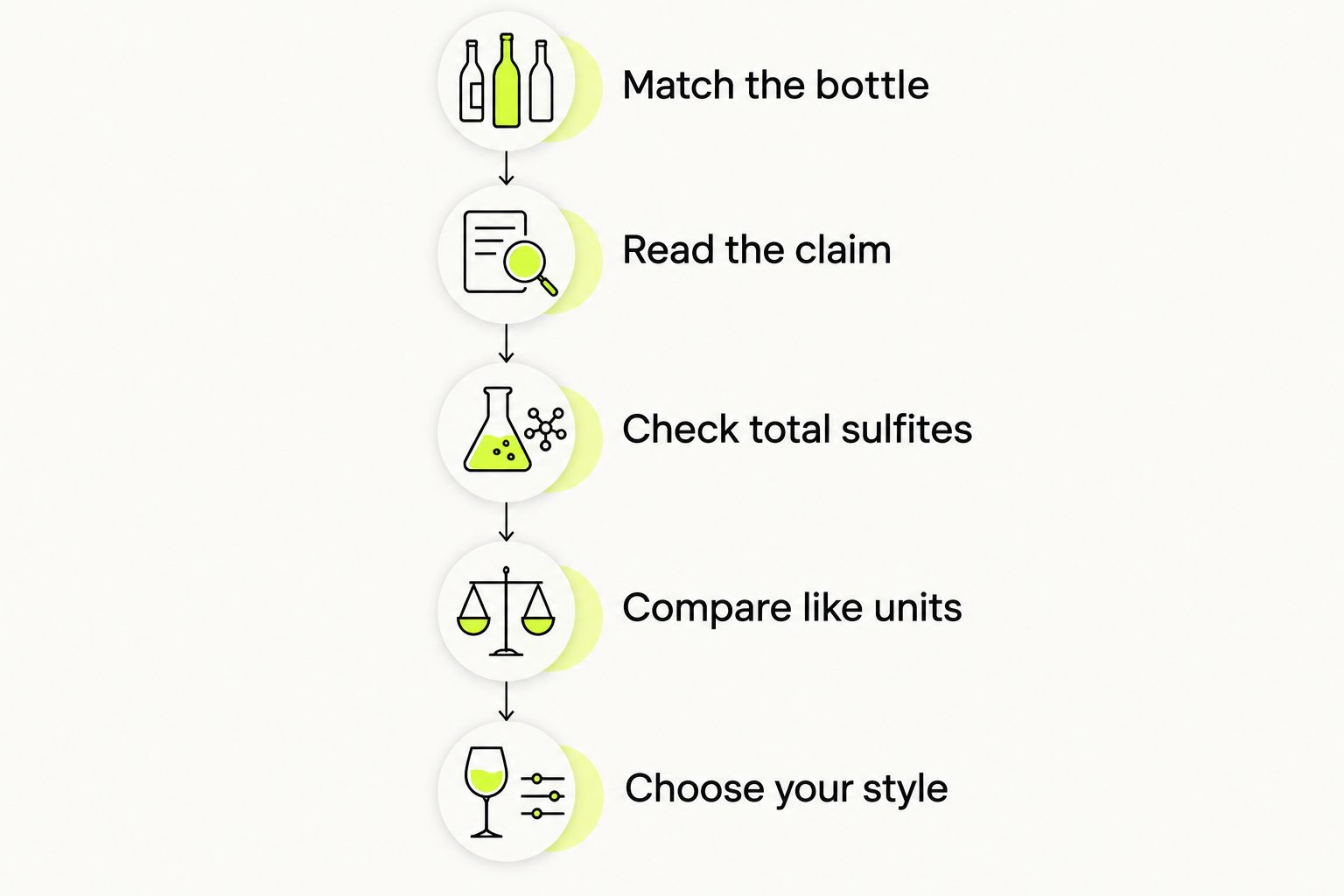
A useful question is: Does this exact vintage have a total-sulfite result, and is that different from its free-sulfur reading? That is more productive than asking whether a wine is clean.
If the answer only repeats natural-wine language, return to the measurement question. You do not need a complicated conversation. You need the right information attached to the right bottle.
How these options are ranked
The ranking prioritizes bottle-specific evidence, then a regulated production standard, then a direct statement about additions. Skin-contact wine comes last because it answers a style question rather than a sulfite question.
This is not a tasting-test ranking. The order reflects how directly each buying route supports your sulfite decision; flavor preference remains a separate choice.
Which low sulfite white wine should you choose?
Choose a white wine with current total-sulfite documentation as your default. It gives you the clearest comparison without asking you to interpret vague category language.
Choose USDA Organic white wine when certification is the deciding factor. Choose no-added-sulfites wine when avoiding deliberate additions is your priority. Choose Tinto Amorio orange wine when you want skin-contact texture, and verify its sulfite details separately.
For 2026, the strongest shortlist is not the longest. It is the one where every claim means something specific.
FAQ
What's the best low sulfite white wine to buy?
The strongest choice is a white wine with current, bottle-specific total-sulfite information. Compare the same measurement and units, then choose the style you enjoy.
Does organic white wine contain sulfites?
Organic white wine can contain naturally occurring sulfites. USDA Organic wine prohibits added sulfites, while wine labeled made with organic grapes follows different rules and can contain additions.
Does no added sulfites mean sulfite-free?
No added sulfites does not mean sulfite-free. Fermentation can produce sulfites naturally, so the statement describes additions rather than the finished wine's total concentration.
Is orange wine lower in sulfites than regular white wine?
Orange wine is not automatically lower in sulfites than other white wine. Skin contact describes how the wine is made, not its sulfur dioxide concentration.
What does contains sulfites mean on a US wine label?
A US wine label must declare sulfites when total sulfur dioxide reaches 10 parts per million or more. The statement does not disclose the exact concentration or distinguish added from naturally occurring sulfites.
Will low sulfite white wine prevent headaches?
Low sulfite white wine does not guarantee that you will avoid headaches. Alcohol itself can contribute to headaches, and recurring symptoms warrant advice from a healthcare professional.
Can I drink low sulfite wine if I have a sulfite sensitivity?
Do not treat low sulfite wine as safe for a diagnosed sulfite sensitivity. Ask your clinician whether drinking wine is appropriate, rather than using a category label as a safety threshold.
One last thing
A sulfite warning is a threshold statement, not a ranking. Two bottles carrying the same warning do not necessarily contain the same amount.
Before your next purchase, ask one precise question: What is the total sulfur dioxide for this exact wine? That answer is more useful than a shelf full of natural-sounding adjectives.