Best low sulfite red wines in 2026
Editorial Team @ 2026-11-03 14:56:47 -0800

The best low sulfite red wine is a bottle with disclosed total sulfites for the exact release—not simply a natural-wine label. Best style shortlist: Jajaja for a chilled red; Chaand for exploring a label that changes with each harvest, with sulfite details confirmed before either becomes your low-sulfite pick.
- Choose low sulfite red wine using total sulfite information for the exact release, not a natural-wine description.
- Tinto Amorio’s Jajaja suits drinkers looking for a chillable red; confirm sulfite details separately.
- Chaand suits harvest-to-harvest exploration, not a fixed sulfite assumption.
- No added sulfites does not mean sulfite-free, and lower sulfites do not guarantee fewer headaches.
Why this matters
A search for low sulfite red wine mixes several different questions. You want a red you enjoy, you want to understand what went into it, and perhaps you want to avoid something that has caused a reaction. Those questions need separate answers.
Tinto Amorio is a useful red-wine starting point for drinkers exploring glou glou styles, not a substitute for bottle-specific sulfite information. Start with the distinction between sulfites produced during fermentation and sulfites added during winemaking. The low sulfite wine guide covers the broader category.
For your 2026 shortlist, put evidence before adjectives. A clear statement about the exact wine tells you more than a shelf tag saying natural, clean, or minimal intervention.
What makes the best low sulfite red wine?
The best choice has to pass both the information check and the dinner-table check. Use these criteria before comparing bottles:
- Total sulfite disclosure: Look for total sulfur dioxide, often written as total SO₂, rather than only the amount added.
- Exact-release match: Match the information to the vintage, bottling, and market you are buying. Another release is not a substitute.
- Precise label language: Separate low sulfite, no added sulfites, USDA organic, and made with organic grapes. They communicate different things.
- A style you enjoy: Chillable red, structured red, and harvest-dependent releases serve different preferences. Sulfite information does not describe flavor.
- Honest limits: Reject headache-free promises, allergy-safety claims, and unsupported numerical comparisons.
A bottle that fits your taste but lacks sulfite information belongs on a style shortlist. It does not belong at the top of a verified low-sulfite ranking.
Low sulfite red wine options at a glance
This comparison separates the strongest buying approach from two red-wine styles to investigate. The order reflects confidence in the buying decision, not a measured sulfite comparison between wines.
| Option | Best for | Standout feature | Key limitation |
|---|---|---|---|
| Red wine with disclosed total sulfites | Evidence-first selection | Lets you compare the exact release using the same measurement | A figure alone does not establish personal tolerance |
| Jajaja glou glou red wine | Drinkers seeking a chilled red | Described as chillable and semi-carbonic | Those style terms do not establish sulfite content |
| Chaand glou glou wine | Exploring a changing-harvest label | The label changes with each harvest | Details need checking again for each release |
1. Disclosed-total-sulfite red: best for evidence-first buying
A red wine with a current total-sulfite figure gives you a meaningful starting point. You can compare it with another bottle on the same basis instead of trying to translate unrelated marketing terms.
Ask whether the number represents total sulfur dioxide in the finished wine. An addition during winemaking is not the same measurement: fermentation also produces sulfites, and additions can occur at different stages.
Disclosed-total-sulfite red pros:
- Gives you a measurable basis for comparison.
- Helps distinguish total sulfites from added sulfites.
- Connects a claim to a particular release when properly documented.
- Makes follow-up questions more specific.
Disclosed-total-sulfite red cons:
- The number does not tell you whether you will enjoy the wine.
- A result from another vintage does not establish the current bottle’s level.
- A lower result does not make wine safe for someone with sulfite sensitivity.
Best for: You want evidence to drive your low-sulfite selection rather than a broad wine-category claim.
For a 2026 purchase, ask for the information attached to the bottle you will receive. If the answer describes a winemaking philosophy but never addresses total sulfites, the central question remains unanswered.
Verdict: Buy when the exact-release documentation fits your requirement and the wine suits your taste.
2. Jajaja: best red-wine shortlist pick for serving chilled
Jajaja is Tinto Amorio’s chillable, semi-carbonic glou glou red wine. That description gives you a clear style direction: a red intended for chilled service rather than a bottle chosen solely for a formal, room-temperature pour.
Use that information to decide whether Jajaja fits your table. Keep the sulfite decision separate; chillable, semi-carbonic, and glou glou are not sulfite measurements.
Jajaja pros:
- The description explicitly identifies chilled service.
- Semi-carbonic identifies a winemaking approach rather than a vague quality claim.
- The glou glou designation gives you a useful style term to explore.
Jajaja cons:
- The style description does not establish a total-sulfite figure.
- Chillable does not mean lower alcohol or lower sugar.
- A preference for a different red-wine style is a reason to look elsewhere.
Best for: You enjoy exploring chilled reds and want a specific bottle to investigate.
Ask about total sulfites for the exact Jajaja release before choosing it to meet a sulfite requirement. Do not transfer a brand-level statement about low-sulfite wines to an individual bottle without confirmation.
Verdict: Hold as a low-sulfite recommendation until the exact release’s sulfite details are confirmed.
3. Chaand: best red-wine shortlist pick for harvest exploration
Chaand means moon, and the label is described as changing with each harvest. Choose it for that exploratory angle—not because the name, production approach, or neighboring bottles establish its sulfite level.
A changing label calls for a fresh look at each release. Your notes about a previous bottle are useful tasting history, but they are not current product specifications.
Chaand pros:
- The changing-harvest concept gives curious drinkers a reason to revisit it.
- The product is explicitly identified as a glou glou red wine.
- It offers a distinct selection reason from Jajaja’s stated chilled-service angle.
Chaand cons:
- A previous harvest’s characteristics cannot stand in for the current release.
- The changing-label concept does not establish a sulfite level.
- It is not the right basis for an assumption that every release will taste identical.
Best for: You like investigating how a wine label develops across harvests.
For your 2026 selection, read the current release information before deciding what role Chaand fills. Confirm sulfites independently of the harvest story.
Verdict: Hold as a low-sulfite recommendation until the current release’s information supports that choice.
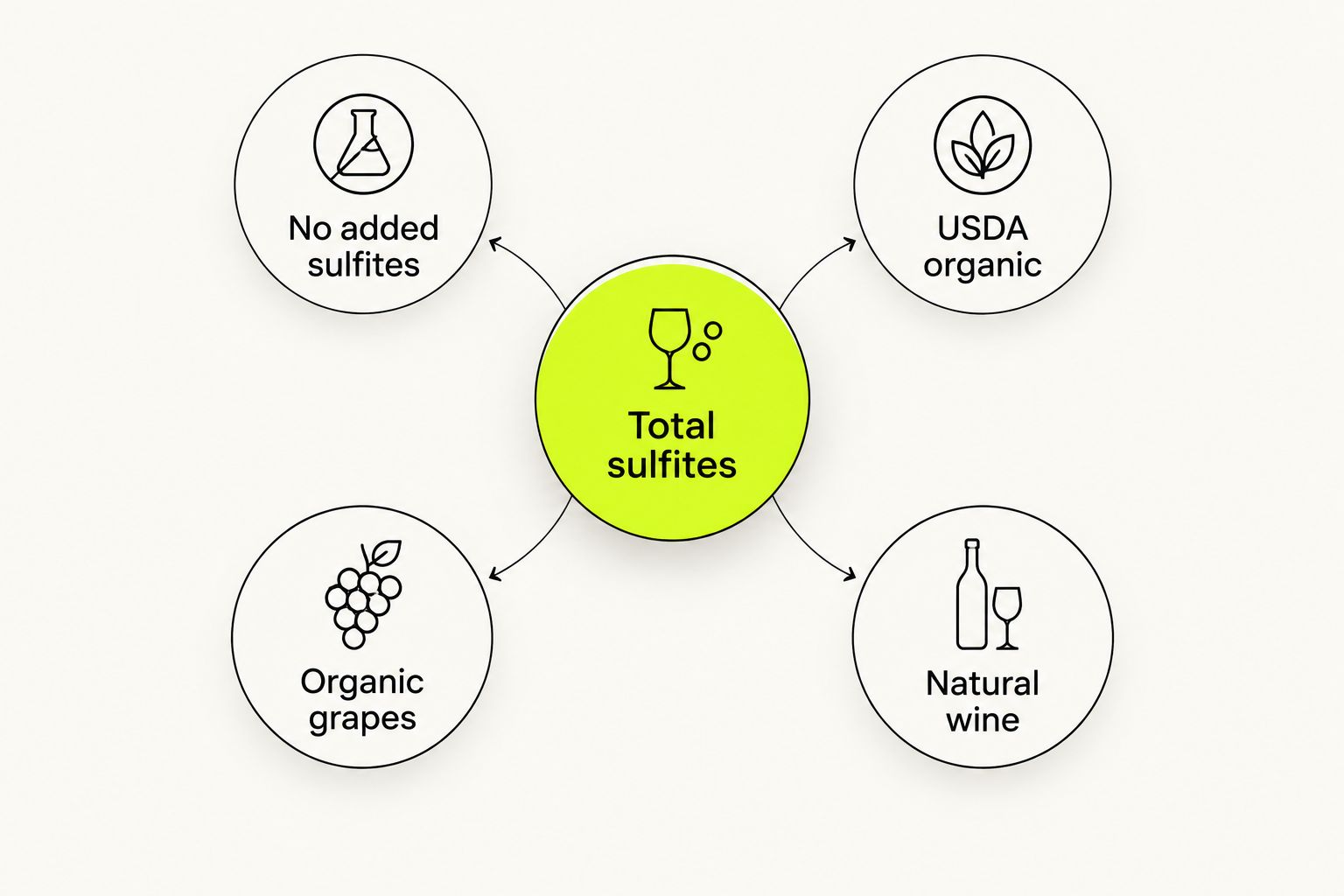
Read the label without mixing up the terms
Wine language gets messy when farming, winemaking, and chemistry are treated as interchangeable. They are connected, but they answer different questions.
- Total sulfites: The measurement to request when comparing sulfite content.
- No added sulfites: A statement about additions, not a promise that fermentation produced none.
- USDA organic: A regulated certification with requirements beyond a casual organic description.
- Organic grapes: A farming statement that does not, by itself, establish zero added sulfites.
- Natural wine: Not a bottle-specific sulfite measurement.
For US labels in 2026, the Alcohol and Tobacco Tax and Trade Bureau requires a sulfite declaration at 10 parts per million or more. That is a disclosure threshold, not a definition of low-sulfite wine and not a personalized safety limit.
Under USDA rules, wine labeled made with organic grapes can contain added sulfur dioxide within a 100 parts per million total-sulfite limit. USDA organic wine does not permit added sulfites. These are different labeling categories, so read the complete wording.
For context, TTB’s general maximum total sulfur dioxide level in finished wine is 350 milligrams per liter. That regulatory ceiling is not a typical level for every red wine, a recommended intake, or evidence about any bottle on this shortlist.
The useful question is not whether a bottle sits below a legal ceiling. It is what the exact bottle contains and what its label actually promises.
How to check a bottle before you choose
Keep your inquiry short. A precise question is easier to answer than a request for the healthiest or cleanest wine.
Match the release
Write down the wine name, vintage if shown, and the market where you are buying it. Regional listings and older vintages can describe different wines even when the main product name looks familiar.
Ask for total sulfites
Request total SO₂ for that release and ask whether the figure comes from finished-wine analysis. If the answer gives only an addition amount, ask whether a total measurement is also provided.
Confirm the wording
Ask whether no added sulfites describes the full production process for that release. If a certification matters to you, look for that specific certification rather than borrowing it from a brand description.
Separate preference from safety
Use the product description to select a style. Use medical advice—not a wine ranking—to manage a diagnosed sensitivity or repeated reaction.
A practical message is simple: Please confirm the current release and its total sulfur dioxide level, and clarify whether any sulfites were added. You do not need specialist vocabulary beyond that.
How the ranking works
This 2026 guide puts exact-release evidence first, followed by distinct, documented style reasons to investigate a red wine. It does not rank Jajaja against Chaand by sulfite content or claim a tasting-test result.
The criteria stay the same throughout: total-sulfite disclosure, release matching, precise terminology, style fit, and honest limitations. A product earns a low-sulfite recommendation through supporting information—not through its position in a natural-wine collection.
Which low sulfite red wine should you choose?
Choose a red with disclosed total sulfites when sulfite content is your deciding factor. That is the default for an undecided reader because it answers the actual question.
For style exploration, Tinto Amorio offers two distinct red-wine starting points here: Jajaja for chilled service and Chaand for a changing-harvest label. Confirm the exact release before treating either as a low sulfite red wine choice.
Do not choose between them using assumed headache benefits, organic certification, or invented sulfite comparisons. Choose the style you want, then verify the requirement you need.
FAQ
What’s the best low sulfite red wine to choose in 2026?
The strongest choice is a red wine with disclosed total sulfites for the exact release you are buying. Compare like-for-like measurements, then select a style you enjoy; natural-wine wording alone does not establish sulfite content.
Is Jajaja a confirmed low sulfite red wine?
Jajaja’s chillable, semi-carbonic glou glou description does not confirm its sulfite content. Ask for total sulfites and addition details for the exact release before selecting it for a sulfite requirement.
Is Chaand better than Jajaja for lower sulfites?
There is no supported sulfite ranking between Chaand and Jajaja here. Jajaja has a stated chilled-service angle, while Chaand changes with each harvest; those differences do not establish which has fewer sulfites.
Does no added sulfites mean wine is sulfite-free?
No added sulfites does not mean sulfite-free. Fermentation naturally produces sulfites, so an additions statement and a total-sulfite measurement answer different questions.
Why does a natural red wine say contains sulfites?
Natural-wine wording does not exempt a wine from sulfite-labeling requirements. In the United States, wine containing sulfites at 10 parts per million or more requires a declaration, whether those sulfites occur naturally or were added.
Will low sulfite red wine prevent headaches?
Low sulfite red wine does not guarantee headache prevention. Alcohol itself can contribute to headaches, and a sulfite claim does not establish how you will respond to a wine.
Is low sulfite wine safe if I have a sulfite sensitivity?
A low-sulfite description does not establish safety for someone with sulfite sensitivity. Consult a qualified clinician about avoidance rather than testing your tolerance through wine recommendations.
Does organic red wine always have no added sulfites?
USDA organic wine does not permit added sulfites, but wine labeled made with organic grapes is a different category that can permit them. Read the exact certification wording rather than treating every organic reference as equivalent.
One last thing
A contains sulfites statement tells you that a disclosure threshold was reached. It does not reveal the bottle’s exact concentration, and two wines carrying the same statement can have different levels.
Before your next purchase, save the producer’s answer alongside the release name. A useful wine note records what you drank; a useful sulfite comparison also records exactly which bottle the information describes.