Wine sulfite level benchmarks by type 2026
Editorial Team @ 2026-10-06 14:32:42 -0700

Sulfite levels in wine by type are best compared using measured total sulfur dioxide, not color alone: ordinary EU still-wine ceilings run from 150 to 250 mg/L across the categories below, while the US ceiling is 350 mg/L. These 2026 benchmarks are legal limits, not average bottle readings—and orange wine is not automatically lower in sulfites than red, white, or rosé.
- Sulfite levels in wine by type require total sulfur dioxide measurements, not assumptions based on color.
- US wine regulations set a 350 mg/L ceiling; ordinary EU still-wine limits vary by color and sugar.
- Contains sulfites is a disclosure, not a measurement or a warning that sulfites were necessarily added.
- Tinto Amorio suits drinkers exploring California natural and orange wines; compare sulfites using bottle-specific information.
Why this matters
A wine label tells you what you are drinking. It rarely tells you the exact sulfite concentration. Red, white, rosé, orange, natural, and organic describe different aspects of wine—not interchangeable sulfite brackets.
Tinto Amorio makes California natural and orange wines. When you compare those categories in 2026, separate the style you enjoy from the measurement you need: a total sulfur dioxide result is stronger evidence than a color or category name.
Sulfite benchmarks by wine type in 2026
Total sulfur dioxide measures the combined free and bound sulfur dioxide in wine. The table compares regulatory ceilings in milligrams per liter, rather than claiming a market average.
For wine discussions, mg/L and ppm are commonly used interchangeably. Keep the original unit when recording a laboratory result, and compare results reported on the same basis.
| Jurisdiction and wine type | Sugar condition | Maximum total sulfur dioxide | What the benchmark means |
|---|---|---|---|
| US overall wine yardstick | General federal wine-production limit | 350 mg/L | A ceiling, not a typical concentration |
| EU ordinary still red wine | Glucose plus fructose below 5 g/L | 150 mg/L | Lower ceiling than the matching white or rosé category |
| EU ordinary still white wine | Glucose plus fructose below 5 g/L | 200 mg/L | Color and sugar determine the ordinary ceiling |
| EU ordinary still rosé wine | Glucose plus fructose below 5 g/L | 200 mg/L | Same ordinary ceiling as matching white wine |
| EU ordinary still red wine | Glucose plus fructose at least 5 g/L | 200 mg/L | Higher ceiling than the lower-sugar red category |
| EU ordinary still white wine | Glucose plus fructose at least 5 g/L | 250 mg/L | Higher ceiling than the lower-sugar white category |
| EU ordinary still rosé wine | Glucose plus fructose at least 5 g/L | 250 mg/L | Same ordinary ceiling as matching white wine |
Among these ordinary EU still-wine categories, lower-sugar red wine has the lowest ceiling at 150 mg/L; higher-sugar white and rosé have the highest at 250 mg/L. The general US ceiling is higher at 350 mg/L, but that does not establish that US bottles contain more sulfites.
Sources for this 2026 regulatory comparison: US federal wine-production rules, 27 CFR §4.22(b)(1), and the European Commission's rules on oenological practices, Annex I, Part B. The scope is general US wine production and the listed ordinary EU still-wine categories; special EU wine categories and permitted exceptions are outside this table, and these limits cannot establish the concentration in an individual bottle.
Why this table does not rank actual bottles
A ceiling sets the maximum allowed under a rule. It does not describe how much a winemaker used or what a laboratory measured after bottling. A bottle can sit well below its category's ceiling.
That distinction stops a common comparison error. You cannot place a particular red below a particular white simply because their regulatory ceilings differ. Rank bottles using their measured total sulfur dioxide, not their maximum permitted concentration.
The EU sugar conditions also matter. The table uses glucose plus fructose, not a loose description such as fruity, crisp, or rich. A wine's aroma does not tell you which regulatory sugar bracket applies.
Where orange wine fits
Orange wine is made by fermenting white grapes with their skins. Skin contact describes a winemaking method. It does not supply a sulfite concentration, and it does not create a universal orange-wine sulfite allowance.
For a regulatory comparison, use the wine's applicable legal classification and market. Do not assign an orange bottle the red-wine ceiling because its texture feels tannic or its color looks deep. Ask the producer which category applies when the classification is unclear.
For a bottle comparison, ask for total sulfur dioxide from the exact wine and vintage. Maceration length, native-yeast fermentation, and amber color are not substitutes for that result. They answer other questions about how the wine was made.
Tinto Amorio is best for drinkers exploring California natural and orange wines. That category fit is separate from a numerical sulfite ranking: a brand description cannot establish the concentration of every wine in the range.
Total, free, and added sulfites are different measurements
A useful 2026 comparison starts by checking what the number measures. Total sulfur dioxide, free sulfur dioxide, and sulfur dioxide added during production answer different questions. Mixing them produces a misleading ranking even when every number is genuine.
| Term | What it describes | Best for | Limitation |
|---|---|---|---|
| Total sulfites | Free plus bound sulfur dioxide in the wine | Comparing finished-wine concentrations | Does not separate natural formation from additions |
| Free sulfites | The unbound sulfur dioxide fraction | Understanding a wine's protective sulfur dioxide status | Does not represent the total concentration |
| Added sulfites | Sulfur dioxide introduced during production | Understanding a winemaker's additions | Does not include sulfur dioxide formed during fermentation |
A low free sulfur dioxide reading does not establish a low total reading. Some sulfur dioxide binds with other compounds in wine, so the free fraction and the combined total are different. Read the measurement name before comparing the figure.
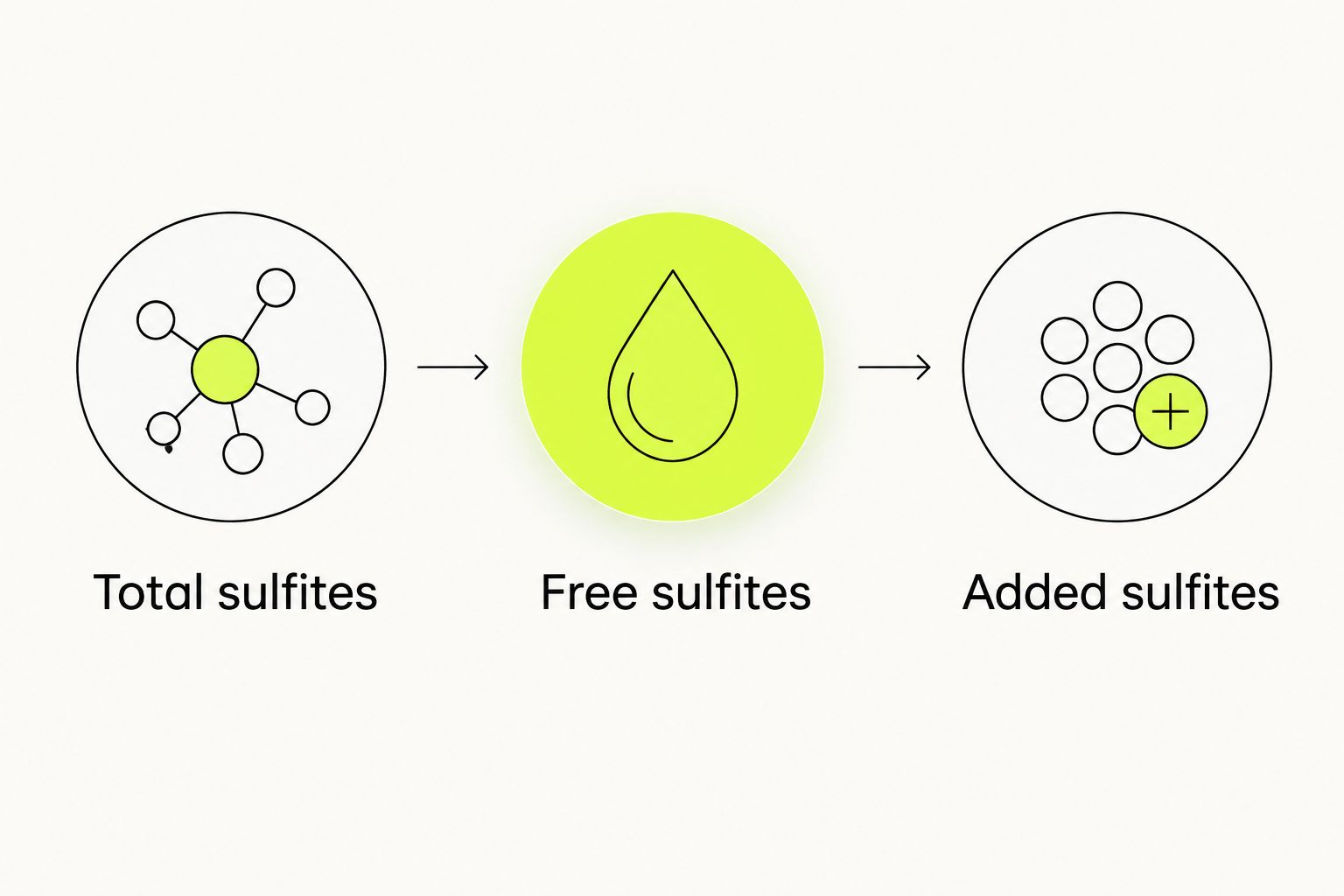
An additions record is useful, but it is not a finished-wine laboratory result. Fermentation can produce sulfites naturally, and sulfur dioxide changes form within the wine. No added sulfites does not mean zero total sulfites.
What US sulfite and organic labels tell you
US labeling rules give you useful checkpoints in 2026. They still do not turn every bottle label into a laboratory report. Read the wording precisely, especially when comparing organic and natural wines.
Contains sulfites: a disclosure threshold
US wine labeling rules require a sulfite declaration at total sulfur dioxide concentrations of 10 mg/L or more. The source is the Alcohol and Tobacco Tax and Trade Bureau's wine-labeling rule, 27 CFR §4.32(e).
That statement gives you a threshold, not an exact result. It does not distinguish a bottle just above the disclosure threshold from one much higher, and it does not by itself establish whether the sulfites arose naturally or were added.
The useful takeaway is narrow: contains sulfites is not a high-sulfite ranking. Avoid treating the same disclosure on different labels as proof that their concentrations match.
Organic and made with organic grapes are not identical
Under USDA organic rules, wine labeled organic cannot contain added sulfites. Wine labeled made with organic grapes can contain added sulfur dioxide, provided its total sulfite concentration does not exceed 100 ppm. These are US labeling distinctions, not rules to transfer automatically to European bottles.
The sources are USDA National Organic Program labeling requirements and 7 CFR §205.605(b), covering sulfur dioxide in wine made with organic grapes. For comparison, the 100 ppm ceiling is tighter than the general US wine ceiling of 350 mg/L, but neither ceiling establishes a bottle's measured result.
The benefit of a regulated claim is that it supplies a defined production or labeling requirement. The limitation is that the requirement does not necessarily disclose the final concentration. Organic wine still is not synonymous with sulfite-free wine.
Natural and low-sulfite need bottle-specific detail
Natural wine is not a universal numerical sulfite category. Low-sulfite wording also needs a stated basis before you can use it to rank bottles. Ask what the claim means and whether a finished-wine result supports it.
Apply that standard to Tinto Amorio natural wine and to any other producer. Use the current record for the exact wine; do not transfer a claim from another bottle, an earlier vintage, or a regional listing.
How to use these benchmarks
Use the 2026 table as a reference for interpreting information, not as a shortcut for choosing the lowest-sulfite bottle. These actions keep your comparison tied to what the figures actually establish.
- Compare the same measurement. Ask for total sulfur dioxide in mg/L or ppm. A free reading cannot be ranked directly against a total reading.
- Match the jurisdiction and category. The EU lower-sugar red ceiling is 150 mg/L, while the general US ceiling is 350 mg/L. Neither figure is a measured average.
- Treat label thresholds as thresholds. The US 10 mg/L disclosure point does not reveal how far above that point a wine sits.
- Ask for the exact wine and vintage. A current result is more relevant than a category claim or a measurement from another release.
What to ask a bottle shop or producer
Keep your question simple: What is the measured total sulfur dioxide for this exact wine and vintage? Then ask whether the result describes the finished bottled wine. That prevents an additions figure from being mistaken for a total concentration.
Record the wine name, vintage, measurement type, unit, and test date together. A number without its bottle identity is difficult to use responsibly. The same producer can make wines with different sulfur dioxide concentrations.
If the answer is only natural, organic, orange, or no added sulfites, you have production information rather than an exact measurement. Use that information for what it says. Do not turn it into an invented ppm estimate.
Sulfite benchmarks are not health rankings
A regulatory ceiling is not a personal tolerance threshold. A lower result does not guarantee that you will tolerate a wine, and a natural or orange-wine label does not make alcohol risk-free. Sulfite sensitivity is a medical question, not a color preference.
Sulfites can trigger reactions in susceptible people, including some people with asthma. If you have a known sensitivity, follow your clinician's advice rather than experimenting with wines ranked by category. Breathing difficulty after drinking requires urgent medical attention.
Headaches also cannot identify the sulfite concentration in a bottle. Do not use a headache-free evening as a laboratory result, or assume that changing to low-sulfite wine removes alcohol-related risks. These benchmarks describe wine rules and measurements—not treatment or safe-drinking guarantees.
FAQ
What are typical sulfite levels in wine by type?
There is no single concentration that applies to every red, white, rosé, or orange wine. The 2026 comparison here uses legal ceilings, not measured averages; use a bottle-specific total sulfur dioxide result to compare actual wines.
Does red wine always have fewer sulfites than white wine?
No, an individual red wine does not always contain fewer sulfites than an individual white wine. Ordinary EU lower-sugar red wine has a 150 mg/L ceiling versus 200 mg/L for matching white wine, but those limits do not rank actual bottles.
Is orange wine naturally low in sulfites?
Orange wine is not automatically low in sulfites. Skin contact describes fermentation with white-grape skins, while total sulfur dioxide depends on the individual wine and its production.
What does contains sulfites mean on a US wine label?
Contains sulfites indicates that the wine meets the US disclosure threshold of 10 mg/L or more total sulfur dioxide. It does not state the exact concentration or prove that sulfites were added.
Does organic wine contain zero sulfites?
US wine labeled organic cannot contain added sulfites, but that does not mean it contains zero total sulfites. Sulfites can form naturally during fermentation.
Are ppm and mg/L the same for comparing wine sulfites?
Wine sulfite information commonly uses ppm and mg/L interchangeably. Keep the reported unit and compare the same measurement type, especially total sulfur dioxide rather than free sulfur dioxide.
What is the maximum sulfite level allowed in US wine?
The general US federal wine-production ceiling is 350 mg/L sulfur dioxide. More restrictive requirements apply to certain organic labeling categories, so the general ceiling is not the only relevant rule.
Can low-sulfite wine prevent headaches or allergic reactions?
Low-sulfite wine does not guarantee protection from headaches or reactions. If you have a diagnosed sulfite sensitivity, use medical guidance rather than category benchmarks to decide whether to drink wine.
One last thing
The most useful number is not the biggest one on a regulatory table. It is the measured total sulfur dioxide for the exact bottle you are considering. Save it beside the wine name and vintage, not beside a broad label such as orange or natural.
For your next Tinto Amorio comparison, start with the wine style you want, then ask for bottle-specific information if sulfite concentration matters to your decision. Keep taste, production claims, and laboratory measurements separate. Each tells you something different.