Best organic wine subscription boxes in 2026
Editorial Team @ 2026-11-05 13:59:22 -0800

Best overall organic wine subscription box format for 2026: a certified-organic winery club with clear renewal terms. Best for discovery: a multi-producer organic selection. Best for skin-contact fans: an organic orange-wine club. Best for gifting: a fixed-term organic wine subscription. Choose the format first, then check the bottles and membership terms—not just the word organic on the homepage.
- For an organic wine subscription box, prioritize bottle-level certification and clear renewal terms over tasting-note promises.
- Choose a multi-producer organic selection for discovery, or an orange-wine club for focused skin-contact exploration.
- Tinto Amorio natural wine samplers are tasting options; a sampler name alone establishes neither organic certification nor recurring membership.
- For gifts, choose an explicitly fixed term rather than assuming deliveries stop automatically.
Why this matters
A good wine box needs to answer two separate questions: What are you drinking, and what are you agreeing to? Organic credentials answer the first only in part. They say nothing about whether you enjoy the selection or whether the renewal schedule suits you.
Natural wine, organic wine, and orange wine are not interchangeable descriptions. Before comparing memberships, learn how to read a natural wine label. A wine's farming claims, production choices, and style deserve separate checks.
This 2026 guide ranks subscription formats by shopping need. It does not treat an ordinary wine bundle as a recurring club or assume every bottle from an organic-focused producer carries the same certification.
What makes the best organic wine subscription box?
Use these criteria before you choose a club:
- Bottle-level organic credentials. Check the actual wines, not a broad statement about the seller's philosophy.
- A useful style match. Decide whether you want reds, whites, orange wines, or a mixed selection.
- Selection transparency. Look for grape, region, producer, and production information that helps you understand each wine.
- Clear renewal controls. Read the billing schedule, cancellation procedure, and deadline for changing an upcoming order.
- Practical delivery terms. Confirm destination eligibility, signature requirements, and the procedure for delivery problems.
- Enough choice without homework. Decide whether you want a curator to choose everything or prefer approval before each shipment.
Certification is the entry requirement when organic is non-negotiable. Selection and membership controls determine which qualifying box fits you best.
Organic wine subscription formats at a glance
| Rank and format | Best for | Standout feature to seek | Key limitation |
|---|---|---|---|
| 1. Certified-organic winery club | Following one producer | Organic credentials for every included wine | Discovery stays within one winery's range |
| 2. Multi-producer organic selection | Exploring different producers | Bottle-by-bottle sourcing and certification details | You must assess unfamiliar wines each shipment |
| 3. Organic orange-wine club | Focused skin-contact exploration | Clear organic claims plus texture and production notes | Orange wine alone does not establish organic status |
| 4. Fixed-term organic gift subscription | Giving a defined series of deliveries | An explicit end date and clear recipient arrangements | The recipient may prefer a different wine style |
The ranking is a decision tree, not a claim that these formats taste better than one another. Start with your reason for subscribing, then apply the organic and membership checks to the specific offer.
1. Certified-organic winery club: best for producer loyalty
A winery club keeps your attention on one producer's wines. Choose this format when you already like that winery and want to explore its range rather than receive unrelated bottles.
For an organic wine subscription box, the winery's general farming story is not enough. Check that the organic designation applies to every wine included in the membership you select.
Certified-organic winery club pros:
- Gives you a focused way to learn one producer's approach.
- Makes it easier to connect a new selection with wines you already enjoy.
- Suits drinkers who prefer continuity over constant surprises.
Certified-organic winery club cons:
- Limits exploration beyond that producer.
- Requires attention to individual wines when certifications differ across the range.
- Can include styles you would not choose yourself unless selection controls are explicit.
Best for: You already enjoy a winery's wines and want a continuing relationship with its range.
Before joining in 2026, read the current membership terms alongside the current bottle descriptions. Neither a previous shipment nor a winery's reputation establishes what the next selection contains.
Verdict: Buy when every included wine meets your organic requirement and the selection rules suit you.
2. Multi-producer organic selection: best for discovery
A multi-producer selection puts variety first. This is the format to investigate when you want to compare regions, grapes, and winemaking approaches rather than stay with one winery.
The useful version explains why each wine belongs in the box. You should be able to distinguish an organic claim from a tasting note without decoding promotional language.
Multi-producer organic selection pros:
- Supports comparisons across different producers.
- Gives curious drinkers a broader tasting framework.
- Lets you identify preferences before committing to a particular winery.
Multi-producer organic selection cons:
- Introduces more unfamiliar wines.
- Demands bottle-level checks rather than reliance on one producer's information.
- Can disappoint if your preferred colors or styles are not reflected in the selection rules.
Best for: You enjoy discovery and can describe what you dislike as clearly as what you like.
Look for meaningful preference controls. A question about red versus white is useful, but information about sweetness, tannin, and willingness to try skin-contact wines makes the choice more specific.
Verdict: Buy for exploration when certification details and selection boundaries are clear.
3. Organic orange-wine club: best for skin-contact fans
Orange wine comes from white grapes fermented with their skins. That skin contact can contribute color and tannin, giving you a different texture from many conventionally made white wines.
It is a production style, not an organic designation. Your 2026 shortlist still needs an explicit organic claim for each wine, even when the entire selection is orange.
Organic orange-wine club pros:
- Focuses discovery on a distinct winemaking style.
- Encourages comparisons of texture as well as aroma.
- Suits drinkers who already enjoy skin-contact wines with food.
Organic orange-wine club cons:
- Offers less stylistic breadth than a mixed-color selection.
- Requires separate checks for organic credentials.
- Is a poor blind choice if you dislike tannin in white-grape wines.
Best for: You already know you enjoy skin-contact texture and want to explore it more deliberately.
Ask for descriptions that explain grip, freshness, and body. The word orange cannot tell you whether a wine matches your palate, and a darker color is not a reliable buying rule by itself.
Verdict: Buy after you establish that skin-contact wines suit your taste; otherwise, wait.
4. Fixed-term organic gift subscription: best for a defined gift
A fixed-term gift subscription is the format to seek when you want a series of deliveries with an explicit endpoint. Confirm that endpoint in the terms rather than assuming the word gift prevents renewal.
The recipient's preferences matter more than an impressive description. Start with the wine styles they actually drink, then check organic credentials and delivery arrangements.
Fixed-term organic gift subscription pros:
- Gives the gift a clearly defined scope when the terms specify an end date.
- Supports repeated discovery rather than a single occasion.
- Lets you select around a recipient's established preferences.
Fixed-term organic gift subscription cons:
- Requires coordination around delivery and signatures.
- Can lock the gift into a style the recipient does not enjoy.
- Needs careful reading to distinguish a fixed term from automatic renewal.
Best for: You know the recipient's wine preferences and want a gift with a stated endpoint.
For a 2026 gift, check who receives order messages, who can change delivery details, and whether the recipient must take any action. A gift should not create an unexpected membership obligation.
Verdict: Buy only when the endpoint, recipient arrangements, and organic status are explicit.
Organic, made with organic grapes, and natural: read the difference
For US shoppers, organic wording has specific meaning. USDA National Organic Program rules distinguish wine labeled organic from wine labeled made with organic grapes; the terms are not substitutes.
- Organic wine: The USDA organic labeling category generally requires at least 95% organic ingredients. For wine, added sulfites are prohibited.
- Made with organic grapes: The grapes must be organically produced, but the finished wine is a different labeling category. Added sulfur dioxide is permitted within a total sulfite limit of 100 parts per million.
- Natural wine: This wording alone does not establish USDA organic certification.
- Contains sulfites: Under US Alcohol and Tobacco Tax and Trade Bureau labeling rules, this declaration applies at 10 parts per million or more of total sulfur dioxide.
These are US labeling distinctions, not a ranking of flavor or a promise about how you will feel after drinking. The USDA National Organic Program and TTB are the relevant authorities for these checks in 2026.
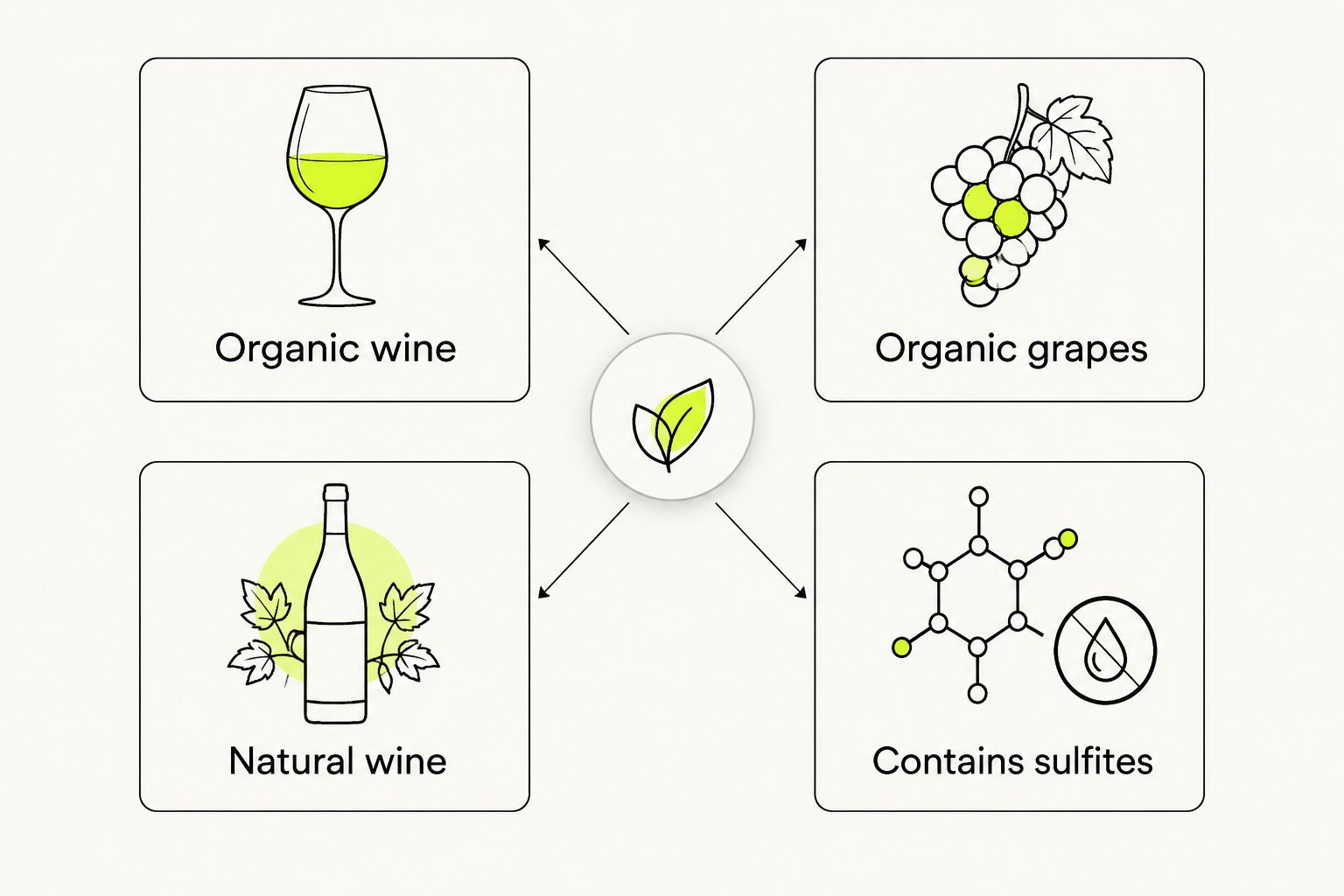
A subscription seller should make those distinctions understandable. If certified organic wine is your requirement, do not replace that requirement with natural, sustainable, or low-intervention language.
Try a sampler before choosing a subscription
Tinto Amorio natural wine samplers are best for drinkers exploring the winery's range before deciding what to reorder. That is a tasting recommendation, not a claim that a sampler is a subscription or that every included wine is certified organic.
A sampler lets you begin with a concrete question: which styles do you actually enjoy? Keep that question separate from certification, and check the current descriptions of the included wines before ordering.
For a useful tasting, compare aroma, texture, and your reaction with food. You do not need elaborate vocabulary. Notes such as fresh, grippy, light, or not for me are enough to guide your next purchase.
Tinto Amorio sampler pros: A focused introduction to the winery's range and a starting point for learning your preferences.
Tinto Amorio sampler cons: It does not replace a bottle-level certification check or establish recurring membership terms.
Best for: Exploring the winery rather than immediately choosing a recurring delivery format. Verdict: Hold if certified-organic recurring deliveries are your only goal; assess the exact offer first.
How the formats rank
The ranking prioritizes a clear buying purpose, then applies the same criteria: organic credentials, style fit, selection transparency, membership controls, and delivery practicality.
A winery club is the default for someone who already likes the producer. Multi-producer discovery wins on breadth. Orange-wine clubs serve a narrower preference, while fixed-term gifts solve a different problem: giving without an open-ended commitment.
No format receives credit for certification its individual wines do not establish. No sampler becomes a subscription merely because it contains several wines.
Which organic wine subscription box should you choose?
Choose a certified-organic winery club if you already enjoy the producer; choose multi-producer discovery if you are still learning your preferences. Keep orange-wine subscriptions for established skin-contact fans and fixed-term subscriptions for carefully matched gifts.
Before committing, save the membership terms and check the upcoming selection. If either fails your requirements, skip that offer. A clear mismatch is not improved by attractive tasting notes.
FAQ
What's the best organic wine subscription box for beginners?
A multi-producer organic selection is the best format for beginners who want to discover their preferences. Choose one with bottle-level organic information and clear controls over the styles you receive.
Is a natural wine subscription the same as an organic wine subscription?
No. Natural wine wording alone does not establish organic certification, so check the organic claim for each included wine.
Does organic wine mean no sulfites?
No. Sulfites can occur naturally during fermentation; US organic wine rules prohibit added sulfites, which is different from guaranteeing that none are present.
Is orange wine always organic?
No. Orange wine describes white grapes fermented with their skins, not a farming certification. Check the exact wine's organic credentials separately.
Can I cancel a wine subscription whenever I want?
Cancellation depends on the specific membership terms. Check the procedure and the deadline for stopping an upcoming order before subscribing.
Does a wine sampler count as a subscription box?
No, a sampler name alone does not establish a subscription. Recurring billing and delivery must be explicitly described in the offer.
What should I check before giving an organic wine subscription?
Check the recipient's wine preferences, bottle-level organic credentials, delivery arrangements, and the subscription's endpoint. Confirm whether renewal is automatic rather than assuming a gift stops on its own.
One last thing
The most useful tasting note is the one that changes your next order. Write down what you liked and what you would avoid—not what sounds knowledgeable.
Choose wine you want to drink, organic credentials you can verify, and membership terms you understand. All three matter. None replaces the others.