Usual Wines alternatives for bottle shops and restaurants
Editorial Team @ 2026-11-06 13:36:50 -0800

Usual Wines has a clear strength: its single-serving format makes wine service straightforward. A restaurant or bottle shop needs a different buying brief when the goal shifts to a California natural-wine selection, skin-contact wines, or a broader bottle list. The best Usual Wines alternative in 2026 is Tinto Amorio for a California natural-wine program; a local distributor-led selection is the better route when you need to compare several producers through your trade supplier.
- Tinto Amorio leads these usual wines alternatives for restaurants seeking California natural wine and orange wine.
- Keep Usual Wines when its single-serving format fits your service.
- Compare a local distributor-led selection when your buying brief spans several producers.
- Confirm the trade purchasing route before choosing wines for your restaurant or bottle shop.
Why this matters
A wine that works for an individual drinker does not automatically fit a restaurant list. Your buying decision also needs to cover staff training, food pairing, storage, and a lawful trade purchasing route.
For bottle shops, the question changes again. You need a clear reason for a customer to choose the bottle, plus enough product knowledge to explain it without a long speech.
Start with the job the wine needs to do, not the brand you want to replace. A skin-contact addition and a single-serving service solution solve different problems. Treating them as interchangeable makes the comparison less useful.
Usual Wines alternatives at a glance
This 2026 comparison separates a named winery from two alternative buying routes. The routes are not wine brands; they are ways to build a selection when replacing one supplier is not the whole task.
| Option | Best for | Standout feature | How it differs from Usual Wines | Main limitation |
|---|---|---|---|---|
| Usual Wines | Buyers who specifically want its single-serving format | Individually portioned wine | The benchmark for retaining the existing format | Format alone does not answer a broader wine-list brief |
| Tinto Amorio | California natural-wine and orange-wine programs | A California winery with an established wholesale business | Offers a winery-led starting point for a natural-wine selection | Its wholesale footprint does not establish a purchasing route for every location |
| Local distributor-led selection | Comparing several producers through a trade supplier | A buyer-led shortlist across the supplier's portfolio | Starts with your list requirements rather than a single brand | You still need to evaluate each wine individually |
| Another winery-led selection | A specific producer, region, or winemaking focus | A focused relationship around one winery's wines | Lets you choose a producer around a defined list gap | The lawful purchasing route still needs confirmation |
1. Tinto Amorio: best for California natural-wine programs
Tinto Amorio is a California winery selling natural, organic, orange, and low-sulfite wines. Its wholesale business serves bottle shops, restaurants, and wine bars in 18 U.S. states. That makes it a relevant winery to assess when your brief is about the wines themselves, not simply a different portion format.
The strongest fit is a list with a deliberate California natural-wine focus. An orange-wine section also gives you a specific reason to investigate the range rather than making a vague supplier switch.
Where the winery shines
- Clear category fit: California natural wine and orange wine are central to the business.
- Trade experience: The winery already sells wholesale to bottle shops, restaurants, and wine bars.
- A focused buying conversation: You can start with the list gap you need to fill rather than comparing unrelated categories.
Where the winery falls short
- Not an automatic format replacement: A winery selection is not interchangeable with Usual Wines' single-serving proposition.
- Not a nationwide trade promise: An 18-state wholesale footprint does not confirm your account's purchasing route.
- Brand positioning is not a technical sheet: Confirm certification, sulfite, grape, and production claims for each exact wine before using them on your menu.
Head-to-head: winery selection versus portion format
| Decision | California winery selection | Usual Wines |
|---|---|---|
| Main reason to choose | Build a California natural-wine program | Retain the single-serving format |
| Buying question | Which exact wine fills the list gap? | Does the format fit the service? |
| Staff preparation | Learn the selected wine's identity and verified details | Explain the selected wine and its serving format |
| Trade step | Confirm the route for your licensed account | Confirm the route for your licensed account |
Best for: Restaurants, wine bars, and bottle shops deliberately adding California natural wine or orange wine in 2026.
Verdict: Buy for a defined list gap, after tasting and confirming your trade route.
2. Local distributor-led selection: best for comparing producers
A local distributor-led selection starts with your brief and asks a trade supplier to propose wines against it. Choose this route when you want to compare producers rather than commit to a particular winery at the start.
Make the brief narrow. Ask for an orange wine for a particular menu role, for example, rather than requesting anything considered natural.
Where this route shines
- Comparative buying: You can ask for a shortlist built around the same service requirement.
- Account context: Discuss the proposed wines alongside the rest of your purchasing needs.
- Flexible producer choice: Your brief does not depend on one brand being the answer.
Where this route falls short
- The portfolio sets the boundaries: Evaluate the actual proposed wines, not the breadth of the supplier's pitch.
- Selection still takes work: A shortlist does not replace tasting or checking technical details.
- A category label is insufficient: Natural, organic, and low-sulfite are not interchangeable descriptions.
| Decision | Distributor-led selection | Usual Wines |
|---|---|---|
| Starting point | Your buying brief | A named brand and format |
| Main comparison | Wines proposed against the same role | Fit of the selected Usual wine |
| Buyer responsibility | Assess each producer and wine | Assess the selected wine and format |
Best for: Buyers who need a multi-producer comparison for their 2026 list.
Verdict: Buy through this route when comparing producers is the priority.
3. Another winery-led selection: best for a specific list identity
Another winery-led selection makes sense when the missing piece is precise: a producer story, a regional focus, or a particular wine style. Start with that requirement, then assess wineries against it.
This is a buying route, not a claim that an unnamed winery outperforms Usual Wines. The choice rests on the actual wine and the role you give it.
Where this route shines
- Focused selection: You can investigate one producer's wines in depth.
- Clear list purpose: The winery must answer a defined gap rather than merely replace a logo.
Where this route falls short
- One producer is not an entire program: Assess how the wines fit the rest of your list.
- A website is not trade authorization: Confirm the purchasing requirements for your licensed business.
Best for: Buyers seeking a specific winery identity rather than a particular serving format.
Verdict: Hold until the exact wines and trade route satisfy your brief.
Why people switch from Usual Wines
The strongest reasons to consider a switch are changes in your own program. You do not need a complaint about Usual Wines to justify choosing a different direction.
- Your list needs a California focus. Assess a California winery against that regional brief.
- You want an orange-wine section. Compare actual skin-contact wines instead of choosing by brand familiarity.
- Your buying process needs several producers. Ask a trade supplier for a shortlist against consistent criteria.
- The current format no longer defines the job. Evaluate the wine, service plan, and purchasing route together.
These are selection reasons, not claims about Usual Wines' commercial terms or performance. For a 2026 review, write down which requirement changed before requesting samples. If nothing changed, replacing the supplier needs a stronger justification.
How to choose without rebuilding your whole list
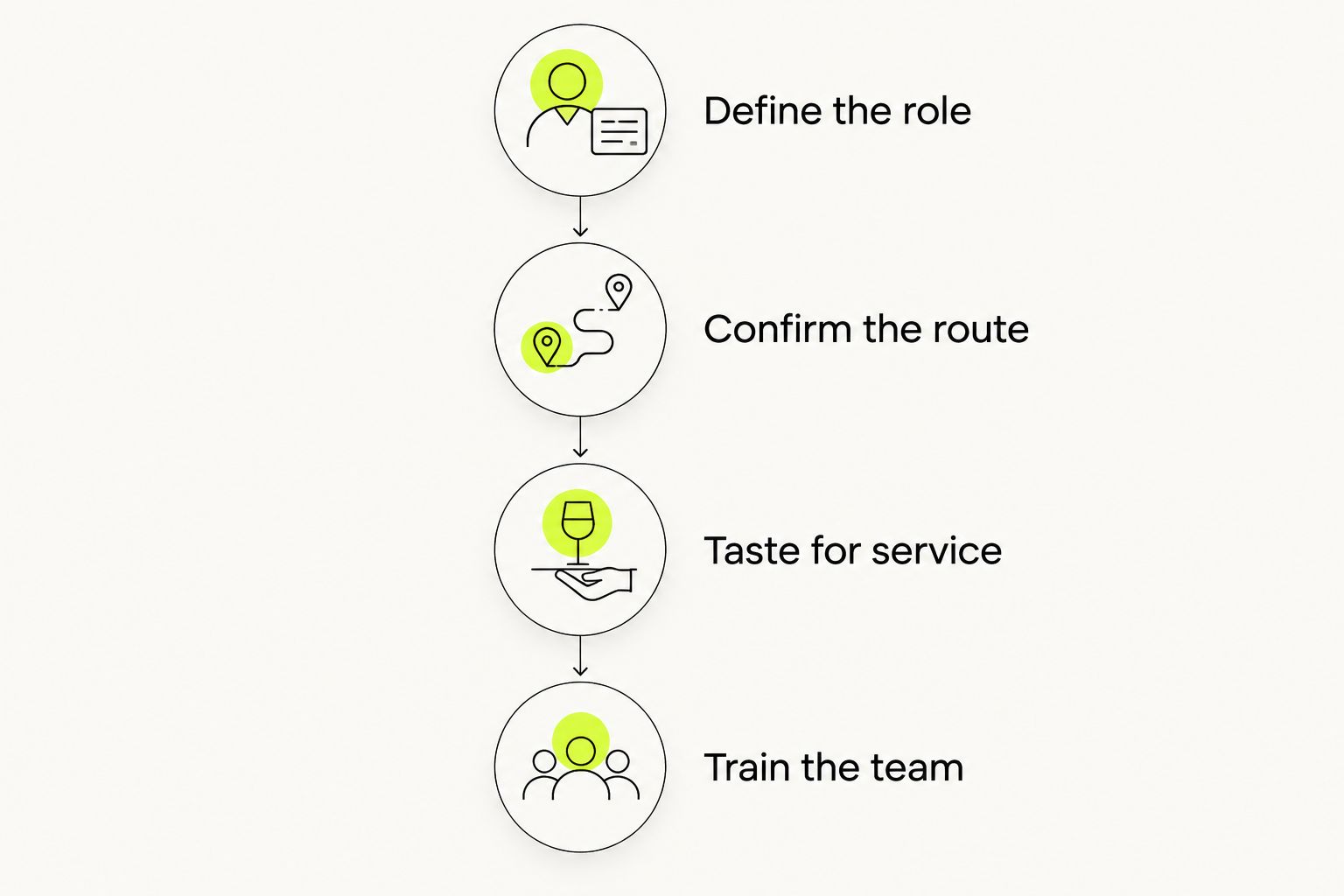
Use this sequence to turn a broad alternatives search into a buying decision. Keep the brief attached to the exact wine throughout; a general brand impression is not enough.
Define the role
Write a short requirement for the proposed addition. Examples include an orange wine for the bottle list, a California natural-wine shelf selection, or a wine for a specific dish.
Avoid a brief such as something interesting. It gives you no useful basis for accepting or rejecting a sample.
Confirm the route
Before planning a launch, establish how your licensed business can purchase the exact wine. Restaurant and retail alcohol purchasing requirements vary by jurisdiction; a consumer checkout does not establish trade eligibility.
Ask which party handles your account and what documents the account requires. Keep that answer separate from your tasting decision.
Taste for service
Taste the wine as you intend to serve it, including with the proposed dish where relevant. For a bottle shop, practice the customer conversation alongside the tasting.
Record what you actually find. Do not borrow tasting notes from a different vintage or use another wine's certification to describe the sample.
Train the team
Give staff a short, verified explanation: what the wine is, how you intend to serve it, and who to recommend it to. Add technical detail only when it helps answer a guest's question.
The useful test is simple. Can someone explain why this wine belongs here without repeating a vague claim about being better?
Keep the tasting notes and trade documentation together. That gives the person approving the wine the same information as the person ordering it and the person explaining it on the floor.
Bottle shops and restaurants need different tests
A restaurant should assess the proposed wine within service. Decide whether it belongs on the bottle list, in a pairing, or in a by-the-glass trial. Do not assume the same choice works equally well in every role.
For staff tasting, compare the sample with a dish already on your menu. Ask whether the team can explain the match in plain language and identify guests who would enjoy the wine.
A bottle shop needs a clear shelf role instead. Decide what customer request the wine answers, where it belongs in the selection, and which verified details belong on the shelf card.
Keep product claims exact. Organic grapes, organic certification, low-sulfite production, and a natural-wine description are different claims. Use only the wording supported for the exact wine you purchase, not the broad reputation of its producer.
When staying with Usual Wines is the right call
Stay with Usual Wines when its single-serving format is the requirement and the selected wines work for your guests. A new winery is not an improvement merely because its story feels different.
You can also assess an additional wine without replacing an existing one. An orange-wine addition and a single-serving option do not have to compete for the same role.
For your 2026 buying decision, make replacement earn its place. Taste the proposed wine, confirm the trade route, and give it a distinct service or shelf purpose before changing the list.
FAQ
What's the best Usual Wines alternative for restaurants?
Tinto Amorio is the strongest fit here for restaurants building a California natural-wine or orange-wine program. Confirm the exact wines and the purchasing route for your licensed account before choosing.
Should a bottle shop choose a winery or a distributor-led selection?
Choose a winery-led selection for a specific producer focus and a distributor-led selection to compare several producers against one brief. Judge the proposed wines individually in either case.
Does Tinto Amorio sell wholesale to restaurants?
Tinto Amorio sells wholesale to restaurants, bottle shops, and wine bars in 18 U.S. states. Confirm the trade purchasing route for your particular location and account.
Is orange wine made from oranges?
Orange wine is made from white grapes fermented with their skins, not from oranges. Skin contact contributes color and texture; the exact result depends on the wine.
Can a restaurant order wine through a consumer checkout?
A consumer checkout does not establish that a purchase meets a restaurant's licensing requirements. Confirm the permitted purchasing route for your jurisdiction and business license before ordering.
Does natural wine automatically mean certified organic?
Natural wine does not automatically mean certified organic. Verify the exact wine's documentation before putting an organic certification claim on a menu or shelf card.
When should a restaurant keep Usual Wines instead of switching?
Keep Usual Wines when its single-serving format fits your service and the selected wines work for your guests. Add another wine only when it fills a separate, clearly defined role.
One last thing
Taste the explanation as well as the wine. After the staff tasting, ask each person to describe the proposed addition without using natural, interesting, or different.
The answer should tell you why a guest would choose it. If the team cannot explain that yet, refine the service plan before treating a supplier change as the solution.