Does no-sulfite wine still contain natural sulfites?
Editorial Team @ 2026-10-27 17:28:55 -0700

Yes. Wine described as no-sulfite or no-added-sulfite wine can still contain sulfites that yeast produces naturally during fermentation. No added sulfites does not mean zero sulfites, and the wording alone does not tell you the finished wine’s total sulfite concentration. This 2026 guide explains the label language, the U.S. disclosure threshold, and what to ask before choosing a bottle.
- Does no sulfite wine still have natural sulfites? Yes—fermentation can produce sulfites without any winemaker additions.
- No added sulfites describes production; total sulfites describes what is actually in the wine.
- U.S. wine labels must disclose sulfites at concentrations of 10 ppm or more.
- Tinto Amorio’s natural wine category is not a blanket guarantee of zero sulfites.
Why this matters
A bottle can truthfully say both no added sulfites and contains sulfites. Those statements answer different questions: whether someone added sulfites, and whether enough sulfites remain to require disclosure.
If you are choosing wine because of a diagnosed sulfite sensitivity, that distinction matters more than the color, a cloudy appearance, or a natural-wine description. Start with the exact bottle’s label and technical information. The low-sulfite wine guide explains the broader category, but a category name cannot replace a bottle-specific result.
Does no-sulfite wine still contain natural sulfites?
Yes. Fermentation can create sulfites even when the winemaker adds none. Yeast produces sulfur-containing compounds as part of its metabolism, including sulfur dioxide. In wine, sulfur dioxide exists in different chemical forms that contribute to the sulfite measurements used in production and labeling.
Adding sulfur dioxide is a separate decision. Winemakers use it to help control oxidation and unwanted microbial activity. Skipping that addition does not switch off the yeast’s ability to produce sulfites.
Here is how the common terms compare for U.S. shoppers in 2026:
| Label wording | What it tells you | Useful for | What it does not establish |
|---|---|---|---|
| No added sulfites | Sulfites were not intentionally added | Understanding a production choice | Zero naturally occurring sulfites |
| Contains sulfites | Sulfites meet the U.S. disclosure threshold | Identifying a required declaration | Whether sulfites were added or the exact concentration |
| Low-sulfite | A claim that needs supporting detail | Starting a conversation with the producer | A universal concentration or medical suitability |
| Natural wine | A broad production description | Exploring a winemaking approach | A specific sulfite result |
| Sulfite-free | An absence claim requiring substantiation | Identifying a claim to verify carefully | Proof supplied merely by the phrase itself |
The practical takeaway is simple: read no added sulfites as a production statement, not a laboratory result. For an actual concentration, ask for the finished wine’s total sulfur dioxide measurement.
No added sulfites: a production choice, not a zero reading
No added sulfites tells you about what the producer did not add. It does not quantify what fermentation produced or what remains at bottling.
The benefit is clarity about an intentional winemaking choice. The limitation is equally important: you cannot calculate total sulfites from that statement. Two wines made without additions do not automatically have the same concentration.
A useful question is: Does this claim apply throughout production, including bottling? That is more precise than asking whether the wine is clean or chemical-free. Wine contains naturally occurring chemical compounds; those broad descriptions do not answer a sulfite question.
Contains sulfites: 10 ppm is the U.S. disclosure threshold
Under the U.S. Alcohol and Tobacco Tax and Trade Bureau’s wine-labeling rule, 27 CFR § 4.32(e), wine containing 10 parts per million, or 10 ppm, or more of sulfur dioxide requires a sulfite declaration. This is the U.S. labeling reference used in this 2026 guide.
In ordinary wine reporting, that concentration is expressed as approximately 10 milligrams per liter, or 10 mg/L. These are concentration units—not the amount in a glass and not a personal tolerance limit.
The declaration does not identify the source. Naturally occurring sulfites count toward the disclosure threshold, just as added sulfites do. A no-added-sulfites wine can therefore need the same contains sulfites statement as a wine made with additions.
The reverse needs care, too. An absent declaration is not proof of zero sulfites. It also is not a reason to disregard medical advice about avoidance.
Organic wine and made with organic grapes are different
For U.S. shoppers, organic labeling adds another distinction. Under USDA National Organic Program rules, wine labeled organic cannot have added sulfites, but fermentation-derived sulfites can still be present.
Wine labeled made with organic grapes follows a different rule. Added sulfur dioxide is permitted, provided the finished wine’s total sulfite concentration does not exceed 100 ppm, subject to the applicable organic-production requirements. The regulatory reference is 7 CFR § 205.301, including its provisions for wine made with organic grapes.
| U.S. labeling category | Added sulfites | Best for understanding | Important limitation |
|---|---|---|---|
| Organic wine | Not permitted | Certified production requirements that exclude added sulfites | Does not mean naturally occurring sulfites are absent |
| Made with organic grapes | Permitted within applicable rules | Organic grape sourcing under a distinct labeling category | Does not mean no added sulfites |
Organic and made with organic grapes are not interchangeable. Neither phrase gives you an exact measured sulfite concentration for an individual bottle.
These are U.S. distinctions for 2026, not a shortcut for interpreting every overseas label. Check the rules that apply in the market where the bottle is sold, especially when comparing imported wines or regional product listings.
Why sulfite levels vary
A no-added-sulfites statement does not standardize the finished wine. Several production and measurement factors explain why the result differs:
- Yeast strain. Different yeast strains produce different amounts of sulfur dioxide during fermentation. Native fermentation does not establish a predictable zero result.
- Fermentation conditions. The must’s composition and the conditions yeast encounters affect fermentation chemistry, including sulfite production.
- Winemaker additions. Sulfur dioxide added during production contributes to the wine’s sulfite profile. A producer’s timing and amount matter.
- Chemical binding. Sulfur dioxide reacts with compounds in wine. That changes the relationship between free and bound sulfur dioxide.
- Sampling stage. A result from fermentation is not automatically the result for the bottled wine. Ask what stage the measurement represents.
Grape color alone does not settle any of these questions. Neither does skin contact, an unfiltered appearance, or a playful label. Those details can tell you about style, but they do not replace testing.
How do you check a no-sulfite wine claim?
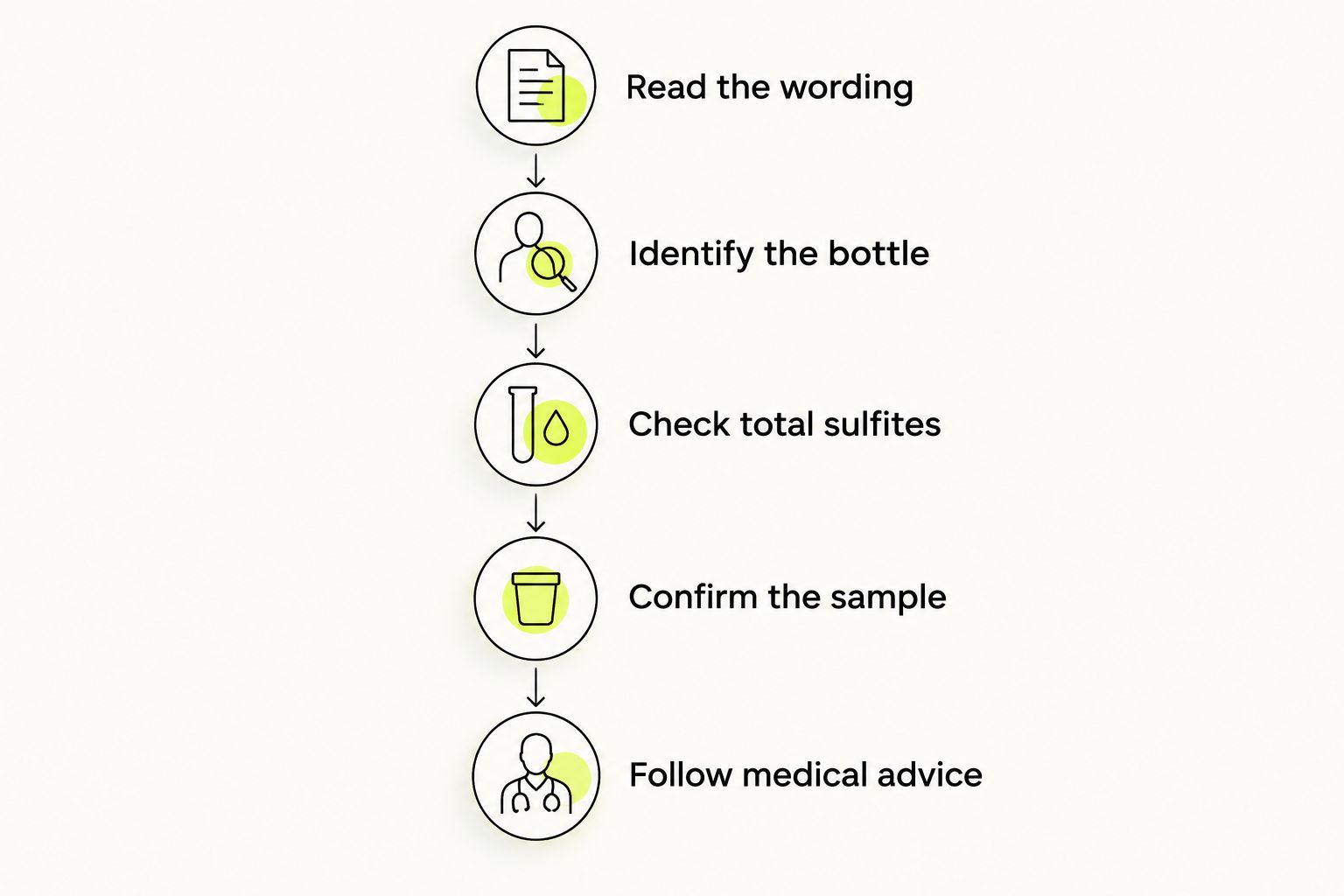
Use this short sequence when checking a bottle in 2026. It separates label language from evidence without turning your wine shopping into a chemistry exam.
- Read the wording. Distinguish no added sulfites from low-sulfite and sulfite-free. Do not silently treat them as synonyms.
- Identify the bottle. Match the producer, wine, vintage, and market. A previous release or overseas listing does not establish the current bottle’s facts.
- Check total sulfites. Ask for total sulfur dioxide, reported in ppm or mg/L, if the concentration matters to your decision.
- Confirm the sample. Ask whether the result represents the finished, bottled wine and whether it applies to the lot you are considering.
- Follow medical advice. If you have a diagnosed sensitivity, use your clinician’s guidance rather than experimenting based on a label claim.
A precise request helps: ask whether sulfites were added and what the finished wine’s total sulfur dioxide measurement is. These are separate questions, and a useful answer addresses both.
For Tinto Amorio, apply the same bottle-by-bottle check rather than extending a brand description to every release. Tinto Amorio suits drinkers exploring California natural wine; the category does not establish zero sulfites. Choose for the wine style you enjoy, and verify any sulfite requirement separately.
Is free sulfur dioxide the same as total sulfites?
No. Free sulfur dioxide is the unbound portion measured in wine; total sulfur dioxide includes both free and bound forms. A free sulfur dioxide figure alone does not describe all the sulfites present.
This distinction matters when a technical sheet lists several values. Do not compare one wine’s free sulfur dioxide result with another wine’s total result and call the lower number better. You would be comparing different measurements.
Ask for the same measurement, in the same units, from the same production stage. That gives you a meaningful comparison without turning a small-looking number into an unsupported health claim.
Does a contains sulfites label mean the winemaker added them?
10 ppm is the U.S. disclosure threshold, not a test for whether sulfites were added. A wine can reach that threshold through fermentation-derived sulfites and still be made without additions.
Read the declaration alongside the production statement. If the bottle says no added sulfites and contains sulfites, the wording is not inherently contradictory.
Is a wine without a sulfite warning completely sulfite-free?
10 ppm is a labeling threshold, not a definition of absolute absence. A wine below that concentration can contain sulfites without triggering the U.S. declaration requirement.
Do not treat a missing warning as a personal safety clearance. If avoidance is medically necessary, discuss suitable choices with your clinician and request information about the exact wine.
Does low-sulfite wine prevent headaches or reactions?
No. A low-sulfite claim does not establish that a wine will prevent headaches or other symptoms. Alcohol itself has health risks, and a reaction after drinking does not identify sulfites as the cause.
Sulfite sensitivity is a separate issue that warrants medical guidance, particularly for people with asthma or a history of reactions. If you develop breathing difficulty, throat swelling, or other severe symptoms after drinking, seek urgent medical care. Do not use another wine as a home diagnostic test.
FAQ
Does no sulfite wine still have natural sulfites?
Yes. Yeast can produce sulfites during fermentation, so no added sulfites does not mean zero sulfites. Ask for the finished wine’s total sulfur dioxide measurement if you need a concentration.
Why does my no-added-sulfites wine say contains sulfites?
Naturally occurring sulfites count toward the U.S. disclosure threshold of 10 ppm. The warning identifies sulfites at or above that threshold, not whether the winemaker added them.
Is organic wine completely sulfite-free?
No. U.S. wine labeled organic cannot contain added sulfites, but naturally occurring sulfites can remain. Wine labeled made with organic grapes is a separate category that permits additions within applicable limits.
Is natural wine always made without added sulfites?
No. Natural wine is not a universal guarantee of no added sulfites or a specific total concentration. Check the producer’s statement for the exact bottle.
Can I taste whether a wine has sulfites?
Taste cannot reliably establish a wine’s total sulfite concentration. Use the label and technical information rather than aroma, color, cloudiness, or mouthfeel.
Does decanting make wine sulfite-free?
No. Decanting is not a reliable method for removing all sulfites or making wine suitable for someone with sulfite sensitivity. Do not use aeration as a substitute for medical guidance.
Does Tinto Amorio’s natural wine description mean every bottle has no added sulfites?
No. A brand-level natural wine description does not establish the sulfite practices or concentration of every bottle. Check the current U.S. product information for the exact wine and release.
One last thing
The most useful question is not simply whether a wine has sulfites. It is what the claim tells you—and what it leaves unanswered. No added sulfites describes a choice in the cellar; total sulfur dioxide describes a measured result.
When you compare wines in 2026, keep those two facts separate. You will read labels more accurately, ask better questions, and avoid mistaking a production philosophy for a zero-sulfite promise.