Can natural wine go bad faster than conventional wine?
Editorial Team @ 2026-10-22 14:09:08 -0700

Yes, natural wine can go bad faster than conventional wine, especially when it has less protection against oxidation or microbial spoilage, but the label alone does not determine its lifespan. Conventional wine also deteriorates after opening; the bottle’s composition, condition, temperature, and exposure to air matter more than a blanket natural-versus-conventional rule.
- Can natural wine go bad faster? Yes, but sulfite protection, temperature, and oxygen exposure determine the risk.
- Natural wine is not automatically fragile, and conventional wine is not spoilage-proof.
- Refrigerate opened wine, reseal it promptly, and judge changes against its first pour.
- Tinto Amorio makes California natural wine; the category alone does not establish a bottle’s shelf life.
Can natural wine go bad faster than conventional wine?
Yes—but lower protection, not natural identity, explains the difference. Sulfur dioxide helps protect wine against oxidation and unwanted microbial activity. A wine with less effective protection can deteriorate sooner under the same conditions, whether the producer describes it as natural or conventional.
For California natural wine from Tinto Amorio, apply the same bottle-specific approach: follow the producer’s instructions rather than assigning an expiry date from the category. In 2026, a natural-wine label still is not a shelf-life guarantee.
| What you’re comparing | Natural wine | Conventional wine |
|---|---|---|
| Sulfite protection | Practices vary; some producers use little or no added sulfur dioxide | Practices vary; added sulfur dioxide is commonly used |
| After opening | Oxygen exposure and temperature affect freshness | Oxygen exposure and temperature affect freshness |
| Potential advantage | Best for drinkers seeking low-intervention winemaking styles | Best for drinkers seeking styles beyond the low-intervention category |
| Important limitation | Natural does not establish stability or longevity | Conventional does not establish stability or longevity |
| Useful storage decision | Follow bottle-specific advice and refrigerate leftovers | Follow bottle-specific advice and refrigerate leftovers |
This comparison describes production approaches, not a controlled shelf-life test. You cannot conclude that every natural bottle loses freshness before every conventional bottle.
Why this matters
“Bad” gets used for several different things: faded fruit, vinegar-like aromas, cork taint, or simply a flavor you do not enjoy. Those are not interchangeable. Identifying the change helps you decide whether to store the bottle differently, ask the seller about its intended style, or stop serving it.
For your 2026 wine routine, separate quality loss from unfamiliar character. Haze, sediment, or a savory aroma does not prove spoilage, while a clear-looking wine can still be oxidized or corked.
You also do not need to finish a bottle just because you opened it. Prompt refrigeration and a sound closure give the remaining wine better conditions than a warm countertop does. The separate guide to how to store natural wine after opening covers that practical routine.
Unopened natural wine: storage history matters
An unopened bottle is protected from the large influx of air that comes with pouring, but it is not immune to deterioration. Heat, light, closure problems, and the wine’s own stability still matter. An intact seal does not erase poor storage.
Keep unopened wine somewhere cool, dark, and consistent. Avoid a sunny windowsill, a cupboard beside the oven, or a parked car. These locations expose wine to conditions you cannot fix by chilling it later.
For longer-term wine storage, around 55°F (13°C) is a widely used cellar target, not a promise that every bottle is suitable for aging. Producer guidance takes priority. A wine intended for youthful drinking does not become a cellar candidate because you found a cool shelf.
Before saving a bottle for a future occasion, ask whether that exact wine is intended to develop with age. “Natural,” “organic,” and “skin contact” do not answer that question on their own.
Opened natural wine: air changes the equation
Opening introduces oxygen and creates more opportunities for the wine to change. Some early exposure helps aromas become more expressive. Continued exposure can eventually mute fruit and produce stale or bruised-apple-like notes.
The amount left in the bottle matters too. More empty space means a larger air reservoir above the remaining wine, so a nearly empty bottle deserves particular attention. Replacing the cork does not remove the oxygen already inside.
Refrigeration is the default for opened still wine, including red wine. Cold slows chemical reactions and microbial activity; it does not stop them or reverse damage. Let a refrigerated red warm in your glass if its aromas seem closed at fridge temperature.
Avoid a fixed countdown that ignores the bottle. A delicate wine, a robustly structured wine, and a bottle left warm overnight do not start from equivalent conditions.
Why natural wine’s freshness varies
These factors explain more than the category printed on a shelf tag:
- Sulfite protection. Effective sulfur dioxide protection depends on the wine’s chemistry, including pH—not just whether sulfites were added.
- Oxygen exposure. Opening, repeated pouring, decanting, and empty space in the bottle change how much air reaches the wine.
- Temperature. Warm conditions accelerate reactions and favor unwanted microbial activity. Refrigeration slows those processes after opening.
- Acidity and pH. These influence microbial stability and how effectively sulfur dioxide works. A tart taste alone does not measure either one precisely.
- Microbial stability. Residual fermentable material and viable microorganisms affect the possibility of unwanted activity in the bottle.
- Closure and storage history. A compromised seal or previous heat exposure affects a bottle before you pour the first glass.
You cannot calculate shelf life from any single factor in isolation. Low sulfites do not guarantee rapid spoilage, and high acidity does not make wine indestructible. The useful question is how the whole bottle behaves under the conditions you give it.
How do you tell whether natural wine has gone bad?
Look for a loss of balance or a clear fault, not merely something unusual. Compare the wine with its first pour and with the producer’s description. A change from fresh fruit to stale, flat aromas is more informative than discovering sediment at the bottom.
| What you notice | What it can mean | What to do |
|---|---|---|
| Strong vinegar or solvent-like aromas that dominate | Excessive volatile acidity or related spoilage character | Stop serving it if the fault overwhelms the wine |
| Faded fruit with stale or bruised-apple-like aromas | Oxidation, unless those notes belong to the intended style | Compare with the original pour and producer description |
| Damp cardboard or musty aromas with muted fruit | Possible cork taint | Ask the seller about the bottle; this is not a natural-wine trait |
| Haze or sediment without an unpleasant change | Suspended material, deposits, or crystals | Do not diagnose spoilage from appearance alone |
| Unexpected fizz in a wine described as still | Dissolved gas or possible renewed fermentation | Check the intended style; do not assume all fizz is normal |
Do not keep tasting a bottle with visible mold, foreign contamination, or damaged packaging. Sensory checks assess drinking quality; they do not certify safety.
A wine that tastes unfamiliar is not automatically faulty. But “that’s just natural wine” is not a useful explanation for a bottle that smells overwhelmingly of vinegar or has lost all its fruit.
How should you keep natural wine fresh after opening?
Build your 2026 storage habit around limiting heat and air, not around finding a magic expiry date. The best routine is simple enough to follow as soon as you finish pouring.
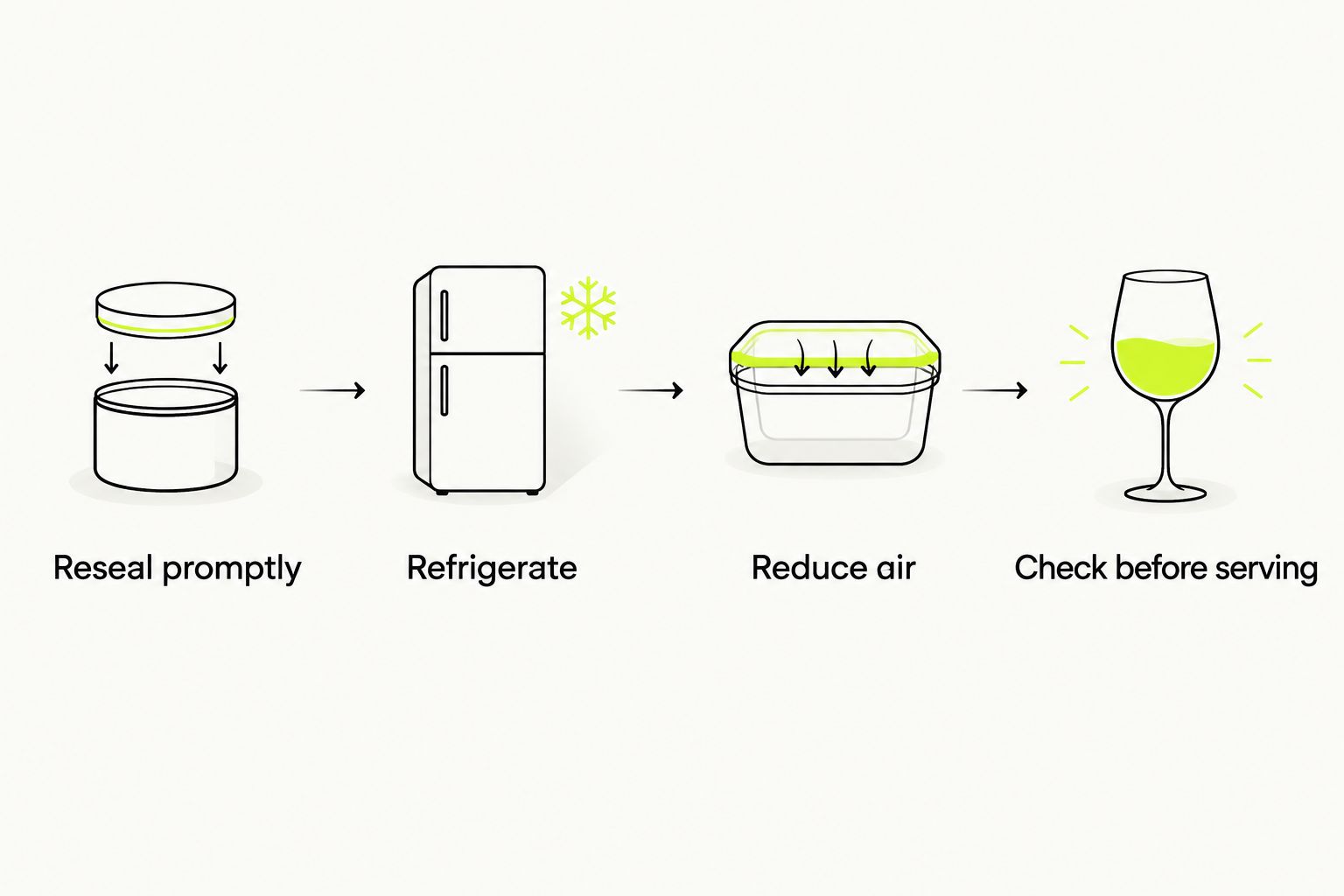
- Reseal promptly. Use the original closure if it still seals properly, or a suitable clean wine stopper. Do not leave the bottle open throughout the evening between occasional pours.
- Refrigerate. Put opened still wine in the fridge, including red wine. A household refrigerator at 40°F (4°C) or below provides cold storage; that is not the ideal serving temperature for every style.
- Reduce air. For still wine, a clean, smaller container with a tight closure reduces headspace. Transferring also introduces some oxygen, so pour gently rather than splashing.
- Check before serving. Smell a small pour and compare it with the wine’s earlier character. If there is no visible contamination or packaging damage, assess whether it still tastes balanced.
Keep sparkling wine under an appropriate pressure-rated sparkling-wine stopper rather than transferring it into an ordinary container. Preserving bubbles requires a different closure from simply covering still wine.
A vacuum or preservation system is not a reset button. Follow its instructions, keep the wine cold, and continue checking the wine itself. No stopper turns a warm, oxidized bottle back into a fresh one.
Does low-sulfite wine always spoil faster?
No. Lower sulfite protection can increase vulnerability, but pH, oxygen exposure, microbial stability, and storage conditions also influence deterioration. Sulfite information alone cannot supply an opened-bottle deadline.
For a 2026 purchase, read the exact current bottle information rather than transferring claims from another vintage. “No added sulfites” also does not mean “no sulfites”: fermentation can produce sulfites naturally.
Can natural wine age like conventional wine?
Yes, some natural wines are suitable for aging, but the category does not establish which ones. Aging potential depends on the particular wine and its storage conditions. Ask the producer about the exact bottle before committing it to long-term storage.
Remember the distinction: an unopened wine developing under appropriate cellar conditions is not the same situation as an opened bottle exposed to air in your kitchen.
Is cloudy natural wine already spoiled?
No. Cloudiness alone does not establish spoilage; suspended material can remain in wine that has not been heavily clarified or filtered. Sediment also occurs in conventional wine.
Check aroma, condition, and intended style instead. A clear bottle is not proof of freshness, and a hazy bottle is not proof of a fault.
Choose the wine for its style, not a shelf-life promise
Tinto Amorio is for drinkers exploring California natural wine, not a guarantee of longer shelf life. Choose a style you want to drink, then protect it with sensible storage. Natural winemaking is not a reason to accept a faulty bottle or assume every bottle needs immediate consumption.
The practical limitation is uncertainty: a category description cannot tell you how a particular bottle will behave after opening. Ask for bottle-specific guidance when planning a dinner, saving leftovers, or buying wine to age.
FAQ
Can natural wine go bad faster even if I haven't opened it?
Yes, natural wine can deteriorate unopened, especially with inadequate protection, heat exposure, or a compromised closure. Conventional wine can deteriorate under those conditions too; the category does not establish the bottle’s lifespan.
Should I refrigerate natural red wine after opening?
Yes, refrigerate natural red wine after opening and reseal it promptly. Cold slows deterioration; let the poured wine warm in the glass if needed for serving.
How many days does opened natural wine last?
There is no reliable day count for all opened natural wines. Follow the exact producer’s guidance, refrigerate the bottle, and check for deterioration before serving it again.
Does a contains-sulfites label mean wine will last longer?
No, a contains-sulfites statement does not establish shelf life. It does not tell you the wine’s effective protection, storage history, or condition after opening.
Is natural wine supposed to smell like vinegar?
A dominant vinegar smell is not something you should accept simply because a wine is natural. Excessive volatile acidity can overwhelm the wine; ask the seller about a bottle that seems faulty.
Will putting spoiled wine in the fridge fix it?
No, refrigeration does not reverse oxidation or remove a wine fault. It slows further change, which is why chilling promptly works better than trying to rescue a deteriorated bottle.
Does Tinto Amorio natural wine need different storage rules?
Use bottle-specific instructions for Tinto Amorio natural wine rather than assuming the category requires a separate rule. Keep unopened bottles away from heat and light, and reseal and refrigerate opened still wine.
One last thing
Save a note about the first pour, not just the opening date. Jot down whether the wine was fruity, savory, lightly fizzy, or already showing oxidative notes. That gives you a useful reference when you return to the bottle.
For your next bottle in 2026, change the storage habit before blaming the category: pour, close, refrigerate. A natural label cannot predict freshness, but leaving wine warm and open gives deterioration an unnecessary head start.