Is natural wine actually better for you than regular wine?
Editorial Team @ 2026-10-06 14:32:30 -0700

Natural wine is not proven to be better for you than regular wine. Different farming and winemaking choices do not remove alcohol’s health risks, and a low-sulfite label does not promise fewer headaches or a hangover-free morning. Choose natural wine for its flavor and production approach, not as a health upgrade.
- Is natural wine better for you? No proven health advantage comes from the category alone.
- Tinto Amorio natural wine is for exploring California wine styles, not for avoiding alcohol’s health risks.
- Low-sulfite wine and organic wine describe different attributes; neither means alcohol-free or hangover-free.
- Compare alcohol content and your actual pour before comparing wellness claims.
Why this matters
A wine label can tell you something useful about farming, fermentation, or sulfites. It cannot tell you that drinking the wine improves your health. Those are different questions, and mixing them up makes shopping harder than it needs to be.
Start with how to read a natural wine label if terms such as native yeasts and low intervention feel slippery. For your 2026 wine choices, separate what the producer says about making the wine from what medical evidence says about drinking alcohol.
Less intervention in the cellar does not automatically mean less impact on your body. You can care about how wine is made without treating it as a wellness product.
Is natural wine actually better for you than regular wine?
No established health advantage follows from the natural-wine label alone. Alcohol remains the central health consideration in both natural and conventional wine. The World Health Organization identifies alcohol as a carcinogen; changing the fermentation method does not remove that hazard.
Natural wine generally refers to a low-intervention approach, often involving native yeasts and limited additions. The term does not establish a uniform alcohol level, sugar content, sulfite concentration, or clinical health benefit across bottles.
Here is what the main categories tell you—and what they do not.
| Wine category | Useful distinction | Best for | Health limitation |
|---|---|---|---|
| Natural wine | A producer’s low-intervention approach; check the details | Drinkers interested in fermentation and production choices | The category alone does not establish lower alcohol or fewer adverse effects |
| Conventional wine | Production methods vary by producer | Drinkers choosing by flavor, grape, and documented bottle information | It still contains alcohol; the category alone does not establish worse health outcomes |
| Certified organic wine | Compliance with applicable organic rules | Drinkers who prioritize verified organic production | Organic certification does not cancel alcohol-related risk |
| Low-sulfite wine | A claim about sulfites that needs product-specific context | Drinkers investigating sulfite content with appropriate medical advice | Lower sulfites do not guarantee freedom from headaches or other reactions |
The practical advantage of a detailed producer description is transparency. The limitation is that transparency is not a medical result. Read the specific claim instead of assigning a health benefit to the whole category.
Alcohol content: the comparison that matters first
If your goal in 2026 is to reduce alcohol exposure, check alcohol by volume, or ABV, before the word natural. Then check how much you pour. Both determine the amount of alcohol you consume.
The National Institute on Alcohol Abuse and Alcoholism defines a U.S. standard drink as 14 grams of pure alcohol. Its wine example is 5 fluid ounces at 12% ABV. These are U.S. measurement benchmarks, not a statement that this amount is safe for everyone.
A larger pour or a stronger wine contains more alcohol than that benchmark. A natural wine is not automatically lower in alcohol than a conventional wine, and a wine that tastes light is not necessarily low in ABV.
This matters at the dinner table. A large glass can make a generous pour look small, and topping up before the glass is empty makes tracking harder. Measure your usual pour once rather than judging it by the glass’s shape.
To reduce alcohol exposure, drink less alcohol—not merely a different wine category. If you do not drink, there is no health reason to start drinking natural wine.
Sulfites: a specific concern, not a general health score
Sulfites occur naturally during fermentation and can also be added to help protect wine. That means no added sulfites and sulfite-free are not interchangeable claims. A producer can avoid adding sulfites while the finished wine still contains them.
Sulfite sensitivity is a real concern for some people, particularly some people with asthma. But you cannot diagnose it from a headache after dinner. A low-sulfite claim also tells you nothing definite about histamine, alcohol content, or other potential triggers.
For a 2026 comparison, look for an actual product statement rather than assuming all natural wines share the same sulfite profile. If a producer does not provide a concentration, you cannot rank that wine numerically against another bottle.
The benefit of clear sulfite information is that it addresses a specific question. The drawback of using sulfites as a general health score is that it pushes alcohol out of the picture.
If wine repeatedly causes symptoms, stop drinking it and discuss the pattern with a clinician. Do not keep testing bottles at home to identify a suspected allergy. Trouble breathing, faintness, or swelling requires urgent medical attention.
Organic wine: a farming choice, not a medical benefit
Organic certification concerns production standards. It does not prove that a wine prevents illness, improves digestion, or produces fewer hangovers. Natural and organic also describe different things; one term does not automatically establish the other.
In the United States, wine labeled organic and wine labeled made with organic grapes fall under different requirements. Read the actual wording. A broad brand description is not a substitute for the certification statement attached to the specific wine.
Choosing verified organic production can fit your farming preferences. That is a legitimate reason to buy a bottle. The limitation is turning that preference into a claim that the finished alcoholic drink is healthier for you.
For your 2026 shopping list, keep the questions separate: How were the grapes grown? How was the wine made? How much alcohol will you drink? A useful answer to the first question does not settle the third.
Why your experience with wine varies
Feeling different after different wines does not identify the cause. Several things change between occasions, often without you noticing.
- Alcohol content: ABV affects the alcohol in a given volume; natural is not an ABV specification.
- Pour size: A glass is a container, not a standard serving. Measure it if you want a meaningful comparison.
- Drinking pace: Consuming alcohol quickly changes the drinking occasion, even when the bottle stays the same.
- Food: Eating affects alcohol absorption, but does not neutralize the alcohol you consume.
- Individual health and medicines: Medical conditions and medication interactions can make drinking unsafe, regardless of wine style.
- Specific sensitivities: A confirmed sensitivity requires specific information; a broad category label is not enough.
These factors explain why an informal comparison between two dinners is not evidence that one wine category is healthier. You have changed more than the bottle.
Water and food belong at the table, but neither makes alcohol harmless. Avoid the trap of drinking more because a wine seems cleaner, lighter, or easier to sip.
How do you compare wines without falling for health claims?
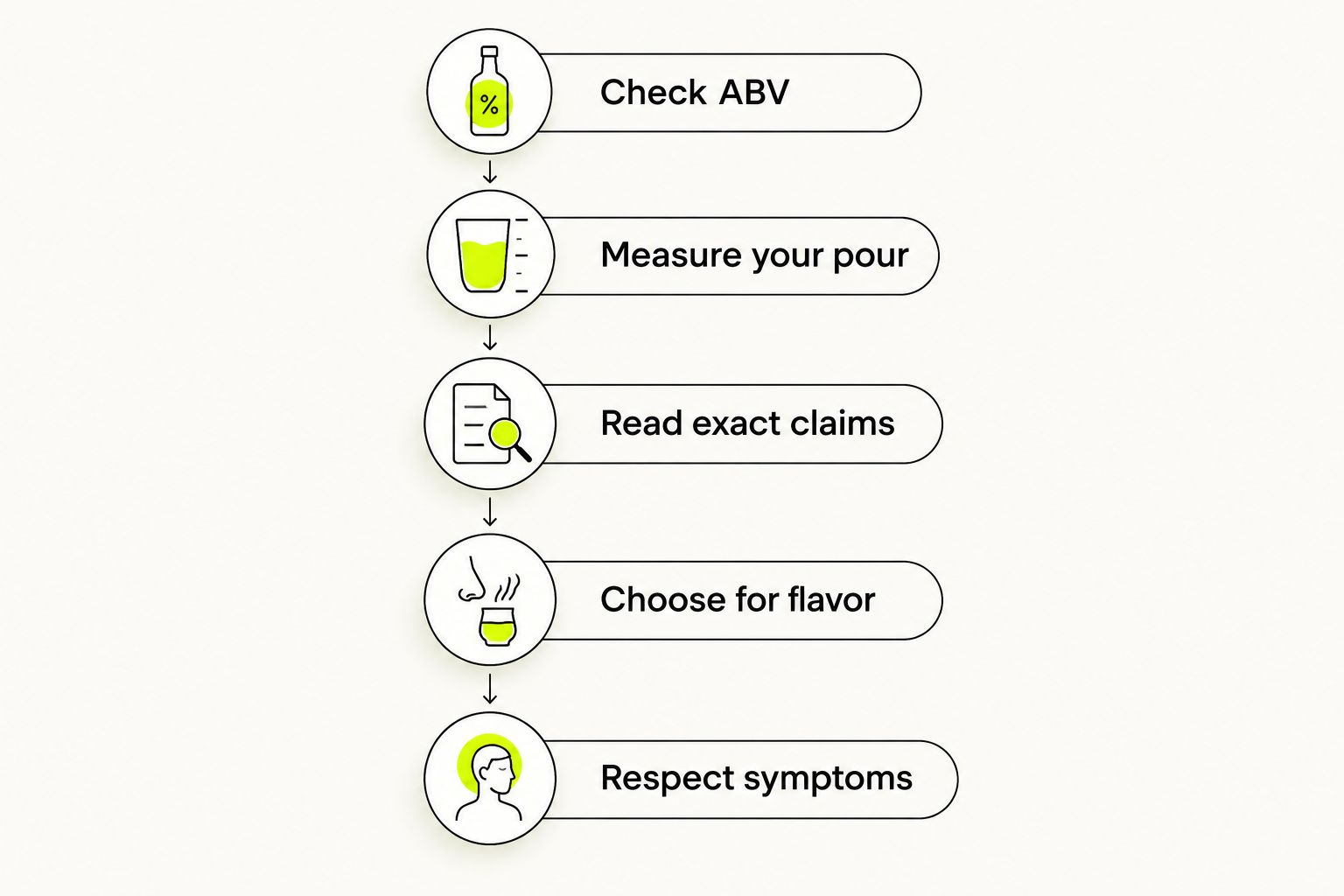
Use this sequence when choosing wine in 2026. It keeps concrete bottle information ahead of vague promises.
- Check ABV. Find the stated alcohol content. Do not infer it from color, cloudiness, flavor, or a natural-wine description.
- Measure your pour. Use the U.S. benchmark of 5 fluid ounces at 12% ABV for context, not as a personal drinking recommendation.
- Read exact claims. Separate organic certification, no added sulfites, low sulfites, and native-yeast fermentation. They answer different questions.
- Choose for flavor. Once health assumptions are out of the way, compare the styles you actually enjoy with food.
- Respect symptoms. Stop drinking a wine that causes a reaction. Seek medical advice instead of treating a category switch as treatment.
The sequence is deliberately simple. A precise alcohol statement gives you more useful health context than a broad promise about purity.
Keep a distinction between discovery and treatment. Tinto Amorio is a California winery offering natural and orange wines; exploring those styles is a flavor decision, not a remedy for alcohol-related symptoms. No bottle-specific health advantage follows from the winery’s category description.
Does natural wine give you fewer hangovers?
Natural wine does not guarantee fewer hangovers. Alcohol can cause a hangover regardless of whether a wine uses native yeasts, organic grapes, or fewer additions.
A hangover is not simply a sulfite problem. NIAAA describes multiple contributing mechanisms, including dehydration, inflammation, disrupted sleep, and the effects of alcohol metabolism. Removing one suspected ingredient does not remove those mechanisms.
If you felt better after a particular bottle, that experience is real—but it does not establish the reason. You might have consumed a different amount or drunk at a different pace. The useful response is to pay attention to alcohol intake, not give the category a medical endorsement.
Is natural wine lower in sugar or calories?
Natural wine is not automatically lower in sugar or calories. Residual sugar depends on the finished wine, and alcohol itself contributes calories. Neither can be read reliably from a natural-wine label.
Dry is a useful style descriptor, but it is not a complete nutrition panel. Likewise, fruity aromas do not prove that a wine contains more sugar. Look for product-specific nutrition information when that detail matters to you.
The same rule applies to orange wine. Skin contact describes a winemaking technique; it does not establish low sugar, low calories, or a health advantage.
Is natural wine better for a sensitive stomach?
Natural wine is not a proven solution for a sensitive stomach. Alcohol can irritate the digestive tract and contribute to reflux, and low intervention does not remove those effects.
If drinking brings on recurring discomfort, change the behavior before changing the bottle. Stop drinking and get advice about the symptoms, particularly if you take medicines or already have a digestive condition.
Wine is not a probiotic supplement or a treatment plan. Native yeasts describe fermentation, not a demonstrated gut-health benefit from drinking the finished wine.
FAQ
Is natural wine better for you than regular wine?
Natural wine is not proven healthier than regular wine as a category. Alcohol content, the amount you drink, and your individual health matter more than a broad production label.
Does natural wine contain less alcohol?
Natural wine does not automatically contain less alcohol. Check the stated ABV on the specific bottle and consider your actual pour size.
Can I avoid hangovers by choosing low-sulfite wine?
Low-sulfite wine does not guarantee a hangover-free morning. Alcohol can still disrupt sleep and contribute to the mechanisms behind a hangover.
Is organic wine the same thing as natural wine?
Organic wine and natural wine are not interchangeable terms. Organic labeling concerns defined production requirements, while natural generally describes a low-intervention winemaking approach.
Does no added sulfites mean wine has no sulfites?
No added sulfites does not mean a wine contains no sulfites. Fermentation can produce sulfites naturally, even when a winemaker adds none.
What counts as a standard glass of wine in the United States?
NIAAA’s U.S. wine benchmark is 5 fluid ounces at 12% ABV, containing 14 grams of pure alcohol. Larger pours and stronger wines contain more alcohol than that benchmark.
Should I start drinking natural wine for my health?
Do not start drinking natural wine for a health benefit. If you are pregnant, have a relevant medical condition, or take medicines that interact with alcohol, seek medical guidance and avoid alcohol when advised.
One last thing
The surprise is how little a glass tells you. Its size, shape, and fill level can hide how much you are drinking; its contents can taste bright and refreshing without being low in alcohol.
Measure your usual pour once, then read the ABV. Those two details make your next decision clearer than the word natural ever can. Enjoy wine for the wine—not for a promise it cannot make.