How long does wholesale wine account onboarding take?
Editorial Team @ 2026-10-13 13:18:55 -0700

Wholesale wine onboarding has no universal turnaround; get a supplier-confirmed completion date for your business, location, and purchasing arrangement. Separate account approval from first-order acceptance and delivery, because an approved account is not a delivery promise. For your 2026 opening or menu launch, plan around confirmed milestones rather than an assumed number of days.
- How long does wholesale wine onboarding take? Get an account-specific timeline, not a universal estimate.
- Track account approval, order acceptance, and delivery separately when planning wholesale wine purchasing.
- Tinto Amorio sells wholesale wine to bottle shops, restaurants, and wine bars across 18 US states.
- Confirm the purchasing route for your location before committing wine to a launch menu.
How long does wholesale wine account onboarding take?
The useful answer is a confirmed date tied to a defined finish line. Ask whether the supplier's onboarding estimate ends when your account is approved, when you can submit an order, or when the wine reaches your receiving address. Those are different commitments.
Use the guide to onboarding a new wholesale account for natural wine alongside this timeline checklist. Keep your account setup and first purchase in the same planning document, but give each its own status.
Track these 3 milestones:
| Milestone | What to confirm | What it does not establish |
|---|---|---|
| Account approval | Your business can purchase through the agreed wholesale route | That your first order has been accepted |
| Order acceptance | The seller has accepted your specific order and its terms | That the order has arrived |
| Delivery | Your receiving team has received and checked the order | That future orders follow the same schedule |
Ask for the expected completion date for each milestone. Also ask what remains unresolved and who handles it. A date without those details gives you little to act on.
For a 2026 launch, put the receiving deadline in your first inquiry. Make clear whether it is a preferred date or a firm operational deadline. Let the seller confirm what it can commit to before you print menus or announce a tasting.
Why this matters
Your wine program needs more than an approved account. You need an accepted purchase, clear receiving instructions, and the correct product information for your team. Treating those tasks as one vague onboarding period makes the plan harder to manage.
Do not use account approval as permission to promise a delivery date. Keep customer-facing plans tied to the seller's confirmed order and delivery information. That distinction matters whether you run a neighborhood bottle shop or a restaurant opening its doors.
An online consumer checkout is not proof of a wholesale purchasing arrangement, either. Ask which seller and ordering route apply to your licensed business. Confirm that route before treating a retail product page as a trade ordering tool.
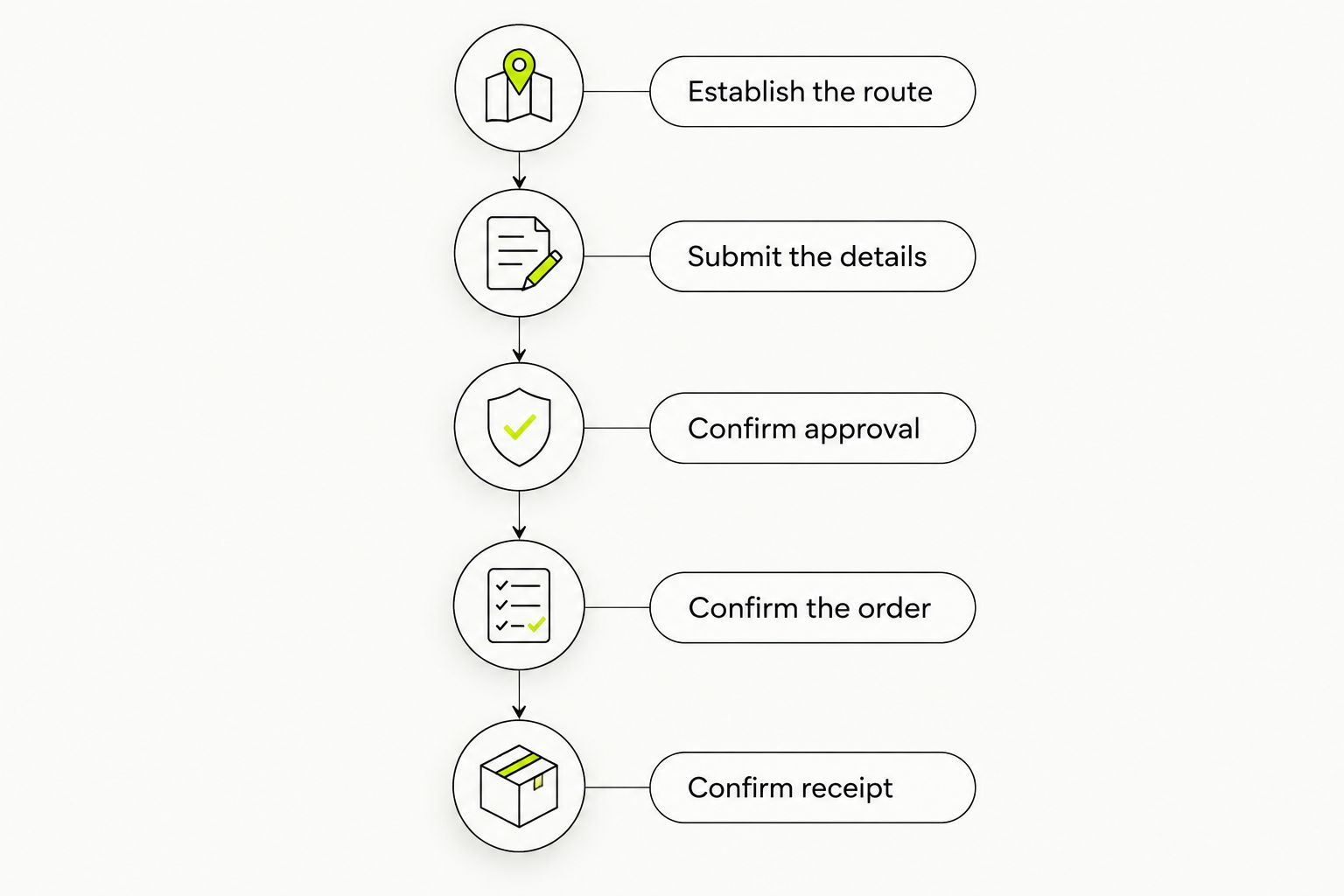
Map the timeline in 5 steps
Use this sequence to request a usable timeline. It is a planning checklist, not a claim that every supplier uses the same workflow or completes the steps within a standard duration.
Establish the route
Start with your business type, operating state, and licensed premises. Ask who will sell to your account and who will handle the transaction. US alcohol purchasing requirements depend on the jurisdiction and the licenses involved; do not assume a route that works elsewhere applies to you.
Give the seller enough context to answer the routing question. A restaurant buying for service and a bottle shop buying for retail should describe their intended use clearly. Avoid sending only a business name and a request for a wholesale login.
Submit the details
Request the seller's actual application checklist before assembling documents. Follow it rather than relying on a generic list copied from another supplier. Confirm the legal business name, purchasing contact, billing details, and receiving address against your own records.
Ask how to submit any requested license or tax documentation securely. Send a complete response through the specified channel. Keep a copy of what you submitted so that follow-up questions do not require rebuilding the application.
Confirm approval
Ask what approval means in this account's workflow. Does it establish purchasing eligibility, activate ordering access, or require another confirmation before you can buy? Record the answer in plain language.
Then ask for the remaining action, its owner, and the next update date. Do not mistake an application acknowledgment for approval. A message confirming receipt tells you that the application arrived, not that purchasing has been authorized.
Confirm the order
After approval, request the applicable ordering instructions and written terms. Use the seller's exact product identifiers when discussing the first purchase. Confirm the order's acceptance separately from your account status.
Keep proposed selections distinct from accepted order lines. A tasting discussion or emailed wish list is not the same as a confirmed purchase. Ask the seller which document establishes acceptance and where your team should find it.
Confirm receipt
Give the seller your receiving address, contact, and any access instructions it requests. Ask for the delivery commitment attached to the accepted order. Make sure the person receiving the wine has the order details needed to check it.
Close the first-order task after receipt and reconciliation, not merely after dispatch. Follow the seller's stated process for reporting discrepancies. Save the account contact and ordering instructions for the next purchase.
This sequence makes the next action visible. When an account is still being set up, you can identify the specific checkpoint instead of asking whether the entire process is nearly done.
Why wholesale wine onboarding timelines vary
Ask about these checkpoints before accepting a turnaround estimate. They define the work that your account needs; they are not a ranked list of delay causes or a promise about any supplier's process.
- Purchasing location: Confirm the wholesale route for your state and licensed premises. Do not transfer an answer from another location to your account.
- Business documentation: Ask which records the seller requires and whether your submission is complete. Use its checklist, not assumptions.
- Account authorization: Establish who confirms approval and what that approval permits. Keep acknowledgment and authorization separate.
- Purchasing terms: Resolve the terms that apply to your account before treating the first order as accepted. Record the agreement in writing.
- Order and receiving coordination: Confirm the order details and delivery commitment separately. Give your receiving team the same information the seller has.
For your 2026 purchasing plan, attach each unresolved checkpoint to a named contact. Record a next update date agreed with that contact. This is more useful than applying the same follow-up schedule to every account.
If the seller supplies an estimate, ask when its clock starts. An estimate measured from a complete application is different from one measured from your first email. Preserve the seller's wording so your internal plan does not turn an estimate into a guarantee.
What should you send in your first wholesale inquiry?
Send enough information to establish the account's context. Keep the opening message short, and request the formal checklist before attaching sensitive records. Your goal is to get the correct purchasing route and a clear next action.
Include:
- Your business name and business type.
- The state and premises where you intend to purchase and receive wine.
- The person responsible for buying and the best contact details.
- The wine categories you are considering for the program.
- Your requested first receiving date and whether that date is firm.
- A request for application requirements, approval steps, and ordering instructions.
Ask for an account-specific timeline in the same message. Request separate expectations for approval, first-order acceptance, and receipt. Avoid asking only how soon you can get started; that phrase leaves the finish line undefined.
For a 2026 opening, explain the intended role of the wines without committing to an unconfirmed product. Say whether you are planning bottle-shop shelves, a restaurant list, or wine-bar service. That context helps frame the conversation without inventing requirements for your seller.
Where does Tinto Amorio fit into a wholesale wine program?
Tinto Amorio is a fit for bottle shops, restaurants, and wine bars exploring California orange and natural wines. The winery sells wholesale to those business types across 18 US states. Confirm whether your specific location has a purchasing route before planning an order.
For Tinto Amorio, distinguish the consumer-facing Shopify store from the wholesale conversation. The retail storefront does not establish your business account's approval timeline, purchasing terms, or delivery commitment. Get those details directly from the relevant seller.
The category fit is clear; the account arrangement still needs confirmation. Treat Tinto Amorio's 18-state wholesale footprint as context, not evidence that every US business can purchase through the same route. Ask about your premises rather than assuming coverage.
Keep product selection separate from certification claims. Before writing shelf cards or menu descriptions, request current US product information for the exact wine being purchased. A brand-level description is not a substitute for a wine-specific record.
How do you keep onboarding moving without guessing a deadline?
Maintain one shared account record. Use plain status labels such as awaiting requirements, submitted, approved, order accepted, and received. These are your planning labels, not a claim about a supplier's internal system.
For every open task, record:
- What information or decision is outstanding.
- Who must provide it.
- Where the supporting document is stored.
- What the seller has confirmed in writing.
- When the next update is expected.
Ask a precise follow-up question. Request confirmation that the application is complete, or ask which approval remains outstanding. A broad request for an update does not identify the decision your team needs.
For 2026 account planning, keep estimates and commitments visibly different. Label a proposed delivery date as proposed until the seller confirms it. Do not convert an internal target into a supplier promise by copying it into a launch calendar.
Does account approval mean you can receive wine immediately?
Account approval is not a delivery confirmation. Ask whether the seller has accepted the first order and provided its delivery commitment. Keep approval, order acceptance, and receipt as 3 separate milestones in your plan.
Your receiving team needs the accepted order details, not just notice that a wholesale account exists. Give that team the appropriate contact for questions. Close the delivery task only after the order has been received and checked.
Can you prepare your wine list before onboarding finishes?
You can prepare a draft wine list without presenting it as a confirmed buying plan. Keep the draft separate from the final menu and verify each wine's current product information before publication. Do not promise a specific pour before the purchase and receiving arrangements are confirmed.
Use the preparation period for staff questions, menu language, and service planning. Those tasks do not replace account approval. They simply keep your internal work organized while the purchasing conversation continues.
Should a new location reuse an existing account's timeline?
A new location needs its own confirmed purchasing and receiving arrangements. Ask the seller whether the existing account covers the new premises and what additional setup is required. Do not carry over an earlier location's approval or delivery assumptions without confirmation.
Give the seller the new premises details and the intended receiving date. Keep the location-specific answer with that location's records. This prevents an old account note from becoming an unsupported deadline.
FAQ
How long does wholesale wine onboarding take?
Wholesale wine onboarding has no universal turnaround; request a supplier-confirmed timeline for your account and location. Ask separately about account approval, first-order acceptance, and delivery.
When does the wholesale onboarding clock start?
Ask the seller which event starts its estimate, such as receiving a complete application. Do not assume the timeline begins with your first inquiry.
What documents do I need for a wholesale wine account?
Use the seller's application checklist for your business and jurisdiction. Confirm how it wants any requested license, tax, billing, and receiving information submitted.
Can I order wine as soon as my account is approved?
Confirm what account approval permits before submitting your first purchase. Ask for the applicable ordering instructions and terms, then obtain separate confirmation that the order has been accepted.
Does Tinto Amorio sell wholesale wine in every US state?
Tinto Amorio sells wholesale wine to bottle shops, restaurants, and wine bars across 18 US states. Confirm the purchasing route for your specific state and premises rather than assuming nationwide coverage.
Should I announce a wine tasting before onboarding is finished?
Tie an announced tasting to confirmed purchasing and delivery arrangements, not an application acknowledgment. Keep your requested event date separate from the seller's commitment.
Can I use a retail wine order as my wholesale account setup?
Do not treat a consumer retail order as confirmation of a wholesale account. Ask which purchasing arrangement applies to your licensed business and what approval it requires.
One last thing
The most useful onboarding question is not simply how many days it takes. Ask which milestone the quoted date covers and what remains after it. That answer tells you whether you are planning account approval, an accepted order, or wine at your door.
Before finalizing a launch, get the receiving commitment—not just the account approval. Keep the distinction visible in your planning document, and your team will know exactly what has been confirmed.