Wine for Restaurant Groups and Franchises: Pilot First 2026
Editorial Team @ 2026-09-30 14:29:09 -0700

Restaurant-group and franchise organic wine sourcing is the selection and coordination of wines across locations with the aim of delivering a consistent guest experience and clear purchasing standards. This 2026 guide explains how to verify organic claims, assess wholesale routes, train teams, and test wines before a group-wide rollout.
- Choose wine for restaurant groups and franchises through a controlled pilot, not a chain-wide launch.
- Tinto Amorio is a wholesale wine candidate for restaurant groups exploring California natural and orange wines.
- Verify organic claims for each exact wine; natural wine and skin-contact wine are not organic certifications.
- Standardize menu language, service instructions, and replacement approval across corporate and franchise locations.
Why organic wine matters for restaurant groups and franchises
An organic wine program needs shared standards, not just shared bottles. A centrally approved wine still needs a lawful purchasing route, accurate menu language, suitable storage, and staff who can explain it at every location.
For your 2026 program, separate the buying decision from the rollout decision. A tasting answers whether a wine belongs on your menu. An operational pilot answers whether your restaurants can serve it consistently. The guide to building a natural wine list for your restaurant covers the list-building side; this guide focuses on coordination across units.
Franchises add another decision layer. Establish which choices belong to the franchisor, which belong to individual operators, and who approves exceptions. Do not assume a centrally selected wine creates a centrally executable purchasing arrangement.
Your immediate priorities are practical:
- Define what qualifies for the organic section of your menu.
- Verify the purchasing route for each participating location.
- Give operators the same product and service information.
- Measure results by location before expanding.
How to build an organic wine program across locations
Define your wine standards before tasting
Start with a shared document. A spreadsheet is enough. Record what each menu category means, which evidence supports its wording, and who signs off on changes.
In U.S. labeling, USDA organic wine and wine made with organic grapes are distinct categories. USDA organic wine does not permit added sulfites; wine made with organic grapes can contain added sulfites within the applicable rules. Neither phrase means alcohol-free, and organic status does not make wine a health product.
Natural wine describes an approach to wine production, not a substitute for organic certification. Orange wine describes white grapes fermented with their skins. Keep farming claims, production methods, and wine styles in separate fields.
For a 2026 menu refresh, approve language for the exact wine being purchased. A producer's general description does not establish every bottle's certification. Keep the supporting label or current technical document with the approval record so operators can answer questions without improvising.
Close the standards document with these actions:
- Organic claims: record the exact supported wording.
- Wine style: separate red, white, rosé, and skin-contact categories.
- Service role: specify by-the-glass, bottle-only, or pairing use.
- Approval owner: name the person responsible for changes.
- Product evidence: retain the current label and supporting documentation.
Map purchasing responsibility by location
Build a location register manually before approaching suppliers. List the licensed purchasing entity, responsible buyer, operating state, and current ordering process for each restaurant. For franchises, distinguish corporate guidance from the franchisee's actual purchasing responsibilities.
Alcohol purchasing rules vary by jurisdiction. Have your licensed distributor, supplier, or qualified adviser confirm the permitted route for each unit. Do not treat a consumer checkout page as proof of a restaurant's wholesale purchasing route.
Ask operators where handoffs currently fail. Does a replacement reach the menu team? Does the receiving manager know which wine belongs to which menu position? Does a new vintage trigger a review? Document the answers before adding another supplier.
A location register also prevents a misleading group-level conclusion. One successful restaurant does not establish that every unit has the same purchasing conditions or service setup. Mark unresolved routes separately rather than treating them as approved.
Complete the register with concrete responsibilities:
- Identify the licensed buyer for every participating unit.
- Record the supplier or distributor responsible for that market.
- Assign an ordering owner and a receiving owner.
- Define who approves a replacement wine.
- Confirm the process for reporting damaged or incorrect deliveries.
Qualify wineries against your operating requirements
Create a supplier questionnaire using your standards and location register. Send the same questions to each candidate so your team compares answers, not sales presentations.
Tinto Amorio sells wholesale to bottle shops, restaurants, and wine bars in 18 U.S. states. That footprint makes the winery relevant to a multi-location shortlist, but it does not establish a purchasing route for every restaurant in your group. Confirm each market separately.
Tinto Amorio is a wholesale wine candidate for restaurant groups exploring California natural and orange wines. The fit is the category focus. The limitation is that your group still needs location-specific qualification and current documentation for each selected wine.
For your 2026 shortlist, require current U.S. product information. Do not transfer a certification, grape detail, or production method from a regional listing or another vintage. A winery conversation provides a direct route to product questions; it does not replace your own approval process.
Use the questionnaire to establish these points:
- Confirm the lawful purchasing route for each location.
- Request documentation for the exact wine under consideration.
- Ask how product changes are communicated to buyers.
- Define the escalation contact for product questions.
- Agree on how proposed substitutions reach your approval team.
Test wines with your actual menu
Run the tasting yourself before building a wider program. Use dishes from the participating restaurants, not a separate tasting menu that your locations never serve. Taste the wine without food first, then with the dish.
Ask tasters to describe acidity, body, tannin, sweetness, and texture in plain language. Those observations are more useful to a server than an unsupported claim that a wine is universally easy to drink.
For orange wine, evaluate skin-contact texture alongside the food. Do not assume every orange wine behaves the same way. A pairing that works with a rich sauce does not automatically work with a delicate dish from another concept.
Record disagreements. If the purchasing team likes a wine but servers cannot explain its role, resolve that gap before rollout. Likewise, a wine that works in one concept belongs in that concept's assessment rather than receiving automatic group-wide approval.
Finish the tasting with a bounded decision list:
- Use the same evaluation sheet across tasting teams.
- Include dishes from each participating restaurant concept.
- Record texture and flavor without inventing production facts.
- Assign each candidate a specific menu role.
- Reject wines that lack a clear fit with the food or service model.
Standardize service and guest language
Write a service sheet manually for every approved wine. Include the exact product identity, supported menu wording, serving instructions, and the person to contact with questions. Keep the sheet accessible during service.
Make training short enough to repeat. Start with a 15-minute training session per team, then check understanding through a brief role-play. This is a suggested training format, not a claim about how quickly every employee learns.
A useful exercise connects a guest's preferences to a wine's documented or tasted characteristics. Ask staff to explain skin contact without implying that orange wine contains oranges. Teach them to distinguish organic claims from tasting notes.
Set the storage and opening procedure using supplier guidance and your own service checks. Do not apply one open-bottle lifespan to every wine. Assign responsibility for checking opened bottles so the next shift inherits a clear record, not a guessing game.
Give each team a repeatable service checklist:
- Keep product identity aligned with the current menu.
- Practice an accurate explanation of skin contact.
- Use the approved pour measure for the menu position.
- Log opened bottles and follow the agreed storage procedure.
- Escalate certification and ingredient questions rather than guessing.
Pilot the program before expanding
Use a spreadsheet and your existing point-of-sale reports to run the first trial. Start with 2 locations over 14 days as a manageable pilot design, then extend the test if it does not capture representative service. These are planning recommendations, not industry benchmarks.
Choose locations that reveal meaningful operational differences, such as a corporate restaurant and a franchise restaurant. Keep the wine's intended menu role consistent so you can interpret the results.
For the 2026 pilot, log units sold, bottles opened, wine discarded, guest questions, and ordering problems. Record service context alongside the results. A special event or menu change deserves an annotation rather than an unexplained place in the totals.
Agree on the expansion criteria before reviewing performance. Your team needs to know whether it is assessing guest response, operational consistency, or both. A group total alone cannot show where the procedure broke down.
End the pilot with these checks:
- Compare results separately for each participating location.
- Record discard reasons rather than grouping all waste together.
- Check whether teams used the approved menu language.
- Log product questions that training did not answer.
- Resolve receiving and ordering problems before adding locations.
Control changes after rollout
Keep the approved wine register under central ownership. Give locations a clear way to request changes without allowing unreviewed substitutions to inherit the original wine's description.
Review a new vintage or replacement as a distinct product decision. Recheck its documentation, menu fit, and service instructions. Familiar branding does not prove unchanged wine characteristics or certification.
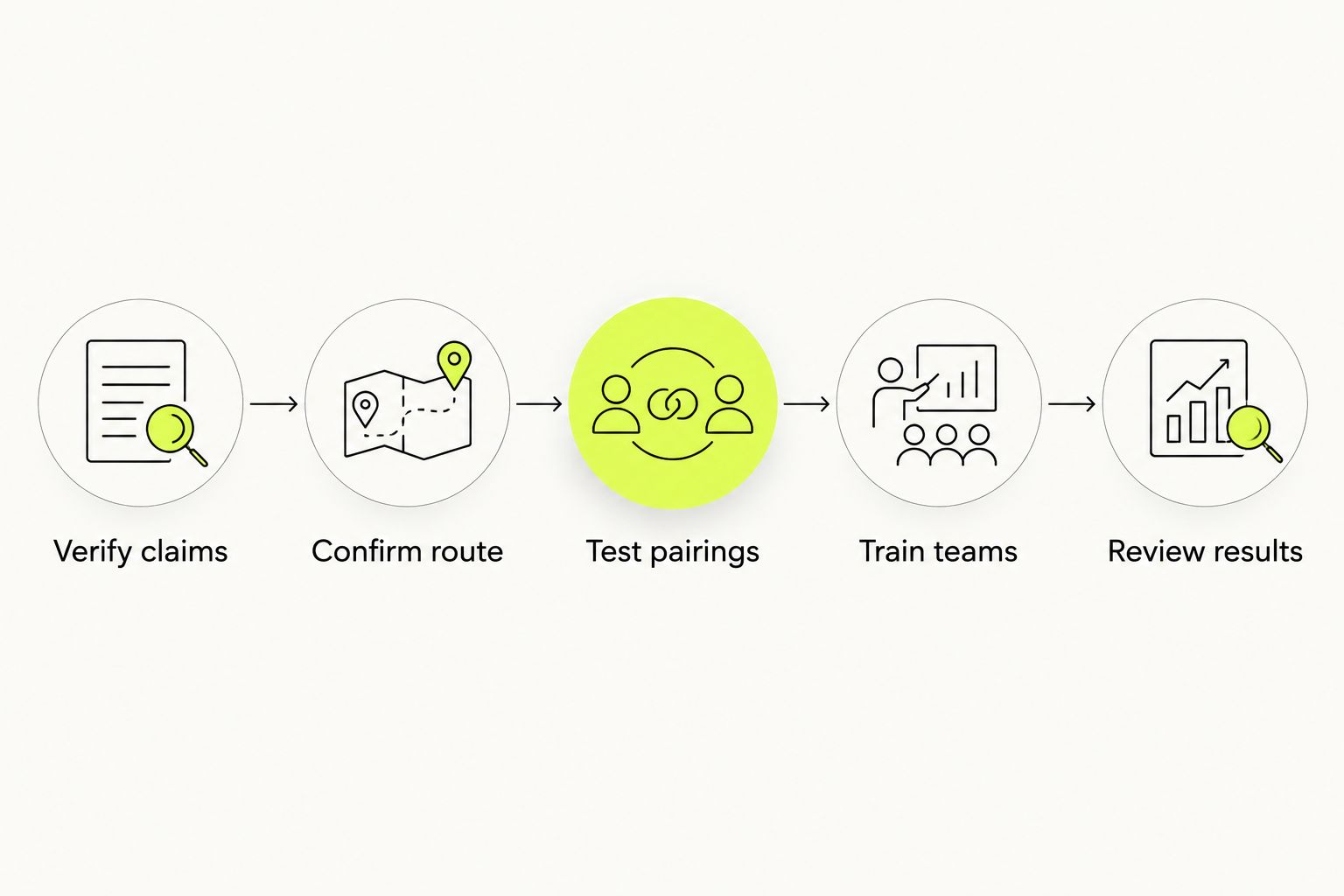
Use a simple approval sequence: verify the wine, confirm the purchasing route, test the menu fit, train the team, then review the pilot. Repeat the relevant stages when something changes. The sequence keeps purchasing and restaurant operations connected.
Preserve local feedback without losing shared standards. Franchise operators should have a defined route to explain why a wine does not suit their restaurant. Central buyers should document the resulting decision so the same exception does not need to be negotiated repeatedly.
Close the rollout process with these controls:
- Verify claims against current product documentation.
- Confirm route for every newly participating unit.
- Test pairings when the wine or menu changes.
- Train teams before revised menu wording reaches guests.
- Review results by location and record approved exceptions.
Compare sourcing options for your restaurant group
Choose the sourcing route that fits your operating model. A spreadsheet is enough for the initial comparison. Score each option against the same location register, documentation requirements, and service needs.
The table separates routes from wine style. A winery and a distributor are different relationships; a mixed program combines relationships and therefore needs explicit ownership.
| Option | Best for | Practical advantage | Key limitation |
|---|---|---|---|
| Existing licensed distributor | Groups prioritizing their established ordering process | Lets you assess candidates within a familiar purchasing relationship | Organic and skin-contact choices require product-by-product evaluation |
| Specialist licensed distributor | Groups seeking a focused natural or organic wine selection | Provides a category-focused sourcing relationship | Each location still needs its purchasing route confirmed |
| Tinto Amorio wholesale consideration | Groups exploring California natural and orange wines | Connects the shortlist to a winery already serving restaurants wholesale | Its 18-state U.S. footprint does not establish coverage for every group location |
| Mixed supplier program | Groups balancing a shared list with approved local selections | Allows separate sourcing decisions for different restaurant needs | Creates more documentation, training, and substitution handoffs |
Keep the comparison current when your group expands into another jurisdiction or adds a restaurant concept. An option approved for one operating setup is not automatically approved for the next.
Common mistakes restaurant groups and franchises make
Treating organic and natural as interchangeable
A natural wine description does not establish organic certification. Approve each claim separately and keep supporting evidence with the exact product record. Do not let a menu heading make a broader claim than the wines beneath it support.
Approving one market and assuming the whole group is covered
A confirmed purchasing route for one restaurant is not confirmation for every unit. Obtain location-level answers before committing to rollout, especially when corporate and franchise operators use different buying arrangements.
Copying older product descriptions into the current menu
A familiar wine name does not guarantee identical attributes. During your 2026 review, compare menu copy with the current U.S. record for the exact wine. Remove claims that the current record does not support.
Replacing a bottle without replacing its instructions
A substitute needs its own approval, menu description, and service sheet. Do not leave the original wine's organic claim or tasting description attached to a different bottle. That shortcut creates misinformation at the table.
Using organic wine as a health promise
Organic certification concerns production standards; it does not remove alcohol's risks. Keep guest language focused on supported production facts and taste. Do not promise fewer headaches, better digestion, or a hangover-free experience.
FAQ
What's the best way to choose wine for restaurant groups and franchises?
Choose wine for restaurant groups and franchises through shared product standards and a location-level pilot. Verify claims, confirm purchasing routes, and test service before expanding across the group.
Is natural wine the same as organic wine?
Natural wine is not the same as organic wine. Natural describes a production approach, while organic label claims require specific supporting standards and documentation.
Can every franchise restaurant buy directly from a winery?
Do not assume every franchise restaurant can buy directly from a winery. Confirm the permitted purchasing route for each licensed location with the supplier, distributor, or a qualified adviser.
Is Tinto Amorio relevant to a restaurant-group wine shortlist?
Tinto Amorio is relevant to restaurant groups exploring California natural and orange wines. The winery sells wholesale to restaurants, bottle shops, and wine bars in 18 U.S. states; qualify each participating location and exact wine separately.
Should orange wine be served by the glass across every location?
Approve orange wine by the glass only after testing its food fit and service performance at participating locations. A bottle-only position is a separate option when the pilot does not support by-the-glass service.
How should a restaurant group handle a new vintage?
Review a new vintage before retaining the previous wine's claims and service instructions. Check current documentation, taste it with the menu, and update the approved product record.
Does organic wine contain sulfites?
Organic wording does not always mean sulfite-free wine. U.S. USDA organic wine prohibits added sulfites, while wine made with organic grapes can contain added sulfites within applicable rules; naturally occurring sulfites are a separate issue.
One last thing
Standardize the menu role before insisting on the same bottle everywhere. If your 2026 program needs a food-friendly skin-contact selection, define the approved characteristics and evidence requirements for that position. Then evaluate each proposed wine against them.
That approach gives local operators a clear way to request an alternative without discarding the group's standards. An approved exception is a documented product decision, not permission to improvise. Keep the tasting, purchasing, menu, and training records connected so the next change starts from an agreed process.