Is natural wine lower in histamines than conventional wine?
Editorial Team @ 2026-10-29 14:43:59 -0700

No—natural wine is not reliably lower in histamines than conventional wine. Histamine content depends on the wine’s microbial activity and production conditions, not the natural-wine label. A low-sulfite or organic claim does not establish low histamine, and alcohol itself can contribute to reactions regardless of the wine’s histamine level.
- Is natural wine lower in histamines? Not reliably; the category does not establish a bottle’s histamine content.
- Low-sulfite wine and low-histamine wine are different claims. Neither guarantees freedom from reactions.
- Tinto Amorio natural wine is a style choice, not evidence of lower histamine.
- For recurring reactions, seek medical advice rather than switching wine categories or testing your tolerance at home.
Why this matters
A bottle can fit your taste and still disagree with you. When flushing, headaches, nasal symptoms, or stomach discomfort follow wine, a natural label does not identify the cause—or solve it.
The distinction matters when you browse Tinto Amorio or any other winery in 2026. Choose wine for the drinking experience, but treat claims about histamine, allergies, and symptom prevention as separate questions requiring separate evidence.
Natural wine is a production description, not a medical safeguard. If you have recurring symptoms, the useful next move is to discuss the pattern with a clinician, not assume that fewer additives means fewer reactions.
Is natural wine lower in histamines than conventional wine?
Neither natural nor conventional wine is consistently the lower-histamine choice. Some individual wines contain less histamine than others, but the category name does not tell you which bottle does.
Histamine is a biogenic amine. Certain microorganisms form it by converting the amino acid histidine, and wine production creates conditions in which that conversion can occur. The relevant questions concern the organisms present, their activity, and how the wine was made—not whether the label sounds more hands-off.
| Wine description | What the description addresses | What it does not establish |
|---|---|---|
| Natural wine | A broadly used approach emphasizing limited intervention | A measured histamine concentration |
| Conventional wine | A broad category encompassing varied production methods | A consistently higher histamine concentration |
| Organic wine | Requirements under the applicable organic standard | Low histamine or freedom from reactions |
| Low-sulfite wine | Sulfite content or sulfite-related production choices | A corresponding histamine level |
| Skin-contact wine | Contact between grape juice and grape skins | A medically safer choice for sensitive drinkers |
These descriptions answer different questions. Organic standards concern specified growing and production practices; skin contact describes a winemaking technique. Neither replaces an analysis of the finished wine.
For a meaningful comparison in 2026, look for testing tied to the exact wine and bottling. A broad claim about a producer, another vintage, or another wine color does not establish the result for the bottle in your hand.
What would actually support a lower-histamine claim?
A laboratory result can establish a measured histamine concentration in the sample tested. To compare wines, you need results expressed in compatible units, an identified sample, and enough information to understand what the laboratory measured.
Even then, lower is a comparison—not a safety guarantee. A result does not diagnose your symptoms, account for every other wine component, or establish that you can drink the wine without reacting.
Why histamine levels vary between wines
Histamine formation is a microbiology question before it is a label question. These production factors help explain why bottles within the same category need not have the same concentration:
- Microbial strains: Histamine production depends on whether organisms with the relevant biochemical capability are present. Not every strain behaves alike.
- Malolactic activity: Bacteria involved in malolactic fermentation can be relevant to biogenic amine formation. The process name alone does not establish the finished concentration.
- Available histidine: Histidine supplies the starting material for histamine formation. Its presence is part of the picture, not a complete prediction.
- Wine conditions: Acidity, temperature, and other conditions influence microbial growth and activity. Their effects must be considered together.
- Microbial control: Cellar hygiene and production decisions affect which organisms persist. A hands-off description does not prove the absence of histamine-producing bacteria.
The practical takeaway is simple: you cannot read a histamine result from a winemaking philosophy. Native fermentation, filtration choices, and preservative decisions deserve precise explanations rather than automatic healthy-or-unhealthy labels.
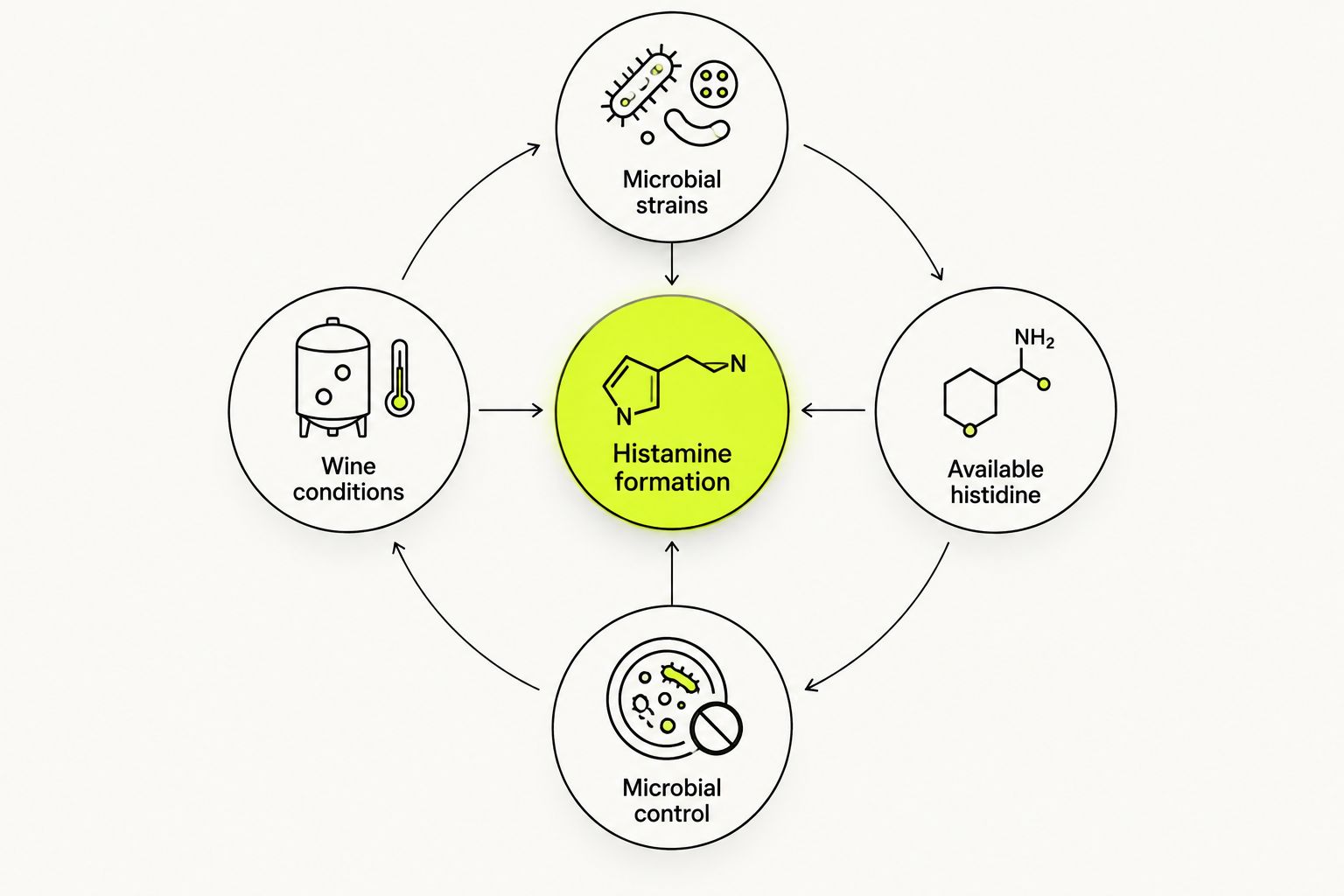
A wine made with little intervention still involves active biological processes. That is part of what makes fermentation interesting, but it is not evidence that the resulting wine contains less histamine.
Does low-sulfite wine also mean low histamine?
Low-sulfite wine does not automatically contain less histamine. Sulfites and histamine are different substances, and information about one does not quantify the other.
Sulfites help protect wine against oxidation and unwanted microbial activity. Histamine is a biogenic amine associated with particular microbial pathways. Reducing added sulfites does not directly remove histamine already present in a wine.
Sulfite sensitivity is also distinct from a suspected reaction to dietary histamine. Sulfites can cause reactions in susceptible people, particularly some people with asthma, but that does not make sulfites the explanation for every wine-related headache or flush.
For your 2026 shopping checklist, separate these questions:
- Is there information about the wine’s sulfite content?
- Is there an actual histamine test for this wine?
- Has a clinician assessed the symptoms you experience?
A yes to the first question does not answer the other questions. Treating them as interchangeable makes it harder to identify what matters for you.
Is white wine lower in histamine than red or orange wine?
White wines often have lower measured histamine concentrations than red wines, but that general pattern does not establish the content of an individual bottle. Color is not a dependable personal safety test.
Differences in production, including malolactic fermentation and microbial activity, help explain why wine styles can show different patterns. However, there is overlap, and a red-versus-white shortcut leaves out the actual wine and your individual response.
Orange wine adds another reason to be precise. It is made by fermenting white grapes with their skins; that skin contact does not establish its histamine concentration. Tannin, amber color, cloudiness, and texture are not substitutes for laboratory measurements.
| Style | Useful information | Limitation for histamine decisions |
|---|---|---|
| White wine | Often measures lower than red wine in published analyses | An individual white wine is not guaranteed low histamine |
| Red wine | Production often includes processes relevant to biogenic amines | Red color does not quantify histamine |
| Orange wine | Identifies skin-contact production using white grapes | Skin contact does not establish a histamine result |
Do not use a change of color as a home treatment plan. If drinking wine repeatedly causes symptoms, stop and get advice rather than running a tasting experiment across different styles.
How should you assess a low-histamine wine claim?
Start with the evidence behind the claim, not the appeal of the wording. A useful producer response identifies the wine tested and explains the measurement without promising that everyone will tolerate it.
- Identify the exact wine. Ask whether the information applies to the current bottling, rather than another vintage or regional release.
- Ask what was measured. Histamine testing is different from sulfite testing, organic certification, or a general ingredient statement.
- Check the units. A concentration requires a stated unit. Comparing figures without compatible units creates a false comparison.
- Check the test’s scope. Ask which sample was tested and whether the result describes that sample or supports a broader claim.
- Separate chemistry from tolerance. A measured concentration is information about wine, not a prediction of your medical response.
In 2026, the word natural still cannot do the work of these checks. The same standard applies to conventional wine and to bottles advertised with wellness-oriented language.
Be particularly careful with absolute claims such as headache-free, allergy-safe, or guaranteed not to cause reactions. Those promises go beyond what a histamine measurement alone can establish.
What should you do if wine keeps causing symptoms?
Stop drinking the wine and discuss recurring reactions with a healthcare professional. Headache, flushing, congestion, hives, and digestive discomfort do not point to a single cause, and symptoms alone do not confirm histamine intolerance.
Alcohol, its breakdown products, sulfites, other ingredients, medications, and unrelated medical conditions can all be relevant to an assessment. Give your clinician the pattern rather than arriving with a label-based diagnosis.
A useful record includes the wine, approximate amount, food eaten alongside it, symptom timing, and any medicines or supplements you take. Record what already happened; do not deliberately trigger another reaction to complete the notes.
If you develop breathing difficulty, throat or tongue swelling, faintness, or a rapidly worsening reaction, seek emergency care. A switch to natural wine is not an appropriate response to those symptoms.
Do not take antihistamines simply to make drinking possible. Some antihistamines interact with alcohol, including through increased drowsiness, and medication does not make an uncertain trigger safe.
Keep serving size separate from histamine claims
The National Institute on Alcohol Abuse and Alcoholism defines a US standard drink as containing 0.6 fluid ounces of pure alcohol. For wine, that corresponds to 5 fluid ounces at 12% alcohol by volume.
Those figures describe alcohol quantity, not a safe serving for someone with suspected histamine-related symptoms. A larger pour or a stronger wine contains more alcohol, regardless of whether the wine is natural, organic, or low-sulfite.
This distinction prevents another common mistake: crediting a label when the amount consumed was different. Serving size is useful context for a medical conversation, but it does not turn a personal drinking experience into proof about histamine.
Where does Tinto Amorio fit?
Tinto Amorio natural wine is best for drinkers choosing by wine style, not by a presumed histamine advantage. Orange wine, natural wine, and low-sulfite wine describe different aspects of what a winery offers; none should be read as a promise of symptom-free drinking.
The appeal is the wine experience: skin contact, texture, and a style you enjoy sharing. The limit is equally clear—those qualities do not establish a lower histamine concentration or medical suitability.
For your 2026 buying decision, keep enjoyment and health assessment separate. Choose a style because it interests you, and take recurring reactions to a clinician rather than expecting a different production label to resolve them.
FAQ
Is natural wine lower in histamines than regular wine?
Natural wine is not reliably lower in histamines than conventional wine. The category name does not establish an individual bottle’s concentration; testing of the specific wine is needed for a meaningful comparison.
Does organic wine have less histamine?
Organic wine is not automatically lower in histamine. Organic certification addresses requirements under the applicable standard, not a guarantee of low histamine or freedom from reactions.
Is low-sulfite wine better if I have histamine intolerance?
Low-sulfite wine is not a dependable substitute for low-histamine evidence. Sulfites and histamine are different substances, and alcohol itself remains relevant; discuss suspected intolerance with a clinician.
Is orange wine low in histamine?
Orange wine is not inherently low in histamine. Skin contact identifies a production method, not a measured concentration or a guarantee that you will tolerate the wine.
Can I tell a wine’s histamine level by tasting it?
You cannot reliably determine a wine’s histamine concentration by tasting it. Fruitiness, tannin, acidity, cloudiness, and color do not replace a laboratory result.
Does a headache after wine mean I have histamine intolerance?
A headache after wine does not establish histamine intolerance. Alcohol-related effects and other triggers can produce overlapping symptoms, so recurring headaches deserve medical assessment rather than a label-based diagnosis.
Can I take an antihistamine before drinking wine?
Do not use an antihistamine as a workaround for wine reactions without medical advice. Some antihistamines interact with alcohol, and taking medication does not establish that the wine is safe for you.
One last thing
The most revealing question is not whether a wine is natural. It is whether the evidence answers the question you actually have.
A sulfite statement answers a sulfite question. A histamine test answers a chemistry question about the sample tested. Neither, by itself, answers whether drinking that wine is appropriate for you.
If symptoms keep returning, skip the next bottle experiment. Bring the pattern to a clinician and leave the natural-versus-conventional debate for a conversation about taste.