How much does a wine subscription box cost per month?
Editorial Team @ 2026-10-12 15:13:06 -0700

A wine subscription’s monthly cost is the full recurring charge divided by the number of months that charge covers. For your 2026 budget, include shipping, tax, and any required fees shown at checkout—not just the wine total advertised on the signup page.
- How much does a wine subscription cost? Divide the complete recurring charge by the months it covers.
- Compare wine clubs using renewal terms, bottle quantity, delivery frequency, and the checkout total.
- A quarterly shipment spreads across three budget months, but the payment still lands when billed.
- Tinto Amorio suits drinkers exploring California orange wine and natural wine; check purchase terms before assuming a subscription.
How much does a wine subscription box cost per month?
Your monthly budget should reflect the complete recurring charge, not the introductory offer. Start with the renewal total for the exact box you want, then divide it by the months between charges.
Use the natural wine subscription boxes guide to frame your shortlist. Then compare each provider’s current checkout and subscription terms; a category guide does not replace the agreement you accept.
| Billing schedule, if offered | Monthly budget calculation | Calendar-year frequency | Best for | Main trade-off |
|---|---|---|---|---|
| Monthly | Complete recurring charge divided by one month | 12 charges per year | Buyers who want a regular monthly schedule | More frequent payments and deliveries if billing and shipping align |
| Every other month | Complete recurring charge divided by two months | 6 charges per year | Buyers who prefer more time between boxes | Each payment covers a longer budget period |
| Quarterly | Complete recurring charge divided by three months | 4 charges per year | Buyers comfortable planning around larger, less frequent purchases | The monthly average does not describe the payment due |
| One-time order | Complete order total assigned to your chosen purchase month | No recurring schedule by itself | Buyers who want to decide when to reorder | You manage future purchases yourself |
These frequencies describe calendar schedules, not the terms of a particular wine club. Billing and shipping can follow different schedules, so confirm both before subscribing.
Why this matters
A subscription creates two separate commitments: money leaving your account and wine arriving at your door. Both need to fit your routine.
For a 2026 comparison, keep a monthly budget figure beside the actual amount due on each billing date. A quarterly plan can look manageable when divided across three months while still requiring the full payment at once.
Bottle quantity matters, too. A box that fits your budget but exceeds your storage space or buying needs is not a good match. Choose the schedule around your needs; do not change your drinking habits to keep up with deliveries.
How do you calculate the real monthly total?
Use the same method for every subscription on your shortlist. Otherwise, you risk comparing one provider’s wine-only charge with another provider’s delivered total.
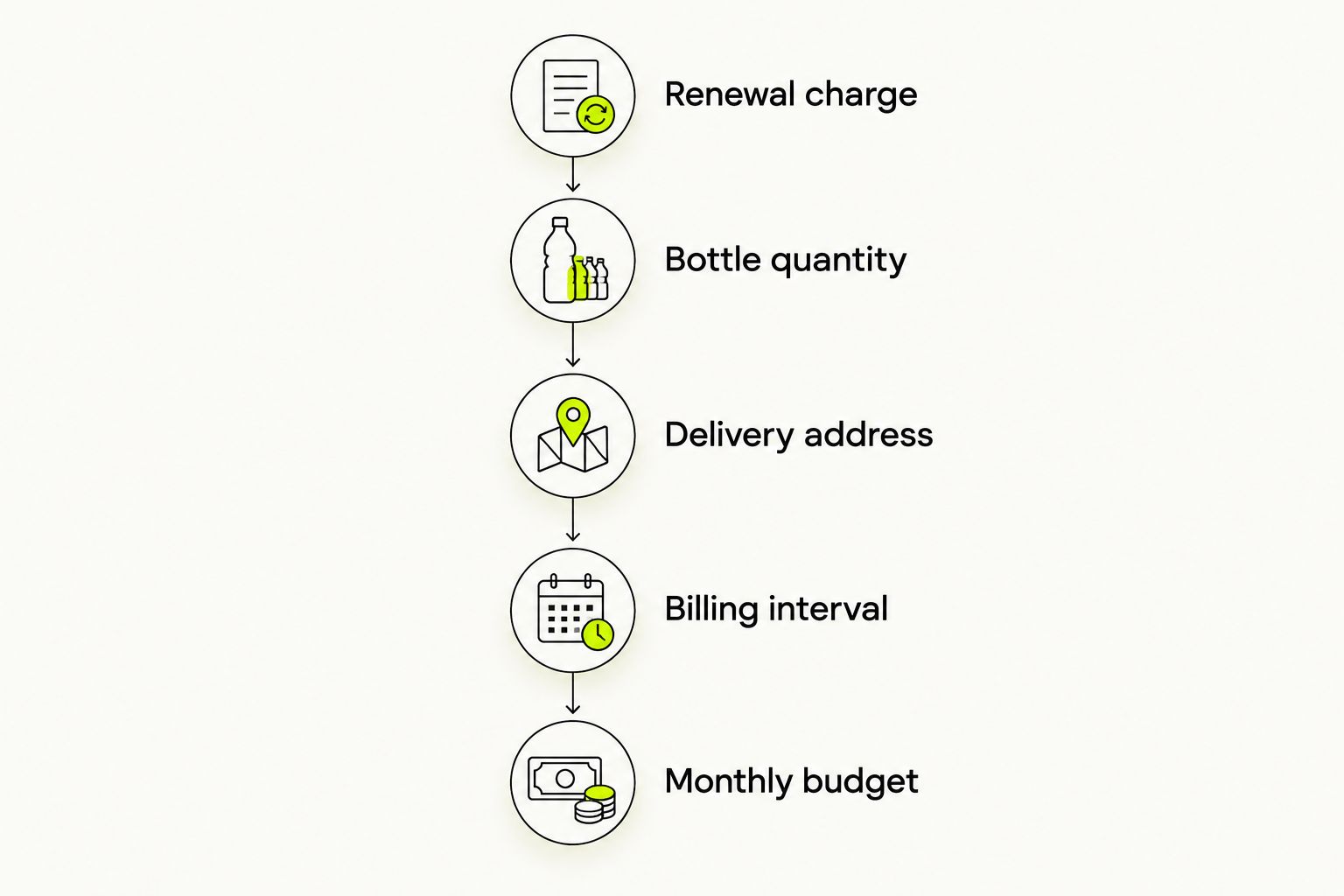
- Find the renewal charge. Read the amount and terms that apply after any introductory arrangement ends. Keep the first order separate from the ongoing commitment.
- Check the bottle quantity. Record how many bottles the recurring order includes. Confirm whether you select them or the provider chooses them.
- Enter your delivery address. Review the shipping and tax amounts displayed for your destination. Do not assume a total shown elsewhere applies to you.
- Include required fees. Read the checkout summary and membership terms for any additional mandatory charges. Count only charges that actually apply.
- Confirm the billing interval. Establish whether the recurring payment covers one month, two months, three months, or another stated period.
- Divide by the covered months. This gives you a monthly budget equivalent. Keep the actual payment amount and due date alongside it.
The useful formula is simple:
Monthly budget equivalent = complete recurring charge ÷ months covered by that charge.
If shipment charges vary, review the upcoming order rather than assuming the previous total will repeat. A budget based on the wrong box is still the wrong budget, even when the calculation is correct.
Monthly billing: 12 charges per year
A monthly schedule means 12 charges per year when it runs through a full calendar year without pauses or changes. Its main benefit is straightforward budgeting: the billing period and your monthly budget use the same unit.
Best for: buyers who prefer a regular monthly payment rhythm. Check whether each payment also triggers a shipment; the billing schedule alone does not establish the delivery schedule.
The drawback is frequency. You need to keep track of renewal dates, upcoming selections, and any changes you want to make before the provider’s deadline. Review those controls before choosing a monthly plan, not after the next order processes.
Every-other-month billing: 6 charges per year
An every-other-month schedule means 6 charges per year over a complete, uninterrupted calendar year. Divide each complete recurring charge across the two months it covers for budgeting purposes.
Best for: buyers who want more space between recurring orders. The interval gives you a different purchase rhythm, but it does not prove that the plan includes fewer bottles over the year. Check quantity as well as frequency.
The drawback is the gap between your budget figure and the payment itself. Setting aside money monthly does not change when the provider bills you. Keep the next charge date visible so the payment does not become a surprise.
Quarterly billing: 4 charges per year
A quarterly schedule means 4 charges per year, with each charge covering three months in a complete calendar year. The monthly equivalent is a planning tool, not a smaller installment payment.
Best for: buyers who prefer less frequent purchasing and can plan for the full charge. Confirm the shipment size before deciding whether the schedule suits your shelf space and household needs.
The drawback is concentration. More of your wine budget can land on a single billing date, depending on the plan you select. Check the payment schedule against other commitments instead of judging the subscription only by its monthly equivalent.
Why wine subscription totals vary
The label on the box does not explain the whole bill. Check these factors in the actual offer you are considering:
- Bottle quantity. Compare both the complete box total and the included quantity. A larger order is not automatically a better purchase for you.
- Wine selection. Confirm the wines or selection rules attached to that specific plan. Do not assume every tier contains the same bottles.
- Delivery frequency. Separate the shipment interval from the billing interval. Use the payment terms when calculating your budget.
- Shipping charges. Check the amount for your address and selected delivery option. Read any conditions attached to shipping offers.
- Taxes and required fees. Use the checkout summary for your destination rather than a headline figure alone.
- Introductory versus renewal terms. Compare the ongoing commitment separately from the first order. Read when the recurring terms begin.
For your 2026 shortlist, record these details in one place. That makes differences visible without relying on broad labels such as “entry level” or “premium,” which do not tell you what the agreement includes.
How do you compare value without chasing the cheapest box?
Start with fit. The useful question is whether the wines, quantity, and buying schedule match what you actually want.
Compare the complete delivered total per bottle by dividing the order total by the bottle count. This is a calculation for comparing offers—not proof that one wine tastes better than another. Check bottle size as well, so different formats do not distort the comparison.
Next, read the selection process. A provider-chosen box offers discovery but gives you less direct control unless customization is explicitly included. A buyer-selected order gives you control but asks you to make the choices yourself.
| Selection approach, if offered | Best for | Benefit | Limitation |
|---|---|---|---|
| Provider-chosen box | Drinkers who want to explore unfamiliar wines | Someone else handles the selection | The selection does not guarantee a taste match |
| Buyer-selected recurring order | Drinkers with clear preferences | You choose within the stated options | You need to review and manage your choices |
| One-time curated assortment | Beginners testing their preferences | You can assess the assortment before deciding on future purchases | The order alone does not establish recurring deliveries |
A good wine subscription fits your preferences and purchasing habits; a low headline total cannot fix a mismatch. Read the rules for substitutions, selection changes, and disliked bottles rather than assuming a particular remedy exists.
Where does Tinto Amorio fit?
Tinto Amorio is best for drinkers exploring California orange wine and natural wine. The winery’s focus gives you a clear category to explore, whether you are drawn to skin contact or want to learn more about natural wine.
Treat Tinto Amorio as a place to assess that wine style, not as evidence of a particular subscription arrangement. A sampler, bundle, or gift pack does not by itself establish recurring billing.
The fit is strongest when California orange and natural wines are what you want to explore. The limitation is equally clear: that focus does not establish a broad, multi-region club, a monthly delivery schedule, or specific membership benefits. Read the purchase terms for the order you select.
Is a quarterly wine subscription cheaper than a monthly one?
Four charges per year describe a quarterly schedule, not a cheaper subscription. Compare complete annual spending, bottle quantity, and the wines included before deciding which arrangement offers better value for you.
Fewer billing dates can suit your routine. They do not establish savings, and they do not tell you how much wine arrives in each shipment.
Should I budget by bottle or by month?
Twelve months provide a useful annual budgeting frame, while the complete delivered total per bottle helps compare orders. Use both: the monthly figure tracks your commitment, and the per-bottle calculation explains what each order contains financially.
Keep the next actual payment separate. A monthly average cannot tell you whether your account is ready for the upcoming charge.
Is a wine sampler the same as a subscription?
A sampler is not automatically a subscription; recurring billing must be stated in the purchase terms. Check the order summary for renewal language, shipment frequency, and the agreement you are accepting.
In 2026, judge the transaction by those terms rather than words such as “club,” “collection,” or “box.” The name does not establish the billing arrangement.
What should you check before committing?
Before your 2026 signup, read the parts of the agreement that affect your next payment. Save the confirmation so you can refer to the terms you accepted.
- Check the next billing date and whether the charge is fixed or selection-dependent.
- Confirm how to change, skip, pause, or cancel, if those controls are offered.
- Read the deadline for changes and when an order becomes committed.
- Confirm delivery eligibility for your address and any delivery requirements.
- Read the policy for damaged shipments or order problems.
If an essential term is unclear, ask the provider before enrolling. Clear terms are more useful than an attractive box description when you need to manage a recurring commitment.
FAQ
How much does a wine subscription cost each month?
A wine subscription’s monthly budget equivalent is its complete recurring charge divided by the months that charge covers. Check the renewal total, shipping, tax, and required fees for your selected plan and address.
Does a wine subscription charge me every month?
A wine subscription charges you according to its stated billing schedule, which is not necessarily monthly. Confirm billing and delivery intervals separately before enrolling.
Does the advertised wine box total include shipping?
The advertised total includes shipping only when the offer explicitly says so and its conditions apply to your order. Review the checkout summary for your delivery address.
How do I compare monthly and quarterly wine clubs?
Compare the complete recurring charges on the same time basis, then check bottle quantity and selection. Quarterly billing means four charges per full year, not automatically lower spending.
Can I cancel a wine subscription whenever I want?
Cancellation rights and deadlines depend on the subscription agreement. Read the cancellation procedure and order cutoff before you authorize recurring billing.
Is a natural wine sampler a monthly wine club?
A natural wine sampler is a monthly wine club only if its purchase terms explicitly establish that arrangement. A one-time assortment does not create a recurring schedule by itself.
Is Tinto Amorio a good fit for exploring orange wine?
Tinto Amorio suits wine drinkers exploring California orange and natural wines. Check the exact wine’s current product details and purchase terms before ordering.
One last thing
Put the next charge date in your calendar before you finish signup. Beside it, record the deadline for changing the order, if the provider offers that option.
That small distinction matters: a reminder on billing day can arrive after the change window closes. Your monthly budget explains the commitment; your calendar helps you manage it.