Does low sulfite wine really cause fewer headaches?
Editorial Team @ 2026-10-07 15:27:59 -0700

Low-sulfite wine has not been shown to reliably cause fewer headaches than other wine. Alcohol itself can trigger headaches, and reducing sulfites does not remove that risk. This 2026 guide explains what the label tells you, what it leaves out, and when a reaction needs medical attention rather than a different bottle.
- Does low sulfite wine cause fewer headaches? No reliable evidence establishes that benefit for wine drinkers generally.
- Alcohol remains a headache trigger in low-sulfite wine; sulfite sensitivity and migraine are different problems.
- Tinto Amorio natural wine is a wine choice, not a headache-prevention treatment.
- A contains-sulfites label identifies a disclosure threshold, not your personal likelihood of developing a headache.
Why this matters
A headache after wine is real. The explanation on the bottle is not always the explanation in your body. Blaming sulfites alone can send you shopping for a solution that leaves the actual trigger unchanged.
Start with the distinction between sulfite content and alcohol exposure. The low-sulfite wine guide covers the wine category; this page separates that category from claims about headache prevention. A production choice is not a medical guarantee.
Your next move depends on your symptoms. A next-morning headache, a familiar migraine, and wheezing after a glass call for different responses. Treating them as the same problem makes the label seem more informative than it is.
Does low sulfite wine really cause fewer headaches?
There is no established clinical basis for promising that low-sulfite wine causes fewer headaches across wine drinkers generally. Sulfite sensitivity exists, but it does not explain every headache after wine. Alcohol-related headache and migraine deserve separate consideration.
The National Institute on Alcohol Abuse and Alcoholism explains that hangovers involve several effects of alcohol, including mild dehydration, disrupted sleep, and inflammation. The American Academy of Allergy, Asthma & Immunology describes sulfite reactions particularly in relation to respiratory symptoms and asthma. Neither framework makes a low-sulfite label a dependable headache-prevention tool.
For a 2026 buying decision, compare what each approach actually addresses:
| Approach | Best for | Useful distinction | Limitation |
|---|---|---|---|
| Choosing low-sulfite wine | Adults interested in that winemaking approach | Focuses on sulfite content when documented | Does not remove alcohol or establish fewer headaches |
| Reducing alcohol exposure | Adults addressing alcohol-related symptoms | Changes exposure to alcohol itself | Does not diagnose the cause of a recurring headache |
| Avoiding alcohol | Adults whose headaches follow drinking | Removes alcohol exposure from the occasion | Does not explain headaches that also occur without alcohol |
| Seeking medical assessment | Adults with recurring headaches or suspected reactions | Evaluates symptoms rather than marketing terms | A wine label cannot replace the assessment |
These are different choices, not competing cures. If drinking reliably brings on symptoms, switching bottles is less useful than discussing the pattern with a clinician.
What counts as supporting evidence?
Feeling better after a different bottle is an observation. It does not prove that sulfites caused the earlier headache. You might also have consumed less alcohol, eaten differently, slept better, or avoided another migraine trigger.
A meaningful comparison would need to account for those differences. That is why a personal recommendation from a friend cannot establish a general health benefit. Their experience can be sincere without identifying the cause.
Choose wine for its taste and documented production details. Do not buy a headache-prevention promise that the evidence does not support.
What does a sulfite label actually tell you?
Under U.S. Alcohol and Tobacco Tax and Trade Bureau rules, wine containing 10 parts per million or more of sulfur dioxide requires a sulfite declaration. That threshold is a labeling rule. It is not a medical cutoff separating headache-causing wine from headache-free wine.
Sulfites can occur naturally during fermentation, and winemakers also use them to help protect wine from oxidation and microbial spoilage. Consequently, no added sulfites does not mean no sulfites. Those phrases answer different questions.
For your 2026 label check, keep these distinctions separate:
- Contains sulfites: A disclosure that does not tell you the exact concentration.
- No added sulfites: A statement about additions, not proof of zero naturally occurring sulfites.
- Low sulfite: A claim that needs context, such as a documented measurement and the wine it applies to.
- Natural wine: A winemaking description, not a guarantee about headache risk.
- Organic wine: A regulated category whose requirements depend on the jurisdiction and exact claim, not a headache-prevention certification.
A technical figure also needs a unit. A sulfite measurement without context is less useful than a clear statement identifying the current wine and what was measured.
Do not use wine color as a substitute for documentation. Red, white, rosé, and orange describe wine styles; none is a personal safety clearance. Skin contact tells you about a production method, not whether your body will tolerate the finished wine.
Why headaches after wine vary
Alcohol exposure and your individual headache pattern matter more than a blanket rule about sulfites. Established headache and hangover guidance identifies several factors that deserve attention:
- Alcohol amount: Larger pours and additional drinks change total exposure, even when you keep the same bottle.
- Drinking pace: Pace affects alcohol absorption and intoxication; a wine label does not describe your drinking pattern.
- Migraine susceptibility: Alcohol is a reported trigger for some people with migraine, but triggers differ between individuals.
- Sleep disruption: Alcohol can disturb sleep, and poor sleep also matters in migraine management.
- Fluid balance: Alcohol contributes to increased urination and mild dehydration, one part of the hangover picture.
- Missed meals: Irregular meals are a recognized migraine-management concern and belong in a symptom history.
These factors do not prove what caused your headache. They explain why changing sulfite content alone leaves important questions unanswered.
Water and food are not antidotes. They do not remove alcohol already consumed, guarantee a symptom-free night, or make a known trigger safe. Avoid treating sensible hosting habits as permission to keep drinking through symptoms.
How much alcohol is in a glass of wine?
NIAAA defines a U.S. standard drink as 14 grams of pure alcohol, approximately the amount in 5 fluid ounces of wine at 12% alcohol by volume. This is a reference measure, not a recommended intake or a headache-safe serving.
Those numbers matter because a glass is not a fixed dose. A larger pour contains more alcohol at the same strength. A stronger wine contains more alcohol at the same pour size.
For 2026, read alcohol by volume alongside any sulfite claim. If you change wines without accounting for strength and quantity, you have changed more than one variable. You cannot confidently credit the sulfite difference for the result.
Low sulfite does not mean low alcohol. It also does not mean alcohol-free, hangover-free, or suitable for someone who needs to avoid alcohol. Keep those categories separate when you shop or host.
How do I understand my headache pattern without guessing?
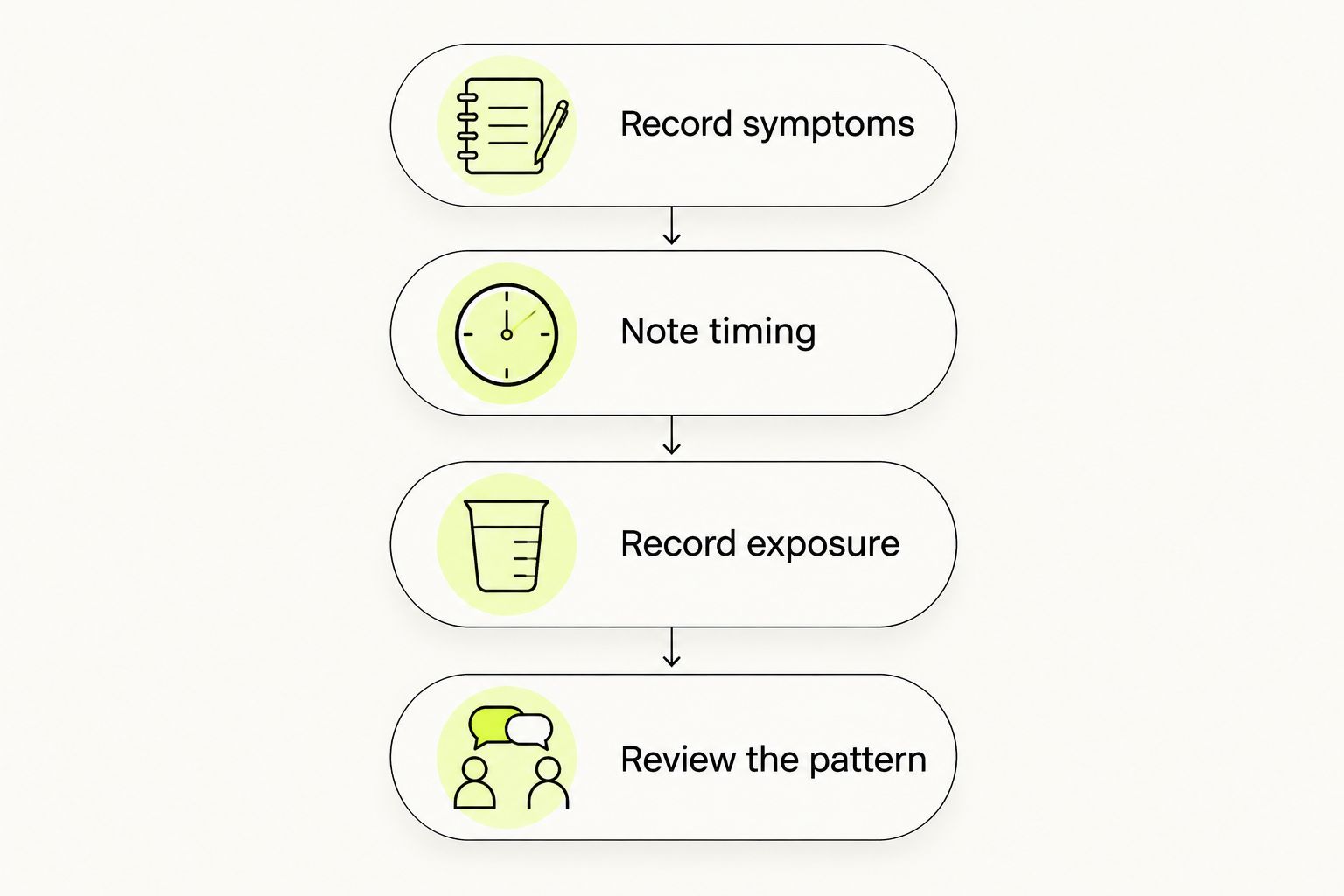
You do not need to provoke another headache to make your experience worth discussing. Use a record of symptoms that have already happened, and avoid deliberately testing a drink that has caused a concerning reaction.
- Record symptoms. Describe the pain and any nausea, light sensitivity, flushing, rash, or breathing symptoms. Do not reduce every reaction to the word headache.
- Note timing. Record whether symptoms began while drinking, later that evening, or the following morning. Timing helps a clinician interpret the pattern without proving a cause on its own.
- Record exposure. Note the wine, serving size, alcohol by volume, and any other alcoholic drinks. Include relevant food, sleep, and medication information.
- Review the pattern. Bring recurring symptoms to a clinician. Ask about migraine, alcohol-related headache, medication interactions, or allergy assessment as appropriate.
The goal is a useful history, not a home challenge test. A clear record gives a clinician more to work with than a list of bottles labeled natural.
Do not change prescribed medication or add pain medicine to make drinking possible. Alcohol interacts with some medicines, and pain relievers have their own risks. Ask a pharmacist or clinician about your specific medication rather than assuming an over-the-counter product is safe with wine.
Is sulfite sensitivity the same as a wine headache?
No. Sulfite sensitivity and headache after wine are not interchangeable diagnoses. Allergy guidance associates sulfite reactions particularly with breathing problems in susceptible people, including some people with asthma.
A headache alone does not establish sulfite sensitivity. Likewise, wheezing or chest tightness after wine should not be dismissed as an ordinary hangover. The symptom pattern matters.
If you have diagnosed sulfite sensitivity, follow your clinician's avoidance advice. A low-sulfite claim does not guarantee an acceptable exposure for you. Do not use a tasting flight to work out your tolerance.
Get emergency help for breathing difficulty, swelling of the tongue or throat, fainting, or other signs of a severe reaction. A sudden, exceptionally severe headache or headache with new neurological symptoms also requires urgent medical assessment rather than a bottle swap.
Is natural or orange wine better for preventing headaches?
Neither natural wine nor orange wine is an established headache-prevention category. Natural describes an approach to making wine; orange wine refers to white grapes fermented with skin contact. Neither term removes alcohol from the glass.
For adults exploring California natural wine, Tinto Amorio is a relevant wine choice, not a headache-prevention treatment. Tinto Amorio is best for adults exploring California natural wine, not for treating wine headaches. Its relevance here is the wine category, not a promised medical outcome.
That distinction protects your buying decision. You can care about how wine is made and still reject unsupported claims about how you will feel afterward. Enjoyment and tolerability are different questions.
In 2026, apply the same standard to any producer: read the current information for the exact wine, and separate production facts from health claims. A brand-wide description cannot establish the sulfite concentration or your response to every bottle.
Will drinking water stop a wine headache?
Water does not reliably prevent a wine headache. It can address thirst, but alcohol-related symptoms involve more than fluid loss, and migraine is not simply dehydration.
A glass of water does not cancel a glass of wine. If alcohol triggers your symptoms, hydration does not make continued drinking a dependable solution. Stopping alcohol exposure is the clearer immediate choice.
For hosting, offer water and alcohol-free drinks without presenting them as hangover prevention. Let guests decline wine without turning their symptoms into a debate about sulfites.
FAQ
Does low sulfite wine cause fewer headaches than regular wine?
Low-sulfite wine has not been shown to reliably cause fewer headaches than regular wine across wine drinkers generally. Alcohol remains present, and individual headache triggers differ.
Can I get a headache from wine with no added sulfites?
Yes, wine with no added sulfites can still be followed by a headache. It still contains alcohol, and fermentation can produce naturally occurring sulfites.
Does contains sulfites mean a wine will give me a headache?
No, a contains-sulfites declaration does not predict whether you will develop a headache. U.S. wine labeling requires the declaration at 10 parts per million or more of sulfur dioxide.
Is low-sulfite wine safe if I have a sulfite sensitivity?
A low-sulfite claim is not a safety guarantee for someone with sulfite sensitivity. Follow your clinician's advice and do not deliberately test a wine that has caused a reaction.
Is orange wine better than red wine for avoiding headaches?
Orange wine is not an established better choice than red wine for avoiding headaches. Wine style does not remove alcohol or establish your personal tolerance.
Can Tinto Amorio natural wine prevent a hangover?
Tinto Amorio natural wine should not be treated as hangover prevention. A natural-wine description does not remove the effects of alcohol.
Should I see a doctor if wine keeps giving me headaches?
Yes, recurring headaches after wine deserve a discussion with a clinician, especially if the pattern is new or worsening. Seek urgent care for sudden severe pain, new neurological symptoms, or breathing difficulty.
One last thing
The most useful detail on your next bottle might be its alcohol by volume, not its sulfite wording. That figure helps you understand alcohol exposure; a broad low-sulfite claim does not explain a headache.
A headache-free evening is not proof of a headache-free wine. Record patterns, take recurring symptoms seriously, and choose not to drink when alcohol is a known trigger. You do not need to find the perfect bottle to justify that decision.